Growing Local: Re-Envisioning Farm to Table With “The Sprouting Kitchen”

Many buzzwords surround today’s local and organic food market. “Farm-to-table” or “farm-to-fork” come with various associations about what it means to have an experience with food grown in the diner’s own backyard. These experiences may include a pop-up dinner at a farm, a restaurant with its own garden, or a cooking class using local produce. The farm-to-table movement has been steadily gaining popularity over the last 20 years and has gained popularity in the US as public knowledge of local food systems becomes more accessible. I got the chance to speak with topic expert, Fallon Bader, Registered Dietician Nutritionist, and founder of The Sprouting Kitchen who shared with me her re-envisioned model of farm-to-table.

Image1

Fallon cooking radishes. Image courtesy of Fallon Bader

Bader defines farm-to-table as “the experience of tasting and observing where food is grown…giving some background and story to where food comes from. When we know the story behind our food it creates more value and pleasure when we eat it.” The main uniting principles of farm-to-table include; food security, proximity, self-reliance, and sustainability. The movement aims to develop local food systems and accomplish social goals such as fresh food access and community health outcomes.

One caveat is that proximity is not the most important principle and is not, in and of itself, what makes food sustainable. Broadly speaking, buying directly from farmers is associated with positive health, social, and economic outcomes. The Sprouting Kitchen takes all three into account by focusing on 1) community nutrition and access, 2) re-skilling people in the kitchen, 3) creating market equity for local farmers, and 4) reducing emissions by utilizing locally-grown food.

Eating local food is beneficial in many ways, especially for the local economy and climate change reduction efforts. Bader shares that this is because, “when you’re buying food directly from the farmer, the farmer then gets more money directly for their produce when you eliminate the grocery store middleman.” The Sprouting Kitchen supports and increases these efforts by teaching people about their local foodshed; how to access it, support it, and how to turn its products (delicious fruits, vegetables, etc.) into nutritious meals.

In addition to helping farmers and the local food economy, eating locally can also reduce your carbon footprint by limiting miles that food would otherwise have to be transported. An example of this is lettuce which, “takes a lot of water to grow so essentially when we’re shipping greens from those faraway places, instead of getting them locally, we’re shipping trucks full of water.” Growing greens in our own backyard, buying from a farmers’ market, or joining a CSA can potentially cut down on carbon emissions.

Produce from the grocery store is often grown and shipped hundreds or thousands of miles to get to us. “When we buy locally the produce doesn’t have to travel so far, and this can help reduce carbon emissions which in turn is good for reducing climate change.” That being said, it is important to note that “local” does not directly correlate to “sustainable.” Scale is only one factor, and the main aspect of sustainable food is the agenda or motivation of the system or actor to be eco-conscious and pursue certain strategies. The farm-to-table movement is a strategy more than it is about miles traveled, and readers should be careful to avoid the local trap.

The Sprouting Kitchen also considers community health and nutrition as a main goal. Bader says, “as far as health outcomes, as a registered dietitian, I have a focus on nutrition, health choices, and behaviors. We work with NMSU and Presbyterian Hospital to sponsor our classes so that we can offer our classes to high-need populations. We also partnered with Chispas Farm, which accepts SNAP – a form of EBT – on their farm in the South Valley.” This access piece is especially important to consider in the broader scope of foodsheds, food justice, and the practice of farm-to-table. The aim of this project is for anyone to be able to come to a class and leave with the knowledge and skills needed to make healthy, community-oriented, and sustainable food choices.

Image2

Fallon teaches her smiling class how to make a delicious meal on a farm. Image courtesy of Fallon Bader

The Sprouting Kitchen is different from the farm-to-table restaurant experience in that those who sign up for the classes go to a farm, tour and speak with the farmer to learn more about what is being grown and why. After, participants get their hands dirty and harvest the ingredients for the meal they will prepare as a class, only steps away from where the food was grown.

“We hope participants come away with skills, knowledge and recipes that would allow them to have better health outcomes…[by giving skills and recipes] we empower people to cook tasty fruits and vegetables in the kitchen,” says Bader. Re-skilling and empowering participants, coupled with the knowledge of local foodsheds and farming practices can change the conversation about health and nutrition, deepen social connections to our neighbors, and create a vibrant marketplace for locally grown produce that is both nutritious and delicious.

To join a class, volunteer, or learn more, please visit The Sprouting Kitchen or contact Fallon Bader at thesproutingkitchen@gmail.com.

Image3

A class working together to prepare a nutritious meal. Image courtesy of Fallon Bader

-Posted by Trinity

Posted in Uncategorized | Leave a comment

Video Series: Happy Earth Day!

This video kicks off our celebration of Earth Day! 2020 marks the 50th anniversary of this important event, and is dedicated to global climate action. May we as humans remember our roles on the planet and aim to be our best sustainable selves — especially during these unique times. Linked below are additional resources pertaining to the video and other ways you can learn about the relationship between yourself and the Earth.

Want to start making some changes? Calculate your ecological footprint to better understand – and reduce – your environmental impact on the planet. Learn how to build a sustainable future with the Story of Stuff Project’s short animated films and documentaries.

sust-home

-Posted by Eliana

Posted in Uncategorized | Leave a comment

Can Ecological Grief Help Build a More Resilient Food System?

Climate change is impacting all of our lives. Climate change has created a crisis for agriculture and food systems. Increases in flooding, wildfires, droughts and extreme temperatures will impact traditions of food production; this altered way of life will result in trauma and symptoms of anxiety and depression.

By 2050, the world’s population is projected to grow to an estimated 9.8 billion people; to feed this population the world’s farmers will have to double their level of production. However, by 2050 global production of corn is expected to decrease by -24%, wheat by -3%, rice by -11%, and potatoes by -9; paradoxically, for the current global population more than 50% of necessary calories comes from corn, wheat and rice.

Water availability is projected to be significantly impacted by 2050, with 32% of counties within the U.S. at a high or extreme risk for water shortage, a limitation that will affect food production.

Image2

Source: NRDC

Lifestyles for many in the United States will also be impacted, as  82%  of cities across our nation could experience at least one severe weather event each year by 2050, which include sea level rise, extreme heatwaves, and intense storms, this will impact the production of our food system.

Resulting changes in lifestyles and will influence food security.  Exacerbating food system concerns is an industrial food system that focuses on inputs like fertilizer and pesticides to get the largest yield of outputs for livestock or a particular kind of produce. This agricultural system aims to acquire the largest yield with the smallest cost for the biggest profit.

Climate change will impact our norms, food system and traditions. A link has been drawn between climate crisis and mental health. This climate related syndrome is labeled ecological grief and is connected to the type of loss that we feel due to alterations in our environment. Additionally, the term “solastalgia” has been coined to link the feeling of despair and hopelessness to the impact of climate change on our daily lives, as a type of homesickness that a person experiences while living at home. For climate change, this is missing a way of life because it has been altered through human impact on Earth’s environment.

The climate crisis can cause grief and mourning for the loss of our way of life, ecosystems and altered landscapes. As a part of this grief, people can go through a process coined as the 5 stages of Ecological Grief that is built around the Kubler-Ross Model of grief. When dealing with environmental and lifestyle changes, these stages are used to describe five different types of reactions a person may have linked to environmental loss:

Climate denial- This describes individuals who do not accept the science behind climate change or people who are fully aware of the climate crisis but turn a blind eye its ramifications.

Climate anger- Anger when relating it to climate change can be connected towards individuals who are taking direct action, such as activists, or directed towards the structures from which climate change emerged.

Climate bargaining- Here people tend to devalue the impact of climate change and focus on ideas like “we are doing the best we can” and fail to address the reality that there is no simple solution to the crisis. For some, this stage is impacted by privilege, many of those who have this perspective live in places where it is harder to see the direct effect of climate change making it easier to ignore.

Climate depression- Depression, anxiety and helplessness become the response when we understand the impact of the climate crisis. Here people tend to feel as though the issue is bigger than themselves and that a resolution is unobtainable.  

Climate acceptance– This stage is perhaps the most complex. In order to accept what is happening to Earth means that it is necessary to be environmentally literate and understand the repercussions that anthropogenic life has caused. Instead of being withdrawn from the impending climate issues, it is essential to face the reality and not let fear stop you.  In this stage people need to function, accept the complexities of the climate crisis and learn how to reimagine and act.

After going through the phases of climate grief it is important to find ways to move forward and act. Instead of dwelling on what have we done to the planet, we have to change our thinking towards the idea of what can we do. We cannot be trapped in a doomsday mentality, but instead accept climate change and learn to take steps to move past denial and into action.

Actions that can be taken to become proactive within food systems:

Image6

Source: Foodprint

Image8

Source: NPR

-Posted by Natalia

Posted in Uncategorized | Leave a comment

Growing in the Desert: A Guide to Arid Land Gardening

Desert

Photo credit: Author

Have you been trying to get a backyard garden going somewhere in New Mexico? Has it been harder than you thought it would be? Do you want to try getting a garden going but don’t know where to start? Well, I have some tips for you! As the general population continues to progress in our mission to build a sustainable food system, more and more of us are attempting to garden on some level in order to gain access to extremely local produce. It can be hard to start a garden from scratch, especially when you live in a dry climate like we have in New Mexico, but with a little planning and some conscious decision making, your garden can thrive, even in the dry, sandy desert!

One of the best ways to have a successful garden in arid spaces is to make sure you are growing crops that do well in dry climates. If you are planning your garden for the first time or for the tenth time, your first thoughts are probably going to be about what you want to grow. It can be tempting to try to grow all of your favorite produce in your garden but there are some things that just won’t grow in the desert, or they will but they’ll drink up your water bill! Choosing crops that thrive on little water can be good for reducing water waste and improving crop yields. Many of the crops that do well in arid climates have been defined through trial and error. It is because of this that some of the best advice can come from gardeners who have been growing for upwards of 50 years.

Infographic

Image credit: Author

In order to utilize the seemingly infinite wisdom of our elders, I spoke with Cecilia Delgado, who is 69 years old and has been gardening intermittently since she was a child. In her opinion, if you would like a high yielding garden, then leafy greens are the best way to go. Growing up, she lived in Puerta de Luna, NM, where she grew what she compared to baby spinach. “The leaves never grew very big, but we had lots of it. We didn’t call it spinach but there isn’t an [English] translation for what we used to call it. But we always had spinach. Spinach is good in the desert.” She also claimed that cucumbers, potatoes, carrots, peas and radishes were always staples in her household, and that pickling is a great way to keep food all year.

Emily Montoya, 68, of Cuba, NM also had some wisdom to share. She swears by pumpkins, melons, squash, tomatoes and calabacitas when growing in dry soil. She also recommends that if you are planning for the future to invest in some fruit trees. “Stone fruits do really well here, and you really can’t go wrong with apples. They make for easy canning to get you through the winter.” Emily is known around Cuba for her cinnamon apple butter and apricot jam. She also felt the need to emphasize the importance of seed saving and informed me that most of her garden is grown from seeds that originated in her own great-grandmothers garden. “You’re already buying the veggies that you like, and guess what, most of them have seeds! Plant them!”

Aside from choosing your crops wisely, you should also be wary of your water usage. Whether you are collecting water or just paying for it, effectively utilizing every last drop can be a crucial practice when gardening in arid regions. One of the best ways and most basic ways to prevent water loss is to water in the early morning to prevent evaporation from the heat of the day. When watering, do not allow water to puddle at the base of plants, this can cause crusting and can actually make the ground around the plant less permeable. If your plants start to wilt, turn brown or get an almost soggy appearance, then you are most likely overwatering. Underwatered plants can usually recover, but when plants are overwatered the damage may be irreversible.

Another thing you can do to help conserve water is measure out how much water you are using if you are using it in smaller quantities. Invest in a watering can or some other method that can help you keep track of the amount of water you are using. If you are watering in larger quantities, then you can use a meter hose attachment that will measure your water usage. There are also a handful of very helpful phone applications that can help you to manage and keep track of your basic water usage.

Utilizing these arid land growing tips can arm you to combat the dry heat of the New Mexico growing season and ensure that you are as successful as possible in growing your own food. Knowing how to handle drought and dry soil can assist in crop yields, reduction of food waste, water waste and cost, and works towards building a sustainable future. It is hard to get produce more local than your backyard, so roll up your sleeves and have fun!

-Posted by Adriana

Posted in Uncategorized | Leave a comment

Save the date for the 12th Annual UNM Sustainability Expo

*The event has been canceled due to COVID-19.*

You’re invited to join us for the 12th Annual UNM Sustainability Expo, happening on Thursday, April 23 from 10:30am to 2:30pm on Cornell Mall.

This year we are celebrating the 50th anniversary of Earth Day and aligning our event with the theme of climate action: 50 Years, 50 Ways to Take Climate Action. The Expo will feature a growers’ market, educational displays, and interactive exhibits. The event will showcase numerous alternative transportation, energy conservation, waste reduction, and sustainable lifestyle practices. Our intention is that attendees connect with campus and community partners, and leave the Expo inspired – and equipped – to take action in their personal lives.

This Expo is organized by UNM students in the Sustainability Studies Program Local Food Systems Practicum class. Longtime coordinating partners include the UNM Office of Sustainability and UNM Parking and Transportation Services.

Stay tuned for more event details. Come celebrate Earth Day with us – and take action to build a more sustainable world – on April 23!

Posted in Uncategorized | Leave a comment

Goodbye Burger, Hello Venison

Atmospheric CO2 concentrations have been increasing at an exponential rate over the past century, to the worry of scientists and environmental activists alike. The agriculture industry makes up approximately 9% of total U.S greenhouse gas emissions, according to the EPA. Meat and dairy consumption drives a large part of these greenhouse gas emissions, so many shifts have been suggested to curb the environmental impact of the industry, including vegetarianism, and more sustainable cattle-grazing methods.

1

Total US greenhouse gas emissions by economic sector in 2016. https://www.epa.gov/ghgemissions/sources-greenhouse-gas-emissions#agriculture

There is not a one-size-fits-all solution to addressing the dietary needs of 7.5 billion people. Plant-based diets and rotational grazing together have the potential to positively impact the environment, but they may be expensive, inaccessible, and culturally unaccommodating. As a complement to existing dietary changes that positively impact the environment, hunted meat should be considered as a beef supplement.

2

Greenhouse gas emissions from agriculture, 1990-2016 Greenhouse gas emissions from agriculture, 1990-2016” https://www.epa.gov/ghgemissions/sources-greenhouse-gas-emissions#agriculture

Older hunters in the United States are attempting to convince younger generations to take up hunting. As interest in hunting has declined, some older hunters are advertising hunting as local and sustainable. The amount of patience and skill required for hunting is also in line with the values of the Slow Food Movement. Supporters of hunting uphold it as one of the oldest conservation traditions in the United States. At this point, humans have removed many natural predators from the environment and must fulfill that role in the ecosystem as a result. This is the case especially for ungulate animals.  Hunting is lauded as a holistic, natural experience that requires one to work for their food in a way that our consumption based society no longer relies upon. But what would be the impact of people taking up hunting and ceasing to consume beef?

This change could have a large impact because cattle currently dominate 65% of global livestock emissions, and ruminant animals as a whole make up about 80% of global livestock emissions. The Food Climate Research Report illustrates the drastic difference between beef GHG emissions and other commodities.

5

Global greenhouse gas emissions for commodities per kg of protein” https://www.fcrn.org.uk/sites/default/files/project-files/fcrn_gnc_report.pdf

Concerningly, demand for meat is rising, prompting further growth of the industry. In response, many approaches have been suggested to curb meat consumption on a large scale. However, some evidence shows that completely abstaining from meat isn’t sustainable on a large scale. This choice often continues to support the agricultural industry, and the ills it causes, without people feeling compelled to switch to smaller scale food options. At this point, we should consider the viability of multifaceted diet changes, with hunting fully incorporated as an approach.

6

Global greenhouse gas emissions from livestock production by emissions source and gas type, 2013 https://www.fcrn.org.uk/sites/default/files/project-files/fcrn_gnc_report.pdf

Recently, there has been a drastic decline in hunting. The end of 2017 marked a drop of 2 million hunters down to 11.5 million total in the United States, over a span of 6 years. In a fast-paced world, the patience, time, and money required for hunting are in short supply. This presents a problem for habitats that require conservation through wildlife management, specifically managing the white-tailed deer population. The United States has relied on hunting as a form of wildlife management, but may have to implement other approaches if hunting continues to decline. Deer already need to be culled, since there are approximately 30 million deer in the US, with only 6 million hunted per year. Deer populations are managed through multiple methods, lethal and nonlethal, but hunters play the most critical role in managing wildlife populations. It is difficult to say what the ideal deer population in the US would be, but some biologists say that 8 deer per square kilometer is the maximum number that a habitat can support in the long term. In contrast with the approximately 32.2 million head of cattle slaughtered in 2017 (up 5% from 2016), the hunting of deer could supplement the number of livestock in the United States.

4

Fewer Americans are hunting, US FWS Survey taken every five years https://www.npr.org/2018/03/20/593001800/decline-in-hunters-threatens-how-u-s-pays-for-conservation

The current populations of both cattle and deer are hurting the environment. Deer are responsible for long-term ecological effects including the spread of disease and can be a danger to drivers. Hunting is a vital aspect of deer management, and it is clear we need to turn away from large scale industrial meat production. By using hunting as a viable alternative to traditional meat consumption, we can simultaneously lessen the impact of the meat industry and manage wildlife populations. Hunting may not be a viable option for every person, but it is an option that can positively impact the environment if more people practice it as an alternative to beef.

-Posted by Kelsey

Posted in Uncategorized | Leave a comment

Organic versus Local: Making the Most Sustainable Choices in Food

Food is fast becoming a critical issue in a world of changing climate. In order to address this challenge, consumer choices in food will have to become much more sustainable than they are at present. In this instance, sustainable covers a variety of scopes, including converting to primarily plant-based diets, eliminating pesticides, using natural fertilizers, reducing greenhouse gas emissions (GHGs), preserving biodiversity, limiting food miles, and maintaining quality and quantity of water. This post will examine the best possible choices a consumer can make in terms of most limiting their environmental impact. In particular, this post will assess the intrinsic pros and cons of two ostensibly-sustainable forms of agriculture: organic and local.

Before examining organic and local agriculture, the distinction between plant-based diets and conventional diets (which incorporate meat) must be taken into consideration. Lamb and beef are particularly unsustainable, with red meat producing 1.5 times as many GHGs as white meat. To compare the vegetarian versus the non-vegetarian diet, a study performed in California showed that the conventional diet requires 2.5 times more energy, 2.9 times more water, 1.4 times more pesticides, and thirteen times more fertilizer than a vegetarian diet. This indicates that the first requirement of sustainable food choices relies upon a diet that greatly limits meat consumption, while focusing primarily on plant-based foods.

With the requirement for a primarily plant-based diet established, the next requisite is that the produce purchased be free of pesticides. Organic foods are ideal for this—either organic-certified or foods from farmers who grow crops according to organic practices. Organic foods prevent pesticide runoff that pollutes water supplies and soil.

Organic agriculture also utilizes natural fertilizers that produce greater yields and have a much smaller impact on the environment than their synthetic counterparts. Synthetic fertilizers do add necessary compounds for plant health, but do not add the microbes necessary for long-term soil health—destroying the soil’s vitality and ability to produce food. Synthetic fertilizers (and synthetic pesticides) must also be manufactured industrially, adding to greenhouse gas emissions. However, in terms of greatest crop yields, according to Lingfei et al. (2018), “25% N substituted with organic fertilizer (OM25) produced the highest yield [in tea plants].” This means that a combination of seventy-five percent organic fertilizer and a synthetic, twenty-five percent nitrogen produces greater yields in tea plants than both purely organic and purely synthetic fertilizers. Similar results were found in the study of tomato plants, which showed that a combination of synthetic and organic fertilizers produced the greatest yields in tomatoes. This implies that a combination of synthetic and organic fertilizers may be the most ideal in terms of greatest crop yields, even though it is less sustainable than purely organic fertilizer.

On the whole, organic production limits the amount of greenhouse gases injected into the atmosphere. This is primarily due to the lack of synthetic fertilizers and pesticides used in organic operations.

What Does “Organic” Mean, and Should You Buy Organic Foods? by SciShow. This video gives an in-depth explanation on what organic is, its benefits, and its drawbacks.

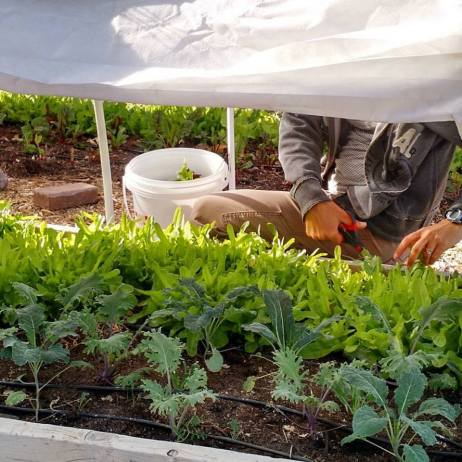
The next topic is biodiversity. Unfortunately, neither local nor organic agriculture ensures the preservation of biodiversity. However, there are ways to limit future loss: by purchasing from growers who actively cultivate a wide variety of fruits and vegetables in a polycultural manner. The Desert Oasis Teaching Gardens (DOT Gardens) at the Albuquerque Academy, New Mexico, are a prime example of this; the DOT Gardens grow not just varying rows of different crops, but different crops within the rows themselves in order to preserve biodiversity and the health of the soil.

row-cover-harvest

Planting a Spring Garden by the Desert Oasis Teaching Gardens. The wide variety of crops within the rows preserves biodiversity and the health of the soil.

As for food miles, both local and organic production show very little difference in transportation emissions. This is demonstrated by Coley et al. (2008), whose study shows that a mere round-trip drive of 6.7 kilometers (approximately 4.2 miles) to buy organic food produces more carbon emissions than cold-storing, packing, and transporting food to a food hub and to a customer’s home—i.e. the conventional method of produce supply. Weber and Matthews (2008) also emphasize this point, explaining that, because eighty-three percent of emissions are devoted to the production phase of food, simply not eating red meat once per week has a greater GHG footprint reduction than buying entirely local food.

The final factor depends on water quality and quantity. There is no evidence that local or organic food uses less water than their counterpart, but there is evidence that organic farms have less impact on water sources due to a lack of pesticide use. According to a study performed by Bohnet et al. 2018, if all farmers in Australia alone were to transition from conventional to organic farming, then the quality of water would improve by fifty-six percent. Organic farming is a key method for conserving the quality of drinking water.

plate

The Planetary Health Plate by the EAT-Lancet Commission. The above plate is considered both healthy and sustainable. It consists primarily of plant-foods, with small sources of animal products to maintain human health.

With a transition to mostly-plant-based diets, with animal products mainly consisting of chicken, eggs, and dairy, organic agriculture is largely more sustainable than purely local production. However, there is growing corporatism in the organics industry that is leading to “cut corners,” including massive numbers of organic chickens only being allowed small porches for outdoor access, as well as insufficient pasture space for organic dairy cows. Because of this, the best option is to become familiar with growers and their practices, as solely purchasing from farms with an organic label discredits those farmers who do practice organic farming (without cutting corners), but simply cannot afford the USDA Organic seal (which is expensive and difficult to maintain). In this case, it is important to recognize the origins of the food production and to discover inputs used (type of fertilizer, pesticides, et cetera). There is also the fact that buying local food improves the economy of an area, particularly if impoverished, because it allows money to recirculate in the community longer. All-in-all, buying organic food saves the planet, while buying local food saves the farmers. Ergo, buying organic food from local farmers provides the best of both the economical and the environmental worlds.

-Posted by Heather

Posted in Uncategorized | Leave a comment

To Bee Ethical is to Bee Sustainable

Among environmentalists, bee populations are a common concern. With the huge amount that they contribute to pollination of so many of the foods we eat, there is no other animal upon whom we depend more thoroughly, and their rapid decline is a threat not only to human food, but to the ecosystems in these tiny animals’ habitats. One of the oft cited ways to help the bee population is to support bee farming through buying honey, beeswax and bee pollen, or by starting your own hive. But how can we save our little friends if we don’t understand and value them as living beings, and not just “things” that we use? With how much we owe to these beings, it is only fair that we consider their wellbeing, and the wellbeing of their ecosystems, in our efforts to keep them around.

To many people, it may be surprising to learn that honey bees are not native to North America (and, in fact, native North American bees do not produce honey). Honey bees were introduced to this continent by Europeans in the 16th and 17th centuries.

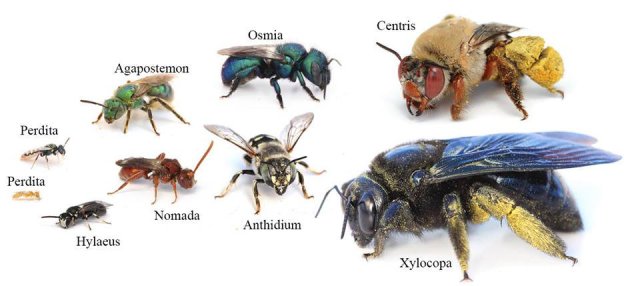
Photo 1 (native bees + honey bee)

Some native North American bees as compared with a honey bee, in the center. https://www.parkrecord.com/entertainment/professor-wants-public-to-bee-informed-about-pollinators/

Photo 2 (scale size of native bees)

Native bees come in a variety of sizes, shapes and colors. https://twitter.com/BeesBackyard/status/1012405066353950720

Like many invasive species, honey bees are often destructive to natural ecosystems rather than beneficial for them. Their presence brings competition to native pollinators, on whom many native plants and ecosystems depend; they are not as effective in pollination as native bees and other native pollinators; and, as a perk, native bees are much less likely to sting people than honey bees. We are left in an ironic predicament in which humans bringing honey bees to North America has significantly damaged populations of native bees, which hurts our ecosystems, yet this lack of native pollinators means that we turn instead to our domesticated honey bees to replace their role in natural ecosystems as well as human food systems.

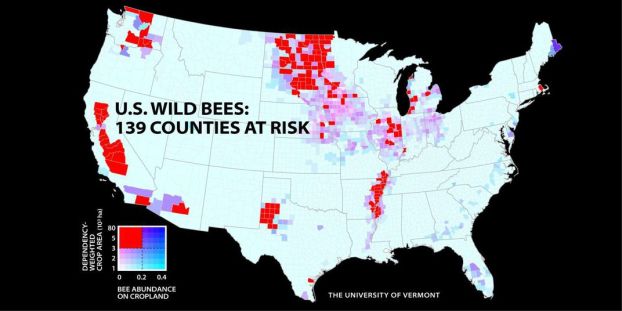
Photo 3 (bee map)

Counties with declining numbers of wild bees, yet rising agricultural pollination demands.  https://www.smithsonianmag.com/smart-news/new-map-highlights-bee-population-declines-across-us-180962268/

However, this doesn’t mean that we should begin domesticating native bees and using them for their labor in place of honey bees. Honey bees are transported around the country to pollinate different crops, which is how many food crops – such as coffee and many different fruits – are able to produce the yields that U.S. consumers demand. This transportation is highly stressful on the bees and can make them more vulnerable to disease, which is a major reason for the explosion of colony collapse disorder (CCD), the name for the sudden disappearance of worker bees in a colony. Beekeeping inherently involves hurting and killing some of the bees, and usually involves practices like killing the queen prematurely because of a reduction in her productivity, stimulating her to lay more eggs than is natural or healthy for her, and preventing the bees from creating new hives because it slows honey production. It may seem that these practices aren’t particularly cruel when done to insects, but there is considerable evidence that bees are complex thinkers and communicators, and experience emotions like any other animal. As in so many things, honey bee farming is both less ethical and arguably less  sustainable than supporting wild, native bees.

It is hard to say whether we can continue producing enough food and phase out honey bee farming. But it would be in our best interest to do so, because we know that native bees are better pollinators than honey bees and better for our environment. Their numbers are suffering as much as those of honey bees, but due to pesticides and habitat loss rather than being farmed. It may take some reworking of our food systems, but it is possible that wild, native pollinators can provide us with all the pollination we need. In fact, they already pollinate a significant portion of our food crops.

So how do we help our native bee friends? There are several actions you can take that will help make real change for the better for our native bees, food systems and ecosystems:

Photo 4 (bee hotel)

A habitat for mason bees at the Rio Grande Nature Center. Photo credit to author.

-Posted by Sarah

Posted in Uncategorized | 3 Comments

A Sustainable Diet Must Consider Physical and Ecological Health

In a culture that is increasingly saturated with vegan “life-style influencers,” it is hard to ignore the assumption that a sustainable diet is one that is plant-based, and one whose products use as few natural resources as possible in order to lessen the global impact of climate change. However, a sustainable diet in such strict terms ignores a more comprehensive consideration of human physical health. An answer for what such a diet looks like might be better understood in relation to a continuum with the following extremes: a fully plant-based diet compared to a diet rich in animal products.

The American Journal of Clinical Nutrition defines sustainable diets as “those diets with low environmental impacts which contribute to food and nutrition security and to healthy life for present and future generations. Sustainable diets are … nutritionally adequate, safe and healthy; while optimizing natural and human resources.” It is important to note that some diets are more sustainable than others, but one’s diet must include deliberate considerations of both physical and ecological health to sustain both human life and the earth simultaneously.

The EAT–Lancet Commission expresses in their extensive report on healthy diets within sustainable food systems that “plant-based foods cause fewer adverse environmental effects per unit weight, per serving, per unit of energy, or per protein weight than does animal source foods across various environmental indicators,” while also cautioning that studies have shown that a total vegan diet – that is to say, one that is completely without consumption of any food or product containing animal products – has links to higher risks of type 2 diabetes and coronary heart disease, specifically plant-based diets that include less healthy plant food such as “refined grains and sugar-sweetened beverages.” With this information, it then becomes important to delve deeper into the carbon and water footprints for various foods  – with special attention to meat products in comparison to plant food – to more appropriately determine a diet that is effective in terms of health for both humans and the earth.

Considering the aforementioned definition of a sustainable diet from The American Journal of Clinical Nutrition, which indicates “low environmental impacts”, one must look at what natural resources are used (and/or wasted) in plant-based agriculture versus animal agriculture to understand why moving away from meat and animal products is important. This becomes more obvious when comparing specific effects from carbon dioxide, and overall greenhouse gas emissions.

The Meat Eater’s Guide to Climate Change directly compares the carbon footprint – which includes both production emissions as well as post-production emissions such as transportation – of meat and animal products, with various plant-based foods. According to their findings, it is clear that overall production of emissions from meat and associated animal products far outweigh those of plant-based foods. The values range anywhere from 3-35 kg of CO2 emitted – depending on the meat or animal product compared to the various plant foods researched, shown in the following chart. The meat and other animal products mentioned here are those that would otherwise replace the necessary nutrients for a physically healthy diet. It is also important to look at the water footprint of many of the same animal and plant foods to determine an effective sustainable diet that considers humans and the earth.

For added clarity, according to the U.S EPA Annual Inventory of U.S. Greenhouse Gas Emissions and Sinks, the United States’ agriculture practices make up for 9.5% of total greenhouse gas emission, of which raising livestock accounts for 41%.


While the data show that crop cultivation makes up half of the CO2 emissions – 10 percent more than livestock – up to 70 percent of all grain produced is fed to the livestock raised in the United States. Producing a kilogram of beef emits 26 kilograms of carbon dioxide, and the average person ate 98 kg of red meat and poultry in 2017. So, if Americans decrease their consumption of such foods, it would decrease overall greenhouse emissions.

The Natural Resources Defense Council has found that beef is about “34 times more climate pollution-intensive as beans and lentils, pound for pound”; if beef were entirely cut out of the American diet, it would reduce greenhouse gas emissions between 46 and 74 percent of the reductions needed to reach the goal made in 2009 at the Copenhagen Summit by former President Barack Obama of 17 percent reductions by 2020. This would still be the case, even if other animal products were kept in diets such as chicken, pork, eggs, and cheese.

A healthy diet that is mindful of physical and ecological health instead is one that focuses on whole grains, fruits, vegetables, nuts, and legumes, with minimal amounts of animal products to add much-needed nutrients and proteins. The EAT–Lancet Commission offers what that diet might look like on a daily basis. They define such a diet as consisting of: Nuts: 50 g (1 -3/4 ounces) per day; legumes (pulses, lentils, beans): 75 g (2-1/2 oz) per day; fish: 28 g (less than an ounce) per day; eggs: about 1 egg per week; meat: 14 g (1/2 an ounce per day; chicken: 29 g (1 ounce) per day; carbohydrate: whole grain bread and rice, 232 g carbohydrate per day and 50 g / day of starchy vegetables like potatoes and yam; dairy: 250 g (8 oz. glass of milk), vegetables: 300 g (10.5 ounces) of non-starchy vegetables and 200 g (almost 1/2 a pound) of fruit per day.

While plant foods have less greenhouse gas emissions, and overall need less water to produce than animal meat and products, one does not need to completely eliminate animal products from one’s diet.

-Posted by Brooke

Posted in Uncategorized | Leave a comment

Composting Dairy Manure with Vermicomposting

Vermicomposting is the process of using worms to compost organic materials such as vegetation, cardboard, and kitchen scraps into vermicast fertilizer. The worms consume this material and then excrete that material into worm castings, which is a phenomenal organic fertilizer for all plants. A vermicomposting company, Worm Power, decided to take on a major problem as the result of animal production: dairy manure. When the company was deciding where to locate in the eastern US, they chose Avon, NY for a few reasons. It is a major agriculture area, focusing on grape and apple production, and dairy cattle. 675,000 cows are currently in production, making this the 3rd largest dairy producer in the nation. These cows are producing an excess of around 16 billion lbs of manure a year! Not only was there an excess of manure, but dairies are also located 5 miles away from two major shipping facilities to ship the finished compost product.

Dairy manure is a major issue that America is struggling to dispose of properly.  One cow can produce 82 pounds of manure per day per 1000 pounds live weight. The average Holstein dairy cow weighs 1300-1400 lbs and could potentially produce around 115 lbs of manure A DAY.

Manure lagoons

Manure lagoon where liquid manure is spread

Farmers typically use the traditional method of spreading manure on fields that need fertilizer (any production field). The problem is, cow manure is HOT from all the nitrogen which will burn the plants if too much is mixed in. A cow produces manure with approximately 210lbs of total nitrogen, 84lbs of phosphorous and 166lbs of potassium every year. Therefore, the manure must be distributed properly or it will have negative impacts on the plants. The liquid manure is separately distributed into dedicated “lagoons” to soak back into the ground.

Production process

Entire process showing how Worm Power converts manure to compost

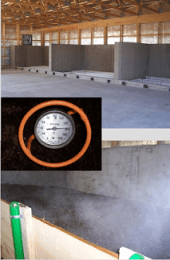
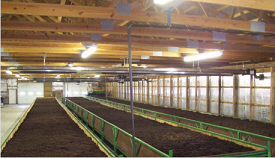
logoWorm Power created a process to turn composted dairy manure first into worm food and then into a profitable fertilizer product. Typically, raw manure would not be fed to worms, but when it is composted and mixed with other materials it provides a good diet for worms. The building where the worms are housed is equipped with automatic ventilation, water, heated/insulated, and a direct lighting system to discourage the worms from crawling out.
aeration bays

The process begins in a covered facility where the raw manure is stored and then mixed with other materials in specific ratios using tractors. The manure mix is housed in aeration bays where the thermophilic composting phase begins. Thermophilic composting is the process of breaking down waste (grass clippings, wood chips, or sawdust) in a large pile using thermophilic bacteria. The material sits here for 14 days, being turned with machinery once. This ensures a few things: weed seed reduction, pathogen reduction, and stabilization of materials. During this process, oxygen and temperature are measure while continuously checking air flow-rate and volume controls to ensure the thermophilic process is working properly.

feeding

Diagram of how the worms are strategically fed

flow through system

Where the worms live in a flow through system

The red wiggler worms are housed in a flow through system as pictured above. They are strategically fed to ensure all the material is composted and harvested properly. If the worms are not happy and not in the correct habitat, they will not feed off the material or breed. Without these two actions, the material will never compost. Therefore, it is important to maintain the correct conditions for bedding, moisture, amount of food, etc.  The farmers taking care of these worms keep a log book with all necessary information and recommend using your nose to investigate, as the compost should not smell.

harvest

Diagram showing how the vermicompost is harvested

After six weeks it’s time to harvest the worm castings. The castings are carefully strained from the bottom layer using a hydraulic machine. These castings will be delivered through three product lines and packaged in bulk or for retail sales. The market focus is on a local and nationwide scale. Residential consumers (gardening/home use) and commercial farmers alike purchase these products with good success.

Worm Power has been awarded nine research grants from Federal and State agricultural agencies to continue developing vermicomposting techniques for large scale environmental challenges such as manure.  They partnered with multiple departments at Cornell University for a long-term project that researched the many ways vermicomposting can consume portions of the extensive amounts of waste generated in the US.

-Posted by Kelli

*All images are from Principles and Practices of Commercial Scale Vermicomposting and Earthworm Husbandry

Posted in Uncategorized | Leave a comment