
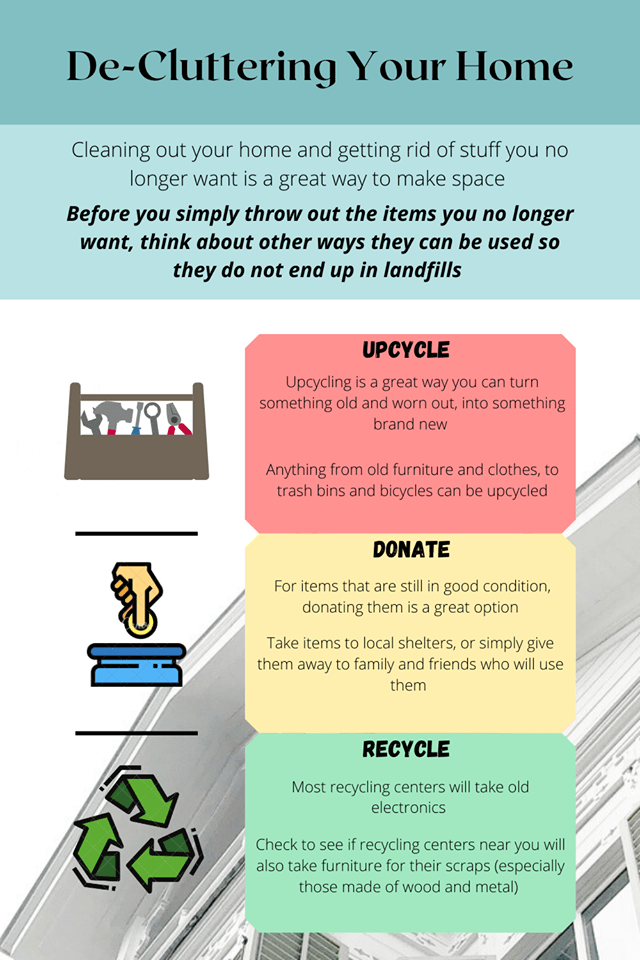
Bored during quarantine? Try de-cluttering your home (while doing your part to reduce waste sent to the landfill).
-Posted by Hannah
Bored during quarantine? Try de-cluttering your home (while doing your part to reduce waste sent to the landfill).
-Posted by Hannah
Supermarkets in the United States are a sight to behold, and a cultural experience that is hard to separate from the American identity. After all, a popular patriot’s tale tells of former Soviet president Boris Yeltsin’s visit to a Texas grocery store in 1989, and his subsequent reformation of the U.S.S.R after his dizzying encounter with the cornucopia of options on the shelves. One need only peruse the candy aisle of the nearest Smith’s to realize that we are truly spoiled for choice.
This level of abundance, however, comes with a caveat that many shoppers are unaware of. A large majority of the brands and packages lining grocery store shelves are owned by the following ten companies:

Image Credit: Oxfam International
Many of these companies even own subsidiaries that appear to be in competition with each other. Cascadian Farms and Annie’s Homegrown are both brands marketed as small-scale, organic, wholesome alternatives to the typical cereal selections found in stores; yet they are both owned by General Mills, the company that supplies over 27 percent of the other cereal brands in the aisle.
In the vast world of multinational food distribution, every dollar is a vote. Customers can choose to support companies and practices that align with their beliefs and distance themselves from those with controversial track records. Ranging from palm oil deforestation, drying up local watersheds, and even the presence of glyphosate in breakfast cereals, all ten of the above companies have been embroiled in their fair share of scandals; not to mention their significant contribution to the industrial agriculture system, which contributes its own host of problems. With the success of services like Buycott and Ethical Consumer magazine, it is clear that interest in socially responsible shopping is on an upward trend. According to a survey by labor market research platform Clutch, “more than half of people (59%) are likely to stop shopping at a company that supports an issue they disagree with”, while “three-fourths of people (75%) are likely to start shopping at a company that supports an issue they agree with.”
For example, many customers choose to boycott Nestle due to the company’s history of controversial business practices, including the restriction of water rights in developing countries. This buying habit is much easier said than done. While some of the brands in the graphic below clearly display the company’s name, there are countless others that an unaware shopper might easily miss, especially since they are marketed to such broad and diverse segments of the population.

Some of Nestle’s holdings, including those not relegated to the food industry. Image credit: ZME Science 2020
It is important to be an informed shopper, especially in the obfuscated world of modern food production. As the list of subsidiaries of a particular corporation starts to gradually reveal itself, it can become harder and harder to shop sustainably. Images of family-owned organic farms found on many health food brand’s packaging might in fact be hiding monoculture farming that damages soil health and local ecosystems. When a shopper chooses an organic option in order to reduce their contribution to pesticide use on farms, they may be supporting an umbrella corporation that employs those same pesticides in all of its other food production operations. While a brand might broadcast its commitment to sustainable resource use, its parent company is more likely to be a major player in the industrial agriculture system, which uses water and topsoil at unsustainable rates.

Another Food and Water Watch table showing the consolidation of the industry.
The disconnect between the average grocery shopper and their food sources is greater now than ever before. Even finding out where your food comes from can be an endeavor, and an extremely important one to undertake at that. It is, after all, the first step to maintaining a sustainable diet.
WHAT CAN YOU DO?
If you find it startling that two corporations can control 61.1 percent of the cracker sales in the U.S., or that it is a Herculean task to find a beverage in the gas station that wasn’t manufactured by Coke, Pepsi, or Dr Pepper Snapple Group (hint: It’s Shasta), then here are some first steps you can take to reconnect with where your food comes from.
The most effective solution would be to simply remove processed foods from your diet. You would not only be cutting ties with the gigantic multinational enterprises that produce these foods, but you would impact long-term environmental health (in a small way) as well as your own continued health and well-being (in a big way). With that said, it is not always feasible to implement such a drastic change (or even desirable – as New Mexicans, I’m sure we all want salty tortilla chips to go with our salsa, but we don’t always have time to make them ourselves). If you are like me and wish to regain control over the foods you buy but don’t have the time or resources to cook 100 percent of your meals from whole foods, consider joining a local grocery co-op. Here you are much more likely to find local, small-scale, organic, and even healthful brands that actually practice what their marketing promotes. Another option is to join a local CSA, or buy produce from farm stands and grower’s markets.
However, if none of these approaches are practical and you wish to continue going to your nearest grocery store (and saving gasoline in the process), don’t fret. As hard as it may be to find, the manufacturer of a product will always be listed somewhere on that product’s packaging, typically on the sides near the bottom. And while there may be a subsidiary or two in the way, barring you from discovering the true producer, Buycott will often do that detective work for you. Even if the particular brand itself is unimportant to you, the app will list campaigns that users can sign up for, oftentimes exposing companies that have been criticized for socially irresponsible business decisions.
While it may be harder than ever to untangle the complex web of American food production, we are fortunate enough to live in the information age; with a little time and effort, you can rediscover where your food really comes from.
-Posted by Ben
Cleaning can be a hassle, especially during our current times, but that doesn’t mean it should be hazardous for your health. This video brings to attention some chemicals in common household items that can be dangerous for both you and the environment. Learn more about the production process, use, and afterlife of certain chemicals, and enjoy a simple DIY cleaning product recipe that helps you save money and resources while staying eco-friendly and healthy.

Check out these resources:
-Posted by Eliana
Outlined here are 9 ways to stay involved – or get involved – in politics during the quarantine for the COVID-19 pandemic. These are all safe to do from the comfort of your home without risking spreading or contracting anything.
STAY SAFE, STAY HOME
Prepare: Just like the world changed after 9/11, the world will likely never return to normal after COVID-19. The pandemic will reshape the world around us, and therefore it is critical to prepare for the changes. This is a video of regular people talking about what they think life will be like. Here is an Australian news story discussing the world after the pandemic ends. Politico interviews 34 experts about the world after this pandemic ends. Here is an analysis of how foreign policy and even politics between states will change after the corona pandemic.
Donate: The first way that you can get involved with politics, both during this 2020 pandemic and always, is to put your money where your mouth is and donate to organizations, causes, or politicians that represent your values.
Volunteering: This does not have to be done in person. A great resource is called volunteer match. This site helps connect people wishing to use their skills to help others during this pandemic, and potentially after, with volunteer opportunities. The opportunities appear to be from home. The city of Albuquerque has a website of opportunities to volunteer on the City’s ABQ volunteers website. There are a variety of local farms that are looking for volunteers. So, if you want to get out of the house, and are able (depending on the restrictions in place at the time), you can always search for local farms looking for volunteers.
Protesting: Although gathering in groups is dangerous during this time of COVID-19, there are still ways to protest. There are calls for a general strike. This is a video about General Strike 2020. Genstrike is a website that details the general strike. =It includes not only striking from work, but also not spending any money on May 1st, or May Day. There are also actions being done by groups like New Mexico Climate Action.
There are many ways to protest on social media. You can spread the word. You can organize, network, plan, and connect because the only successful way to effect change to the system we live in is to stand together. DO NOT STRIKE ALONE!! Mutual aid groups are paramount to a successful strike. You can find or create these on social media.
Write letters to the editor: Though newspapers and magazines are becoming less relevant, they are still important sources of political information for a large segment of the population. This is a video where the viewer is led through the writing of a letter to the editor by a media outreach leader at the Natural Resource Defense Council. This video offers more steps and advice for writing a letter to the editor.
Hold a press conference: Anyone can hold a press conference, although it does help to be a specialist in the area that you are discussing. This written link explains how to prepare to hold a press conference. This is yet another great tool for educating yourself on planning and holding a press conference. This video provides strategies for planning a press conference, and this one shares numerous dos and don’ts of holding a press conference. Anyone can reserve a room at their local political office, then send a press release, like this one with focus on business press releases, or this one, which focuses on a general information about a press release. Here are some final tips for holding a great press conference.
Sign a petition: There are a vast number of petitions that you can sign from the comfort of your own home during this pandemic, and after. There are social justice petitions, environmental issue petitions, and many individual petitions for a sustainable economy.
Run for office: This video explains how and why normal people should run for political office. This is a step by step, how-to boot camp on running for political office.
Attend a public meeting: There are a variety of public meetings that people can attend virtually while in isolation. There are progressive organizations like indivisible Nob Hill and Climate Action New Mexico. There are also political advisory groups operating in Albuquerque, Bernalillo County, New Mexico and the Federal government. There is also a zoom on the topic of the pandemic on the oil and gas industries of New Mexico.
-Posted by Dani
I trudged up a hill that overlooked a small Afghani village. Burdened by a heavy backpack that held a frequency jammer, I also carried a ballistic plate carrier holding 4 plates, camelback: full of water, a chest-full of loaded magazines, first-aid kit, night-vision goggles, a belt around my waist full of 40mm grenades, a helmet on my head, and my rifle equipped with a grenade launcher. I was second-to-last in the formation, and the guy behind me was carrying even more than me, being a machine-gunner who held his own weight in ammo. A compound wall on our left came to a corner at the top of the hill, and as I approached it, I stopped to help him up the rest of the way. My lungs burned, struggling to get enough oxygen. Our platoon had made the left turn onto a walking path that followed the wall along the border of the town, and as we began to do the same, we could see down on the whole village, and our target building on the far end. While we took in the view and began to make our way along the same path, a machine-gun opened up on our position. Bullets cracked overhead and all around us, hitting the wall to our left as we mustered strength we didn’t know we had to sprint down the wall. Puffs of dirt went flying, making it seem like the longest 40 yard dash in the world, weighted down by about 50 lbs of gear at about 13,000 ft. of altitude. Finally, we were able to make it to an opening in the wall, a gate to the compound, and take cover. Right when we made it through, I dropped the cumbersome bag and took up a position behind the wall, laying down in the prone, and returning fire. Then, our own machine guns started, and soon we had A-10 aircraft doing strafing runs, unleashing what seemed like the wrath of God from their spinning cannons while we all cheered.
This small memoir illustrates the adrenaline our soldiers feel while at war. But what’s more than the adrenaline rush, which Sebastian Junger (Author of Tribe: On Homecoming and Belonging) says is “wired into us” and “hormonally supported,” is the brotherhood that warriors feel towards each other. He explains this as “a mutual agreement within a group, that you will put the welfare of the group – the safety of everyone in the group above your own.” It’s the feeling of being a part of something larger than one’s self, and is an integral to the human experience.

When someone has that magnitude of a selfless connection with their fellow humans, and then are thrust back into the “real-world”, away from all the danger, simplicity, and lack of comforts, they naturally yearn to return to war. Often times, this feeling of detachment coupled with the trauma you’ve faced (witnessing gruesome death/dismemberment and wondering “why not me?”) can lead to a host of mental-health issues unfortunately ending in suicide. When someone loses their purpose, direction, and motivation, everything around them can crumble.
When Victor Versace, the founder of Desert Forge Foundation returned from his second combat deployment with the Army, he had multiple friends commit suicide and a few others drink themselves to death. He decided to try to do something about it, and drew parallels between military service and agriculture. It turns out, being a warrior in the garden can be extremely therapeutic, and helps people feel more connected and present (something the people with post traumatic stress often struggle with). So he set out to inspire the people he served with to join him in the South Valley to grow chile. They operated for a few years on various farms, often drawing crowds of volunteers who wanted to be a part of the Desert Forge story.
I came into the story when I met Vic at Smith’s one day while I was working a job I hated: armed security at a grocery store. We struck up a conversation about the units we served in, talked about his organization, and exchanged numbers. Now I work as the Program Coordinator, and my job consists of working with trainees, volunteers, and other members of the organization on the Rio Grande Community Farm. Lately, since all gatherings have been deemed unsafe, the majority of what I do is plant seed, water them, re-pot transplants, and work in the field. From my perspective as a “combat veteran,” I can say that there is no better therapy than doing manual labor, working towards a goal with other people who have had similar experiences.
The Warrior Farmer Project is a section of Desert Forge Foundation, and its goal is to become a national training program for veterans looking for careers in agriculture. Most recently, the program has provided employment to two veterans over the winter at the Rio Grande Community Farm. In years prior, Desert Forge operated on “partner farms” where volunteers and trainees would work the land. These farms vary from orchards to hops and chile fields. The program is currently undergoing structural changes that will make it more formal. This will include an application process, a standard curriculum and schedule, as well as a uniform. For more information about the organization, please visit our website.
As times change, we (the farming community) are forced to come up with new solutions to new problems. There are new developments every day, and every day our food systems become more and more stressed, and soon, we worry that imported food will become less and less viable to feed the masses. This is placing increasing importance on teaching more people how to grow their own vegetables, and we believe that a resurgence of the Victory Gardens of WW2 will be an important part of bolstering our food security. In their glory days during the second world war, “the US Department of Agriculture estimates that more than 20 million victory gardens were planted. Fruit and vegetables harvested in these home and community plots was estimated to be 9-10 million tons, an amount equal to all commercial production of fresh vegetables, allowing the farmers to supply troops overseas with food while the people back home supplemented their diets with the food they grew themselves.” The more people we can get involved in supplying themselves with vegetables, the better, as we are already seeing major changes in the current system as it struggles to adjust to the changing landscape.
-Posted by Tyler

Explore more strategies for recycling at home and grow your understanding of recycling and waste management on the national scale.
-Posted by Hannah
As the effects of humans and our systems become more apparent on their impact of the environments around us (climate change, pollution, extinction, etc.), individuals have taken the initiative to hold themselves accountable and live more sustainable lives. The UCLA Sustainability Committee includes in their definition of sustainability “Sustainable practices support ecological, human, and economic health and vitality”. Whether a person tries to live sustainably by reducing their carbon emissions, living waste free, or shopping organically, there is one factor that impacts our environment greatly that is often overlooked: The environmental impact of our beloved cats and dogs.
Cat’s and Dog’s “Paw-Print”
The United States is the leading country of pet ownership, and according to Gregory S. Okin’s study on cat and dog food consumption Dog and cat animal product consumption is responsible for release of up to 64 ± 16 million tons CO2-equivalent methane and nitrous oxide, two powerful greenhouse gasses (GHGs). This large impact is mostly due to the high meat consumption in cats and dogs. A great way to try and reduce our animal’s impact is to look at their diet and source sustainable pet foods that strive for environmental, social and economic health.
What is the Solution?
There are many diets that owners may choose to feed their pets. On one side of the spectrum you can choose a raw food diet, and on the other end you can choose a vegetarian. There are dry foods, wet foods, and combinations of both. Make sure you always consult with your veterinarian to make sure your pet is healthy. Whatever diet you choose to feed your pet, there are steps everyone can take to reduce the environmental impact of their pet food.
Amount of Pet Food
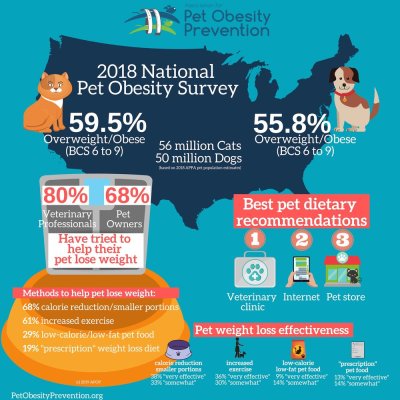
According to Kelly S. Swanson in her article Nutritional Sustainability of Pet Foods, as of 2013, an estimated of 34% of dogs and 35% of cats in the United States were labeled as overweight or obese. Not only does an animal being overweight and overfed lead to serious health problems, but it also impacts the environment. Maintaining your pet’s weight and feeding them the proper amount for their size cuts back on food waste and reduces your pet’s negative impact. Swanson says that if the percentage of cats/dogs that are overweight/obese were fed the proper amount, it would have a significant impact of the footprint animals contribute to our food systems.
The data at the Association of Pet Obesity and Prevention (APOP) shows that as of 2018, an estimated of 59.5% of cats are overweight/obese and 55.8% of dogs are overweight/obese, showing levels have increased drastically. Reducing these numbers may also reduce their environmental impact. The website also offers guides and calculators to help pet owners determine what is the proper amount to feed their pet.
Where you source pet food
Debbie Phillips-Donaldson in her article on petfoodindustry.com says “According to documented reports received by USDA, more than 57 common pet food ingredients are sourced from supply chains using child labor, while more than 16 have sources using modern forms of slavery.” Paying attention to not only the environmental impacts of pet food but the social impacts as well is just as important in buying sustainable pet food.
Fortunately, there are certifications and labels you can look out for on your pet food that show the consumer the product is not only reducing its impact on the environment but is also sourcing their ingredients ethically.
The USDA offers an organic certification. This certification allows consumers to know mostly about the farming practices that were used when producing ingredients. It focuses on soil health, crops, pest management and even animal and human welfare. The Marine Stewardship Council (MSC) is a certification based upon three aspects: Sustainable fish stocks; minimizing environmental impact; and effective management. You can read in more detail about each certification here.


Another great certification to look out for are companies labeled B corporations. B Corporations are “business that meet the highest standards of verified social and environmental performance, public transparency, and legal accountability…”. The first pet food brand to be B Corp certified is Only Natural Pet located in Boulder, Colorado.
Paying attention to labels and other certifications on the packaging on pet food brands can give you insight to their practices and whether the pet food is sustainable or not. Certifications let the consumer know that there are requirements being met by the brands towards sustainability.
In Summary
Pet food is a large contributor in our food systems and to the impact our food systems have on the environment. It is important we bring awareness to this issue to allow us to be aware of our choices and their impact. Not only should individual pet owners strive towards making sure they are purchasing sustainable pet foods, but the pet food industry as a whole should be striving towards the goal of environmental, social and economic health, as they play a huge role in our food systems. Always staying informed and making smart choices as consumers can be first steps to having sustainable systems.
-Posted by Hannah
There are many ways in which you can make shopping and cooking more sustainable and Earth friendly. These videos include tips for shopping, what to buy, and a recipe too. Enjoy!
You can still support your local growers and producers during the pandemic! Explore Edible New Mexico’s Local Provisions Guide to find out about farms, restaurants, and other food businesses that are open. Many now have curb-side pickup, delivery, and online ordering options.
Although the Albuquerque Downtown Growers’ Market is not happening in Robinson Park this spring, you can participate in their weekly “Farm to Car” program! Pre-order online from local producers, and then pick up your produce and other goodies downtown on Saturday mornings.

March 9th 2020 Marked the kick-off for the 4th World Conference on Women and the 64th Commission on the Status of Women, to take place at the United Nations Campus in Manhattan, New York. This was also a time for dozens of other parallel gatherings and community building opportunities organized by grassroots and NGO groups from around the world. By historic circumstances, this event I was to participate in, was one of the first of many events to get cancelled in the weeks to come in anticipation of the spread of the COVID-19 virus. This gathering was also historic in my own life. It would have been my first time to the Big Apple, and more importantly- I was to appear on the Panel, “Sisters, Seeds and Soil: Bold Voices and Choices for Ecofeminism,” and attend a week-long advocacy practicum organized by the Women’s International League for Peace and Freedom (WILPF). I was to appear on this panel with a few other people representing their work and organizations like organizers with Seeding Sovereignty, and Indigenous Iowa, Farm School NYC and the Black Farmer Fund, and more.

Statewide Next Gen Farmers group meeting in Northern New Mexico. Photo courtesy of Next Generation Farmers & Seed Savers
Additionally, some of the main goals of the UN gathering this year were to review theprogress and identify of gaps and challenges to fulfilling the 1995 Beijing Declaration (en español) on women’s rights, and the 2030 Sustainable Development Goals (SDGs). Since my invitation to participate in all of this, my neurons have been firing with excitement thinking about the ways the projects throughout my state are working to empower women and fighting for a sustainable future. Writing about the bold voices and choices of womxn, LGBTQ and indigenous people in my community is a topic I am still very excited to expose on the international stage. There is an amazing scope of work occurring in New Mexico working to cultivate knowledge, build community, seeds, soil, and sustainable farming. There has always been a sense of urgency to preserve and contribute to these projects, but in light of the pandemic- this urgency is more apparent than ever to all of our communities.

Youth organizing seed packets for the opening of the Espanola Healing Foods Oasis seed library. Photo credit: Emilt Arasim
If you have not heard or seen it yet, New Mexico has a vibrant and thriving local food movement. Literally on every level- from preserving the native seeds or foods, regenerating soil, building sustainable farms and urban agriculture corridors, to fighting for food, land and water sovereignty and social justice. All these efforts are not new to our communities, and wisdoms from the past still inform the work of today. Combined with our use of acequias, a centuries-old communal watering system, some could say our state fosters a strong foundation for an agroecological movement. New Mexico and the surrounding regions entail diverse cultures, living within equally diverse landscapes, and carrying a very complex history of colonialism that still impacts communities today. There are many ways that communities are harnessing traditional knowledge and practices that sustain our communities, rebuild our natural environments and work towards social justice. Even in the time of a global pandemic, we are exercising our resilient local food system, and grow food that is accessible and nutritious.

Soil comparison at the first soil health crash course at the developing community farm and agroecology center sponsored by Project Feed the Hood. Photo Credit: Stefany Olivas
The opportunity to participate in the UN events arose through my involvement as an undergraduate student in Biology and University of New Mexico but was a perfect fit because of my evolving community activism over the past 7 years. In particular I have been “in training” with organizations like the Center for Social Sustainable Systems (CESOSS), and Project Feed the Hood, a food justice campaign of the 40-year-old organization, SouthWest Organizing Project (SWOP). My hope and excitement for the social justice work in New Mexico has been growing exponentially since my learning has been enriched by the Chicana/o Studies and taking classes with the Sustainability Studiesprogram at UNM. I have had the amazing privilege of linking my passion for cultivating food and community with a critical analysis on the agrarian heritage, resilience and radicalism of our communities throughout the state. This foundation makes it easy to image why I think we have a lot to offer when it comes to international discussion of seeds, soil, sustainability and climate action.
Equally important is the need to de-romanticize this perspective of our “Land of Enchantment.” Despite great efforts and potential of our local food system, governments continue to allow and subsidize Fracking in Northern New Mexico, or the military-industrial complex in Albuquerque. These are some of the same leaders that leveraged our local farm movement throughout their political careers. Our small farmers still do not make a living wage, and they still cannot afford to purchase the organic food they cultivate. Despite the many barriers and challenges to bolster our resources to full-blown local food movement- farmers are still growing and finding ways to distribute their fresh, nutrient rich produce in the time of this pandemic.


Agroecology also holds an international stage at the United Nations, as one of the many promising platforms to mitigate climate change and bring about social reform. This practice and praxis could also help us achieve milestones of the 2030 SDGs. To the local agroecologist, growing food in harmony with the environment doesn’t just restore biodiversity, and nutritional foods. It also means actively confronting industrial agriculture and extractive industries that destroy the land, its ecosystems, and the communities that live there. We may not call it agroecology yet, but New Mexicans are working diligently to grow, process and consume food communally, sustainably, using traditional (and contemporary) methods, while also working to achieve sovereignty, realize food justice, and ultimately use local food as a tool to organize for all types of social justice.
| My top fan-girl interests in general: | Rapid-response initiatives providing basic needs and cultivating knowledge: |
-Posted by Stefany
Roxanne Swentzell is an artist, seed-saver, and a founder of the Flowering Tree Permaculture Institute. In 2013, she and her son, historian Porter Swentzell, along with 14 volunteers from the Santa Clara Pueblo, committed to an experiment: to eat only the foods of their ancestors for three months, which they dubbed the Pueblo Food Experience (PFE). In that time, they experienced remarkable changes to their health individually, and a greater connection to their collective roots. Since then, Roxanne has been working to spread the word and rekindle the viability of heritage foods in her community.
The following interview has been edited for clarity and brevity.
Jade: In doing your research for the PFE, did you discover a food you’d never had before?
Roxanne: There’s things like amaranth I’ve been growing for 30 years—I knew you could eat the young leaves, but I never learned how to process the seed. It was one of our staple foods, but was totally lost; now in the communities if you say “amaranth,” they go, “What’s that?” Also, things like wild spinaches, cat tails, wild things you can get out in the fields, those are things that I may have known about but I never tried before {laughs}.
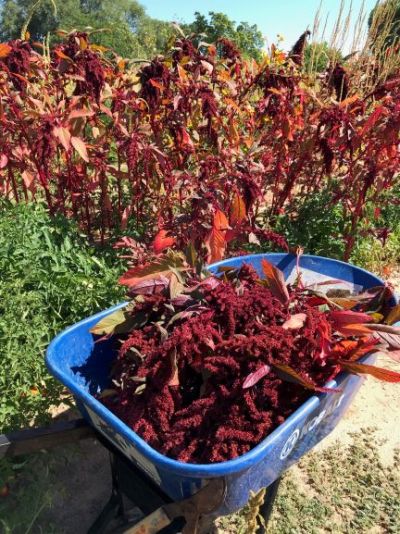
Harvesting amaranth at Roxanne’s garden. Image courtesy of Roxanne Swentzell
You offer classes to your community through your Flowering Tree Permaculture Institute—can you tell me more about that?
We teach certain things, like how to make tamales or process corn, and it changes based on what the needs are at the time. That’s why we put together the cookbook [The Pueblo Food Experience Cookbook]. A lot of times people don’t know where to start, and the cookbook seemed like a good way to help them start the conversation. Even though we’re a much more intact tribe than most in the US, many Pueblo people don’t know about these foods anymore. For me, that’s really scary, because if we lose these foods, we lose a lot. That’s the same for every culture—the diversity is very important. The connections are very important.
What needs or opportunities do you see right now?
For years now we’ve been getting enough seed to grow out enough food to get to more people. Now we’re slowly putting together a little processing facility so that a group of us gets together and processes some of this corn. And that’s just one product, so it’s a big project {laughs}. We’re working on one strand of this basket, and it’s going to take all our lives to put the basket back together. And that’s just one community—I’m desperate for the whole world to start doing this.


Have any other groups reached out to you about their experiences doing similar work?
Many of the tribes around the US are trying to find and nurture back their original diets, which is exciting because we’re all rediscovering and holding onto ourselves in this way again. The scary part of it is that as soon as it becomes a fad then people want to jump in on it. It’s fun to try other people’s food, but don’t take it—that’s a colonizing mentality. Just like the seeds I’ve been saving all these years, we are very adapted to very specific conditions. If you’re interested in going about finding health this manner, it’s a really fascinating journey—let’s find out what fits us, individually, the best. All your answers are in you.
Are there any community organizations you’ve been able to partner with?
I partner with the Traditional Native Farmer’s Association; I’ve been working with them for about 20 years, we’re very much on the same path. There’s also a group out of Tewa Women United called the Oasis of Espanola, and they’ve been working on putting together a food forest in Espanola. I also work with a little organization here in the pueblo called HOPE, Honoring Our Pueblo Existence; we do a lot of work together, but it’s very localized within the women’s society doing specific cultural stuff for the pueblo.
What crops are you focusing on this year?
I probably have over 35 varieties of corn from our area, and that means about 30 years to grow each one of them out. We have to pick and choose carefully or try desperately to get more people to grow them. Right now we’re focusing on our main corn, blue, white, red, and some of the sweet corns. The more unique varieties I’ve put in smaller fields just to keep the seed alive—I’m hoping that somebody will fall in love with them and maybe grow a whole field and keep them alive. But it’s a big job.


Do you have any other projects for the near future?
This year we’re building a greenhouse that’s combined with a turkey pen, because turkeys are a very important bird to us. It’s really good pest control; if you just walk turkeys through your field every morning, they take care of all the bugs and fertilize everything, and in the end you get turkey meat and feathers. I’m into putting things together like that. I’m also continuing to teach a few classes—I teach in the summer a design permaculture course that focuses on Native sustainability. I’m also wanting to focus on growing out more of the traditional medicine plants. So, all of that and more {laughs}.
Is there a particular recipe you enjoy teaching people who are interested in trying an ancestral way of eating?
The thing is, it’s not a specific food, it’s how you interact with it. The more connected you are to the process, the richer it is. You go out there and put that tomato seed in the ground and water it, see that first flower come out, watch that fruit grow {laughs} and you get all excited ‘cause it starts to turn red. All those moments you interacted with that plant, it’s almost like a spiritual experience, because, “Oh my god, that’s the tomato I grew.” This is when they talk about food as medicine—it becomes something much, much bigger. When we put that back in our food, we hold it so dear because we saw what it took. Reconnect to your food, step by step, put the basket back together. Instead of buying everything, try growing one of the things you eat often, and then if you can do that, grow another one. And then if you can do that, just keep going. Reconnect. Reconnect.
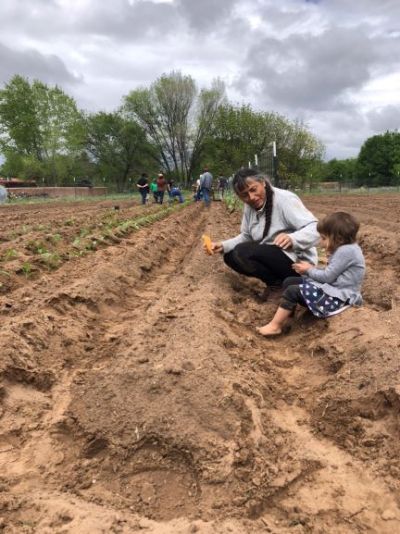
Planting day at Flowering Tree Permaculture Institute. Image courtesy of Roxanne Swentzell
Easy Crops to Grow in Pots or Indoors:
Bell Peppers ~ Mint ~ Kale ~ Strawberries ~ Tomatoes
-Posted by Jade

 ABQ Stew