Planting Seeds for Community Needs: Project Feed The Hood

The ultimate goal of farming is not the growing of crops, but the cultivation and perfection of human beings.
– Masanobu Fukuoka, the One-Straw Revolution –
Quoted by “Lo,” a Feed the Hood farmer

header

You may have seen Project Feed the Hood (PFTH) at last year’s Lobo Growers’ Market. If so, you – like many others – may have been curious as to what they do. PFTH is one of the great grassroots organizations building community throughout Albuquerque. They have been focusing on food literacy and food justice in the Albuquerque area for four years.

As an initiative of SouthWest Organizing Project (SWOP), Project Feed the Hood developed their organization through a desire to work with diverse cultures and a passionate belief that food markets should be within walking distance to all residents, allowing for equity of access. They believe that automobile ownership should not be a prerequisite to purchasing healthy food. Areas that do not have equitable access to food and are known as food deserts. This means that both adults and children do not have many nutritious options because there is not a supermarket within three miles of where they live. Their only options for food are often just local convenience stores.

These unhealthy options contribute to health issues, such as obesity and diabetes, that plague the population in these areas. Unfortunately, many of these food desert neighborhoods are in lower socio-economic areas with large Hispanic and ethnic populations. These are target populations that often experience food insecurities. PFTH also believes that children should be taught from the beginning about the importance of healthy food in growing up big and strong. Not only that, but they should know how to grow it as well.

Initially, Joaquín Lujan, a community organizer, asked if Travis McKenzie and Rodrigo Rodriguez wanted to assist with a gardening project at a local small church located on the Westside of Albuquerque. This garden was in a food desert area, and led to the development of Project Feed the Hood. The project was the catalyst for their mission with food and social justice para la comunidad (for the community).

This slideshow requires JavaScript.

Project Feed the Hood was formed by four founding volunteers: Rodrigo Rodriguez as the main Garden Coordinator, Joaquín Lujan  and Travis McKenzie as Garden Coordinators, and full time volunteer Casey Coty. Later, their  ranks grew as Loren “Lo” Gomez, Marisol Archuleta, and Casey Holland joined the PFTH crew.

Utilizing SWOP’s connections, PFTH partnered with community members in Albuquerque’s International District and City Council representative, Rey Garduno, to procure the International District Garden off of Gibson, on the corner of Ross and Wellesley. The garden has been a great success! In addition to the community garden, PFTH works with over seven schools around Albuquerque to install gardens and assist with integrating them into school life.

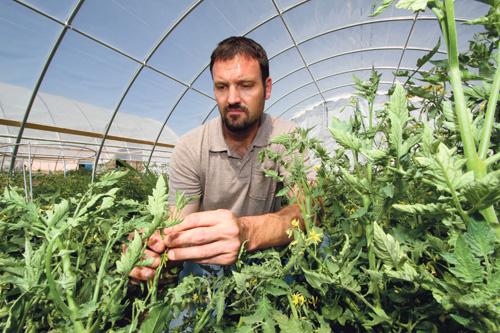
After three years with these initiatives, Project Feed the Hood started a farm in the South Valley, Feed the Hood Farms (FTHF), where they grow a large variety of seasonal vegetables and raise laying hens.  FTHF is working towards making PFTH’s community initiatives economically sustainable through the use of funds earned from produce and egg sales. It is also an opportunity to create sustainable jobs and continue developing the South Valley’s foodshed. FTHF has a farmstand that operates at the SWOP office (downtown, near 10th & Park) through the growing season in addition to engaging the community at the Nob Hill Growers’ Market and the Lobo Growers’ Market. They offer free workshops throughout the year in all topics of gardening, with a focus on teaching others how to grow their own affordable, nutritious food.

Last fall, we gathered with Project Feed the Hood at the International District’s annual community garden “Pumpkin Smashing” event.  All ages participated in pumpkin pie eating contests, pumpkin throwing and the smashing of pumpkins with pitch forks, shovels and sledge hammers. Everyone had a great time. Lo was asked how he feels about the work that they are doing, and he responded that it is very satisfying to see the change that happens within communities when people are working together to grow food.
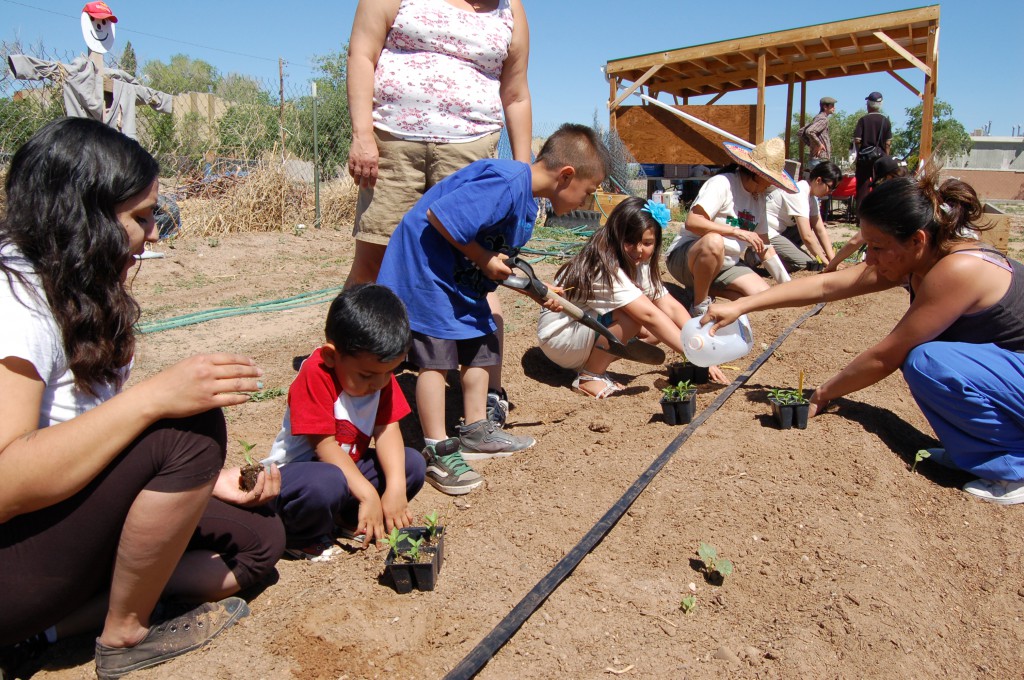
Project Feed the Hood, International District

Project Feed the Hood, International District

Food access and food justice offer individuals a deep sense of cultural pride and community building. Most importantly these tenets teach healthy nutrition and make good nutrition a reality. Feed The Hood continues to meet their mission through hard work and dedication to community members. Their future hopes are to further integrate themselves into local communities and to continue spreading the word about affordable nutritious food.

-Posted by E.J.
Posted in Uncategorized | 1 Comment

Final Film Screening

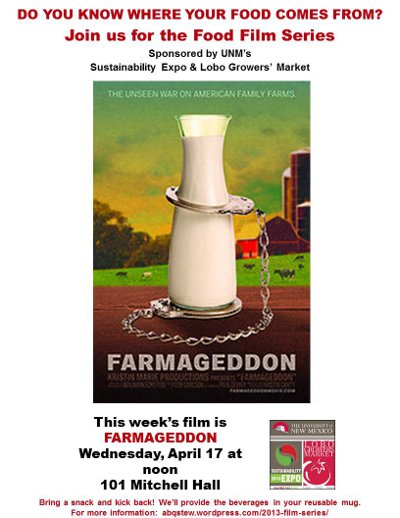
FoodFilmSeriesFlyer-4

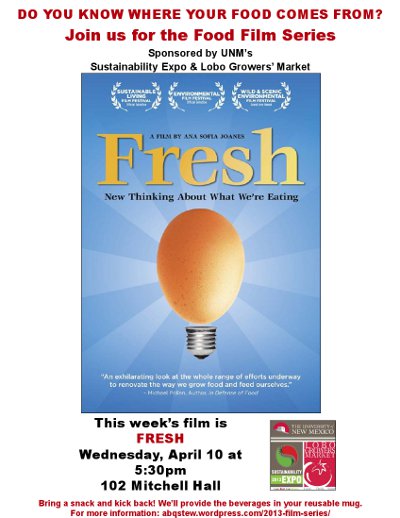
Join us for Farmageddon, the final screening in our spring Food Film Series. The film is free and open to the public. Food and refreshments will be provided, and discussion will follow.

Thank you to all who made the film series a success. And mark your calendars for the 5th Annual Sustainability Expo and Lobo Growers’ Market on April 23. One week to go!

Posted in Uncategorized | Leave a comment

Preventing Youth Hunger in New Mexico

An Interview with New Mexico Appleseed’s Jennifer Ramo

Most of us are aware that New Mexico is a state burdened by poverty. However, we may not be aware just how much poverty affects children and their access to food. Child hunger is an increasing issue all over the nation, but it is especially prevalent in the state of New Mexico. The Children’s Defense Fund states that in 2011 159,009 New Mexican students were in the free and reduced school lunch program and 46,612 participated in the Summer Food Service Program. Our state has a huge need for food support in schools. In fact, New Mexico Food Banks report that in 2010 thirty percent of children were living in poverty in our state. That means that New Mexico had the third highest child poverty rate in the country!

Children who regularly eat breakfast tend to have higher IQ scores, according to a study by the University of Pennsylvania School of Nursing. Image credit: http://nmhealthierweight.com

Children who regularly eat breakfast tend to have higher IQ scores, according to a study by the University of Pennsylvania School of Nursing. Image credit: http://nmhealthierweight.com

While these statistics may sound dire, many organizations and firms have risen to the challenge of combating youth hunger. At the forefront of these organizations is New Mexico Appleseed, a non-profit law firm that fights for food justice in the Albuquerque school system. Appleseed was founded in Albuquerque in 2006 and it is currently one of seventeen centers around the nation. The firm has been successful in creating food programs and implementing policies into New Mexican legislation. In order to get a better understanding of Appleseed’s impact on Albuquerque’s schools, I had an interview with Jennifer Ramo, Appleseed’s executive director.

Caption: Executive director Jennifer Ramo was a graduate from Albuquerque Academy High School. Image credit: http://www.bizjournals.com

Caption: Executive director Jennifer Ramo was a graduate from Albuquerque Academy High School. Image credit: http://www.bizjournals.com

According to Jennifer, Appleseed creates “systemic solutions” to poverty issues in New Mexico. They work with the state, cities, counties, and schools in order to solve hunger issues. “Appleseed is very unique because we collaborate with other groups to talk about the issues and solve problems. We perform economic research and then test it – no one else really does that,” said Jennifer. This unique approach has been very successful in changing policy and because of it great things are starting to happen in New Mexico.

For example, Appleseed’s “Breakfast After the Bell” bill (SB 144) allows children in low income schools around the city (ones with at least 85% of children needing reduced lunch) to be served a nutritious breakfast during the first few minutes of class time. Breakfast is given to every student in the classroom, not just the ones that qualify for food assistance. Jennifer mentioned that serving breakfast during class is much more effective than when it is served before class starts. Statistics have shown that only about 38% of children receive breakfast when it is served before class (due to children being late, not having enough time, etc.) whereas 90-100% will receive breakfast when it is served in class. The Albuquerque Journal recently featured Appleseed in an article stating that the bill is estimated to feed about  55,000 more students a year while maintaining the $2 million allocated already each year for lunch subsidies. According to Jennifer, Appleseed is still finishing up some of the bill’s details but it was signed by Governor Susana Martinez on April 2nd, 2011.

In addition to the breakfast bill, Appleseed has worked to improve school lunch and has created summer food programs to ensure children still have access to quality food when school is not in session. With the help of caring organizations like Appleseed, New Mexico is well on its way to finding food justice and ensuring that its students are happy, healthy, and well-fed.

Image credit: http://blog.psjd.org

Image credit: http://blog.psjd.org

-Posted by Heather

Posted in Uncategorized | 2 Comments

Protecting the Squash Sister

Squash plays a fundamental role in the story of the Americas. Squash historically served as one of three Native American staple crops, along with beans and corn. Together, these three crops are known as the “Three Sisters.”

In addition to its significance to humans, squash plays an important role in North American ecosystems. For example, the North American squash bee exists specifically to pollinate squash crops. Developments in human agriculture are harming native pollinators such as the squash bee, however. In order to control harmful pests commonly called squash bugs, farmers growing squash tend to spray chemical pesticides. Fortunately, alternatives to indiscriminate pesticide use exist for those interested in sustainable squash production.

In order to understand how these alternative pest control options work, it is important to first understand the biology and behavior of the targeted pest. Squash bug eggs take a week to hatch. The first generation is born during late spring through mid-June, and a second generation appears in the late summer and early fall. Before becoming adults, young squash bugs molt several times. They look gray-brown with wings right before reaching the shiny green adult stage, and they often appear in clusters on a plant. Squash bugs feed on the sap of squash plants. They puncture the plant, which causes it to wilt. This feeding behavior is often referred to as “lacerate and flush.” Squash bugs feed on the actual fruit in addition to the plant, which causes rotting and dead spots that reduce fruit quality.

Squash Bug Life Stages. Image Credits: Eva Melady

Squash Bug Life Stages. Image Credits: Eva Melady

The squash bug is the most common pest to affect crops at Skarsgard Farms in Albuquerque, New Mexico, and the farmers combat the problem by “beating them out.” This means the farmers understand the life cycle of the squash bug and plan around it by planting their squash at unusual times. The height of squash bug destruction occurs during the warm days of late spring, for that is when squash bug reproduction takes place (Cranshaw, 2008). The squash bugs target immature squash plants during this time. By the time the squash bugs plan to mate, however, Skarsgard already has mature summer squash plants. These mature squash plants are not ideal mating sites because squash bugs specifically need germinating squash in order to reproduce (Cranshaw, 2008).

Monte Skarsgard. Image Credits: Randy Siner

Monte Skarsgard. Image Credits: Randy Siner

The mature squash plants are also stronger and healthier than they would have been if they were younger during squash bug reproduction. The farmers at Skarsgard note that the healthier a plant is, the more resistant it is to pests. Aside from obvious advantages in terms of pest management, Skarsgard says that having squash available earlier than usual means better prices and a greater diversity of vegetables for their customers. Skarsgard Farms believes in working with nature rather than using pesticides. According to Monte Skarsgard, “Let nature take over, and [the agrarian ecosystem] will reach equilibrium.”

For those not keen on giving up pesticide use completely, a farming technique called perimeter trap-cropping (PTC) significantly reduces the environmental and economic impact of pesticides. This pest control option involves planting a crop that is more attractive to pests in a perimeter around a central crop. Pests will leave the main crop in order to feast on the perimeter crop, and farmers can take advantage of this by exclusively spraying the perimeter crop. Blue Hubbard Squash is an effective perimeter crop that farmers can plant around a main squash crop. Squash bugs generally find it more attractive than other types of squash plant. PTC systems using Blue Hubbard in squash fields can reduce insecticide use by 94%. “Turks’ Turban” squash also works as a perimeter trap crop, but Blue Hubbard works better because it will not die as quickly and it also has better resistance to bacterial infection.

Certain management steps are necessary for PTC.

  • Keep the perimeter crop plant healthy, so don’t neglect it. This will prevent an outbreak of bacterial infection in addition to preventing die-off before the end of the season.
  • Monitor the trap-crop regularly.
  • Spray the trap-crop as soon as the squash bugs start to infest it. This will increase the survival chances of the trap-crop.
  • Do not try PTC if there will be huge gaps in the barrier. Multiple rows of the trap-crop might be necessary.

To learn more about PTC, explore the following articles:

Comparison of Perimeter Trap Crop Varieties: Effects on Herbivory, Pollination, and Yield in Butternut Squash

Demonstrating a Perimeter Trap Crop Approach to Pest Management on Summer Squash in New England

Using Trap Crops for Control of Acalymma vittatum (Coleoptera: Chrysomelidae) Reduces Insecticide Use in Butternut Squash

-Posted by Amy

Posted in Uncategorized | Leave a comment

Growing Food Security

When asked, most people will tell you that they believe there are two weeks of groceries available in their local supermarkets. Because of efficiency planning by the few large food distributors there is now just 3 days of food available in your local stores. If there is a major disruption of the distribution system that’s all you’ve got until FEMA or some other disaster preparedness organization can bring food supplies in to your area.

White out. Photo credit: http://www.flickr.com/

White out. Photo credit: http://www.flickr.com/

All we need to do is look back to the 2006 March snow storm that closed all the routes into Albuquerque for up to a week. V.B. Price reminds us in his new book The Orphaned Land that Albuquerque store shelves were almost empty by the time the highways were again open. Without local food producers, our community is at the mercy of a food system that is rapidly becoming more concentrated into fewer and fewer corporations driven by the bottom line to maximize their profits. We can ensure a more secure food supply and counter the concentrated food distributors by shopping at local farmers markets in our area.

Shopping for local food has a number of benefits for you, the farmers and your community. When you’re buying produce you’re meeting the person that grew those crops. You are able to learn about their growing process and how to cook foods you’re unfamiliar with, as well as taste new foods at many of the markets. The farmer can benefit from learning from you and others about your needs. In this way we build relationships between people. New connections in turn help meet the changing needs of the community. A stronger community can be more responsive to changes, enhancing the overall community health and well being.

Keeping your money in your community has far-reaching benefits. When you shop at a large chain grocer only 38% of each dollar stays in your community. Shop at a farmers market and  58% or more of each dollar you spend stays in your community. Now you’re helping to keep work in your area. You’re investing in your farmers which means they will be able to invest in providing more, better food for you.

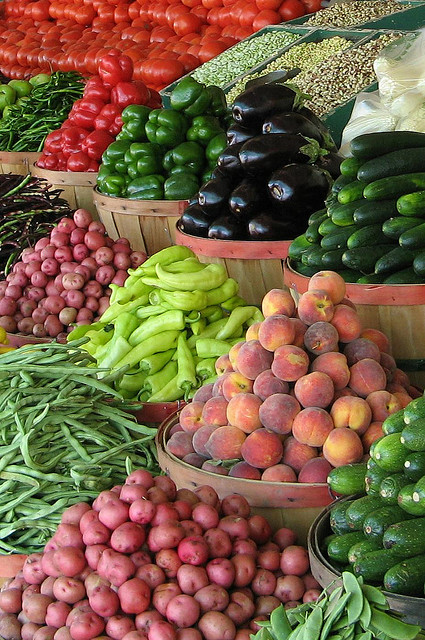
Farmers' Market. Photo credit: http://www.flickr.com/

Farmers’ Market. Photo credit: http://www.flickr.com/

Some local farms such as Skarsgard Farms use greenhouses to extend their growing season. This kind of investment in growing capacity allows farmers to provide fresh local produce year around. Now you can enjoy the freshest local produce all year. These farmers become better off economically by lengthening the growing season and providing more local produce during the off season. Now we have a wonderful cycle of growth in the farming community, and more local food to meet the needs of the community. As local demand increases more people are becoming interested in becoming farmers. Wow – more food, more jobs, more local control over our food supply! Now when you shop you know you are helping keep your community healthier and more people are living better lives.

According to local farmer and market manager for the Albuquerque Northeast Farmers’ & Artisans Market, Jedrek Lamb, we are not yet a sustainable food region but we have the ability to reestablish the tradition of locally supported farmers here in New Mexico. The potential for growth is huge, as New Mexico currently spends 4 billion dollars a year on food – of which 97% is imported, commonly from 1500 to 2000 miles away. Currently consumers spend about $14 million of that $4 billion at farmers’ markets.

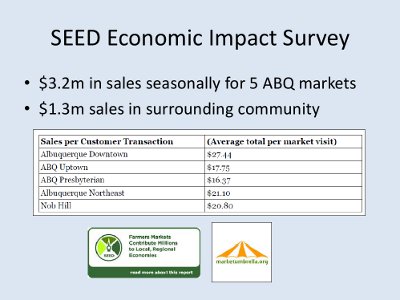
Economic impact of Albuquerque area markets. Credit: J. Rowland

Economic impact of Albuquerque area markets. Credit: J. Rowland

Farmers’ markets also directly benefit local merchants near the markets in additional sales that grow the area economy. Albuquerque has a number of farmers’ markets that support local and regional farmers and provide quality foods at reasonable prices. To finding out about the markets close to you can visit the New Mexico Farmers’ Markets Association (NMFMA) website. The NMFMA website is a wonderful place that provides information for shoppers about when and where markets are held. There is information on the produce that is available during various times of the year, as well as how to cook different vegetables and recipes. Not only can you learn when to get leeks but how to turn them into a delicious soup.

There is no way to predict the next time our food supply will be placed at risk. What we can do is invest in our own community’s ability to feed itself. By doing so we can reap the benefits of a stronger community, traditions and wellbeing. May 18th begins the regular farmers’ market season in Albuquerque. Make it a goal this year to go to a farmers’ market and begin to build a better future for everyone and have a fun time doing it.

Posted in Uncategorized | Leave a comment

Cactus-Fed Beef

New Mexico is home to many different types of agricultural resources, which may come as a surprise to those who know New Mexico as a desert or a dry climate. New Mexico has a weathered history of experiencing droughts. Droughts are defined as an extended period (month or year) in which an area experiences a shortage of annual precipitation, which in turn results in a depletion of surface and/or ground water. This results in plants and animals not getting proper nutrients to survive.

New Mexico experienced a widespread drought only a decade ago, which the New York Times referred to as an “extreme five year drought.” Although the Department of Agriculture states that droughts are a rare occurrence they have grown to be considered the “new normal.” Ranches and farms have been greatly affected by droughts, which have raised production costs above marginal profits resulting in cases of debt and foreclosure.

Many New Mexican ranches have been experiencing extreme jumps in hay prices. Rancher Vern L. Wood told me that in the last two years he has seen grass hay prices rise from about $50 a ton to $300 a ton. Price increases significantly affect ranches when purchasing 200 half-ton bales of hay for the winter season. For the past two years ranchers have been hoping to make their money back during the spring and summer seasons. They hope that they will no longer have to purchase large quantities of grass hay, because there will be enough moisture to grow adequate grass to feed their livestock. Although, for the past two years Mr. Wood says that he has had to continue occasionally feeding hay into the late summer months to keep his cattle healthy. He hopes that his livestock can scrounge enough grass to stay alive.

Mr. Wood normally puts out various protein supplements that keep his cattle healthy, but there has been a large increase in demand for these commodities as well. So, many times cattle will go weeks without proper nutrition, which results in weight loss, and ultimately lower resale value of livestock. Many ranchers are not making sufficient profits to purchase hay and supplements for their livestock. Mr. Wood says that after many months of strain he came across one of his elderly neighbors Pete Muller, who is 95, and a native New Mexican rancher, burning the prickly points off of cacti in his fields for the cattle to eat. This idea of burning cactus is a practice that is not new to the Southwest, but has been practiced since the early 1900s and was very common during the thirties when the region was experiencing the Dust Bowl.

Mr. Wood says that the idea has stayed the same but the practice has changed. Originally ranchers would cut down their cacti and stack them in large piles and then set them on fire. Now with propane tanks Mr. Wood can walk around and burn cactus out in the field. He says that although this process is much faster he still cannot burn the cactus fast enough to feed his herd. Even with his herd feeding off of cactus Mr. Wood continues to buy protein supplements for them. Although the cactus does contain many nutritious attributes, he fears that it does not contain everything they need.

New Mexican ranchers have yet to see the end of hard times and have not even begun to see the light at the end of the tunnel. Their hardships may continue because of lack of precipitation, but they have caught one small break with the cacti, which many originally saw as a nuisance. Mr. Wood says that he thought he might start his own new fad of Cactus-Fed Beef, hoping that it may put a positive spin on the drought. So the next time you eat a burger, ask yourself, am I eating cactus?

-Posted by Seth

Posted in Uncategorized | Leave a comment

The Martinez Apple Orchard: Fresh Family Food

They can be tangy, sweet, sour, tart, crisp, soft, and shiny. Apples are much more than a fruit falling from a tree. They may be considered Mother Nature’s candy. Apples in the grocery store may be coming all the way from states such as New York, Washington, and Michigan. However, why buy an apple from across the country when you can eat delicious apples grown in New Mexico? In northern New Mexico is the town of Dixon, and just three miles to the west you will find the community of Cañoncito where the Martinez Apple Orchard grows.

It began two generations previous with Delfin Martinez and his wife, Beatrice. Delfin was in the middle of a game of black jack with Beatrice’s uncle. Delfin won the bet and acquired 15 acres of land containing an abundance of apple trees. Here the Martinez Apple Orchard was established. The orchard has since grown to 18.5 acres of land growing fruits such as apples, cherries, and peaches. The orchard is a family owned operation and is led by Delfin’s son, Fred Martinez, with his wife Ruby. Being a family run orchard, I had the delightful opportunity of speaking with Fred Martinez’s nephew, Frankie Martinez. He was able to explain the operations of the family apple orchard in some depth.

The orchard currently has about 9 different varieties of apples to choose from. There are Macintosh, Romans, and Jonathan apples. They also have Golden delicious and a Jonagold apple which is a hybrid of Golden Delicious and Jonathan apples, yum! Also being grown are Gala apples and Granny Smith. Frankie told me they even have a tree that produces what they call a Banana Apple.

“We rarely sell this one. It is very sweet and soft. It really almost tastes like a banana. Ha-ha! It tends to ripen very early in the summer. However, our most popular apples are Golden Delicious and Red Delicious. Golden Delicious are personally my favorite. They are a lot sweeter with a bit of a tangy taste to them. They usually have a nice crunch to them as well. Macintosh apples are also really good; they are a little more on the bitter side. Depending on how ripe it is, they can be either very crisp or a little more mushy.”

Does Martinez Apple Orchards sell any value added products?”

“Yes we do, depending again on the time of year. Toward the middle of October there is the Dixon Art Tour. The whole town is set up for this studio art tour. Visitors come and tour different houses with local art on display. For this event my mom, aunt, and cousins make apple pies to sell. We also prepare the usual cider and caramel apples.”

Which apples can I expect in a caramel apple? Are some better to use than others?”

“We usually make our caramel apples with Granny Smith because they are a little more bitter. The tarter the apple, the better it is for baking.”

“What is the usual day like when working on the apple orchard in season?”

“The way we work is by starting with of a group of people picking apples all day. We have a tractor for loading, and when we have filled it up we take it to our shed to start sorting. Most of my family are the ones doing the sorting. This takes a long time and sometimes we’ll stay up as late as midnight. We have a machine that my grandpa bought which polishes the apple to make them look presentable. It rotates the apple all around which allows us to see if there are any bird bites or insect holes. The apples that are still good but don’t look as nice are turned into cider. We then continue to sort the apples by size into large boxes. In the end the hard work is worth the reward I’d say.”

“How is the apple orchard kept alive through the winter?”

“The early spring is actually when we really have to take care of the trees and prevent them from freezing. This is when many of the trees are blooming and are most vulnerable. It’s a real hassle. My uncle has an alarm which notifies him when the temperature is low enough to cause the trees to freeze. We have large torches set up about every 40 yards. He lights these to keep the trees warm. We also have a large wind machine which circulates the air on top of the trees to keep it from staying dormant and cool. As the spring season begins to warm and the trees begin to bloom, we have a bee keeper come to allow the bees to pollinate the orchard. In turn, the bee keeper collects all the honey that was made. ”

“How may I plan on buying your apples?”

“We sell a lot of our produce at local farmers markets. We are most prominent in Taos, Española, Santa Fe, and Los Alamos. We do not travel to Albuquerque as much, but it is possible to find us there every now and then. For special events we will also sell in Angel Fire and Red River.”

“We will also sell large orders for those who want to buy from us. Sometimes we have our regular customers driving all the way from Texas to buy our apples. This last year was also our first year selling to the Albuquerque Public Schools (APS). We started by selling around 1,200 bushels or more to APS. My uncle is willing to take the necessary trips to Albuquerque to supply the amount being bought. If our customers stay happy, we will likely continue to sell to APS.”

I always look forward to the moment of biting into the Martinez Apple Orchard’s Golden Delicious. It is sweeter and more delicious than any apple I have bought from a supermarket. If you ever wish to try a new and refreshing apple you may travel to Dixon to be greeted by pleasant family with an amazing orchard full of fresh fruit.

-Posted by Lynnea

Posted in Uncategorized | 3 Comments

Want To Be A Farmer? Need Land? LandLink!

Farm fresh produce, courtesy of travelersjoy.com

Farm fresh produce, courtesy of travelersjoy.com

“I wanted to buy some land for farming, but it was too expensive for us, so I was really excited to find LandLink” says Mona Angel of Laughing Turtle Farms. Like many people, Mona has wanted to get back to the idea of locally produced food. Her partner, Anne, feels that “it is not enough to just opt out of the industrial food system,” but that it is her responsibility to support the local food system by being a farmer. Having more farmers means more fresh food.

But what if you want to farm, and you have no land? LandLink provides a forum where landowners, who are unable to work the land themselves, and potential farmers can “link up” to form a mutually beneficial relationship. LandLink provides the screening tools in order to make this process easier on the landowners. Land owners can simply reach out to LandLink with the type of land they have and the type of farmer they are looking for. LandLink then posts inquiries from potential candidates and puts the two parties together. In addition to this service, LandLink also posts training, internship, and mentorship opportunities to aspiring farmers and ranchers. The Central New Mexico LandLink is a service provided and run by the MRCOG Agriculture Collaborative in Albuquerque with the goal of “getting the next generation of farmers and ranchers onto the land with the support they need to succeed.”

Working the land, courtesy of mrcog-nm.gov

Working the land, courtesy of mrcog-nm.gov

For Mona and Anne, LandLink made farming possible. Both grew up around farms but never had the option of owning land themselves. “After I earned my permaculture certificate from UNM, I wanted to put it to use,” said Mona. Following an encounter with Lora Roberts, a former employee at the Ag Collaborative who introduced them to LandLink, Anne said they “loved the idea of farming without needing to buy the land.” Mona and Anne found two properties from LandLink listings and were put in contact with the landowners. They currently work the King Orchard in the North Valley and have started a permaculture-based farm along the Rio Grande.

Laughing Turtle Farms.  Photo courtesy of mrcog-nm.gov

Laughing Turtle Farms. Photo courtesy of mrcog-nm.gov

“Both owners live on site, so they are around,” says Mona. However, that is where the similarities in owners ends. At the farm the owner is “not very involved.” He shows off the plot during the growing season and picks some fresh food for his family, but that is about it.  He provides the land simply because he wants it to be used and he desires access to “real food.”  Mona and Anne sell their bounty under the name Laughing Turtle Farms at local growers markets around Albuquerque. They may even be at the Lobo Growers Market in April at UNM. In contrast, the orchard owner is pretty involved. It is more of a partnership in which both the owner and Mona and Anne work the land and make decisions together. Mona and Anne sell the apples from the orchard at markets and to La Montanita Coop, and they split the profits with the owner.

Mona and Anne are just one of the several success stories from LandLink. A quick look at LandLink’s website will show more success stories and many ways to get involved. If you are thinking, “I don’t live in New Mexico, what about me?” Don’t fear, LandLink has partner sites in several states including Montana, Michigan, California, and Washington, just to name a few.

If you are looking to inject yourself into the local food system, or to make your land productive, seek out your local LandLink website and get involved. Like Mona says, “It is the best feeling to see people enjoying a fresh veggie that I grew!” Why not be a part of that special feeling, LandLink!!

Courtesy of mrcog-nm.gov

Courtesy of mrcog-nm.gov

-Posted by Blair

Posted in Uncategorized | Leave a comment

Third Film Screening Happening Today!

FoodFilmSeriesFlyer-3

Join us for Fresh, the third in a series of four engaging films on food, agriculture, health and sustainability that will be shown during the month leading up to the 5th Annual Sustainability Expo and Lobo Growers’ Market event. Help us build a community of sustainable agriculture advocates and generate buzz about the Sustainability Expo on April 23rd!

The films are free and open to the public. Refreshments will be provided, and discussion will follow each film.

Next week’s final film is Farmageddon. Stay tuned for more details, or see the full list of screenings.

Posted in Uncategorized | Leave a comment

More Green Time, Less Screen Time

Building ice sculptures in January in the Corrales Bosque. Photo by Stephanie

Building ice sculptures in January in the Corrales Bosque. Photo by Stephanie

“We used to run on down there to the river when it got low and jump in; we would cover ourselves with mud and play like we were Greek gods and goddesses.  Honey, we thought we were somethin’.  We would watch the silvery minnows and make them our subjects; this was before they were considered an endangered species, of course”

Evelyn Losack, a local Corrales farmer, recalls her youth growing up in the Rio Grande Valley. Evelyn is a Corrales farmer and concerned citizen. Some of this concern springs from her observations of the evolution of entertainment technology and its impact on how children play.

This picture of children spending their days outdoors used to be as common as yucca in New Mexico up until recently, when technology began beating out nature in its quest to gain the attention of youth. Richard Louv, the author of Last Child in the Woods, has coined the phrase ‘Nature Deficit Disorder’ (NDD) which describes the human costs of alienation from nature, diminished use of the senses, attention difficulties and higher rates of physical and emotional illnesses detected in individuals. He explains how children who spend a majority of their time inside playing video games and watching TV are not only missing out on the abundance of learning experiences found in nature, but are beginning to become disconnected with their natural surroundings.

In regards to sustainability, NDD’s premise is that these children will grow up to be adults that have no relationship with nature. They will have no emotional attachment to the forest behind their family’s house, the trees in the playground, or the flowers in the garden. They will not respect the natural environment around them and therefore they will not care or advocate for it.

In New Mexico today, schools, youth groups and government organizations are working to reverse this trend and bring children back out into nature. The Sierra Club in New Mexico is at the forefront of this movement with the Leave No New Mexico Child Inside Coalition. The Sierra Club partners with environmental educators, community-based organizations, health organizations, state agencies and outdoor recreation groups as well as Latino and Native American advocacy groups and faith-based communities to reach out and achieve their mission. One of their most recent successes comes from their partnership with the Sandia Mountain Natural History Center where students from many Albuquerque Public Schools and other local schools come to hike in the Sandias and learn about local ecosystems. Since it began in 1994, the center has served 198,932 New Mexican students; 10,302 during this school year alone. Their mission statement is “to develop an ecologically literate citizenry.”

Another group working in Albuquerque is BEMP, or the Bosque Ecosystem Monitoring Program. This program is a joint project through the University of New Mexico and Bosque Preparatory School where K-12 students perform research and collect long-term data about the Rio Grande River Bosque. Dan Shaw, the co-director of the program says, “students can be involved in meaningful ways in the conservation and stewardship of the living river that sustains us all.” This program is almost two decades old and growing. Every single month, there are at least one thousand students out on the landscape doing some kind of monitoring; collecting core weather data, monthly precipitation or measurements of forest production.

These are only a couple of programs going on in New Mexico. Diane D. Denish, former Lieutenant Governor, said “Outdoor experiences help children develop healthy bodies and minds. Kids need more ‘green time’ and less ‘screen time’ in order to gain a sense of ownership and responsibility for their natural environment.” This movement can begin with the community, schools and parents.  Make a point to encourage youth to play and explore outdoors. This relationship they build today with nature will help protect and sustain our planet in the future.

-Posted by Stephanie

Posted in Uncategorized | Leave a comment