Two Simple Steps to Move Towards a Plant-based Diet

When someone thinks about sustainability, the first things that come to mind may be buying local, switching to CFL or LED light bulbs, recycling, and the list goes on. But not a lot of people think about what they’re eating. One of the most effective ways to become more sustainable is to become plant-based. It’s more effective than any other kind of vegetarian diet, and is much less carbon intensive than a completely “local” omnivorous diet. According to National Geographic,  “One of the easiest ways to slim your water footprint is to eat less meat and dairy.” I know that “going vegan” can sound intimidating, because having a plant-based diet means avoiding all animals products, like dairy, meat, fish, gelatin, honey, and others. But it isn’t as hard as it seems. Here are two easy steps to get you closer to a vegan diet.

Step one is to start eating whole foods and to familiarize yourself with ingredients in processed foods. Focus on learning new recipes and reading the ingredient lists on foods you usually buy. Start cooking at home as much as you can. There are vegan healthy recipes you can follow, or enjoy some more comfort food recipes (my personal favorite). Feeling more comfortable with making your own food will help you avoid animal products that can be hidden in processed foods. Do not worry about cutting out all animal products now; just start just making your own food as best you can. Buying processed foods is also okay: just read the labels and avoid certain ingredients if you want to ensure that you’re buying plant-based foods. And don’t worry, you don’t need to be perfect right away! Step one can take some time getting used to, and you don’t need to go cold turkey (pun intended)!

VEGPIC3

Some delicious vegan comfort food recipes from Serious Eats.

If you feel like you might not have time to prepare your own food every day, try food prepping. Make all of your food for the week on one day in about two or three hours. Make large batches and store them in the fridge or freezer. This simple practice makes eating at home a lot more efficient. If you have restrictions on what kinds of food you can access (you live in a dorm room, have limited access to grocery stores, etc.), do the best you can to select a wide variety of whole, plant-based foods. Cost may also seem to be an issue, but many substitutes for meat (beans, tofu, quinoa, etc.) are cheaper and a lot more sustainable. Change takes time.

VEGPIC4

Here are a few more vegan recipes compiled by a magazine based in Philly.

For the second step, focus on switching some animal products to vegan substitutes. The easiest switch is probably from cow’s milk to a plant milk. Coconut milk is the most sustainable because it uses the least pesticides, least water, and produces the smallest amount of greenhouse gases out of a variety of other milks. There are also now vegan cheese, ice cream, and yogurt from a variety of companies that can be found in most large grocery stores. There are lot of different kinds of vegan “meats” and other “dairy” products like butter and cream cheese. All of these substitutes have smaller footprints than their counterparts because animal products take a lot more resources (energy, water, land) to produce.
VEGPIC1

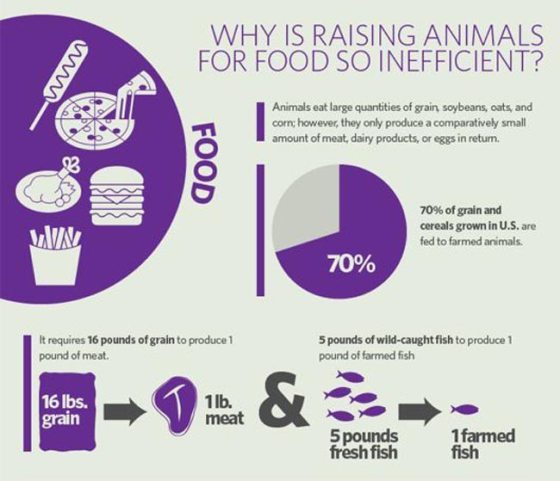
Going vegan can be a lot more efficient and use a lot less resources compared to an omnivorous diet. Image credit: greenerideal.com

A recent study shows that people are more motivated to change their diets to plant-based if it means that they will be helping, instead of hurting, people and the earth around them. Going plant-based, or even vegetarian or pescatarian, all help in terms of sustainability for the future. A plant-based diet cuts your carbon footprint in half. It also slows deforestation and overfishing. A vegan uses one tenth of the water in their diet than an omnivore does, mainly because all of the grains that are used to feed animals go straight to people. Going plant-based has so many benefits and is now easier than ever to do. There are so many substitutes and resources available, more than there ever were before. Going vegan is one of the most sustainable things someone can accomplish, so why not give it a shot?

-Natasha

Posted in Uncategorized | Leave a comment

Sustainable Food for UNM Students

Eating on campus can be a sustainable adventure that educates and creates healthy habits that last a lifetime. Colleges all over the US are working towards connecting students to their local foodshed and to fresh food, by buying locally and lowering their waste.

At first glance, it may not look like UNM as an institution is thinking a lot about sustainable food – but that is not the case. There is a long way to go to reach a visibly and wholly sustainable experience on campus but creating that will start with an acknowledgement of our current accomplishments.

SUST1

Sustainability written in metal above the plate receptacle in La Posada. Photo by author.

Chartwells, the parent company to UNM Food, has numerous sustainability initiatives . These initiatives include “providing fair trade options” and “encouraging local spending.” Head Chef Hassan Abassary and Director of Operations Karen Lombardi are both devoted to sustainability and work toward Chartwells’ stated objectives.

In a presentation to my sustainability class, Chef Hassan proudly listed – off the top of his head – some of the of current successes in the La Posada dining hall:

  • Pinto beans served often at the “Red or Green?” station are grown in the Four Corners region and sourced through La Montanita Co-Op Distribution Center;
  • Tamales, enchiladas, tortillas, and sopapillas are purchased locally from Bueno Foods;
  • The pork served is hormone free and bought from Kyzer farm, a New Mexican family farm;
  • Meat is not the focal point of each meal station;
  • La Posada makes deals with local farmers to buy as much of their lowest cost misshapen produce as possible to avoid waste in the fields;
  • La Posada composts kitchen scraps and food waste through Soilutions.

Head Chef Hassan clearly loves to cook. At a UNM Food student associate reception he personally cooked each person’s dinner, smiling and describing the diverse ways to combine the available ingredients. With such a personality in the kitchen, it is no wonder that Chartwells does a good job of serving a range of vegetables in new and fun ways in the dining hall. I am surprised by big, juicy Portobello mushrooms, a lime and feta lentil dish, and the variety of  kale-based dishes that are not only healthy, but delicious. These dishes make sustainable diet choices easy by putting local and fresh food front and center in delicious plant-based meal options.

Other initiatives at La Posada are advertised on the walls in large framed pictures captioned “cage-free eggs” and “rBGH free dairy.” As these practices become the norm for food service providers, UNM Food can make a bigger difference if it pursues other methods of increasing sustainability.

SUST2

Signage for sustainable commitments, a step in the right direction. Photo by author.

Some failures in perception come mainly from a lack of upkeeping the advertising and more signage near food. And although “sustainability” is in big metal letters above the dishwashing station, the wall with statistics about accomplishments has not been updated since August 2017. Being sustainable is one thing, but letting people know, and making people think more critically about it, is an even better option.

This slideshow requires JavaScript.

Things are looking promising for the sustainability of eating on campus for UNM students. Karen praises Chef Hassan for his dedication to taking measurements of all the diverted food waste through donations, composting, and suggested portion sizes. She believes that with some recent staff additions, it is now likely that the statistics on the wall will be updated and Hassan will have more time to develop new sustainable solutions in the dining hall.

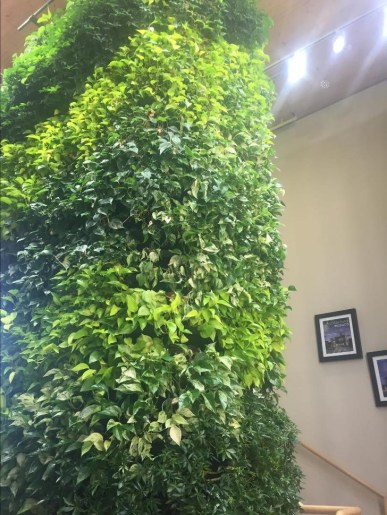
While the management staff of La Posada feel that more edible plants in and around La Posada would be great; indoor plants also offer a passive way to regulate temperature and clean the air. The columns in La Posada provide a good space to grow vine plants. There is also talk of an herb garden inside.

SUST5

Colorado State University features a “plant column” in their LEED Platinum pavilion. Photo by author.

Local fruit and nut trees could be planted around the outside of La Posada, including some of the plants found here.

This slideshow requires JavaScript.

A dining hall that feeds thousands presents an opportunity to affect thousands. By shifting our current setup, we can further connect people to their food and invite them to think about the possibilities of how we can affect our communities through our everyday choices – starting with what we eat.

-Coleen

Posted in Uncategorized | Leave a comment

Vermicomposting in New Mexico

What is vermicomposting? It is composting using worms, Specifically with Eisenia fetida, the most common type of red worm. These worms are favored because they are sturdy and tend to stay near the surface, helping to quickly process food waste. When worms eat your waste, they produce casts (poop) mixed with other decayed organic matter. This compost contains eight times the microorganisms than the food consumed, five times more nitrogen, seven times more phosphorus, and eleven times more potassium than typical soil. It’s also rich in humic acid, which balances pH in the soil.

Why vermicompost? It can be done indoor or outdoor, large scale or small scale, and the compost is very nutrient rich. Most people prefer to vermicompost because it can be done with a small bin indoors used to get rid of kitchen scraps. The vermicompost process is also much quicker than traditional methods. If the bin is kept properly, there will be no odor. Plus, composting is good for the environment. Instead of throwing away food scraps you can turn them into valuable fertilizer for plants and gardens.

How to get started. Mary Appelhof, author of Worms Eat my Garbage, recommends to calculate how much food waste your family produces in a week and then “plan on one square foot of surface for each pound of food waste per week.” You can buy a plastic bin or a stacked configuration to use for the worms, or more preferably build a wooden one.

Picture1

Get started. Photo by author.

The bin will need holes for ventilation or one big hole covered with mesh.

Picture 2

A mesh screen insert. Photo by author.

For substrate it is recommended to use some sort of natural material like mushroom compost. You can get as simple as using wet shredded newspaper or even leaves. I would not recommend leaves because of all the bugs that can be introduced to your bin from them, but if the bin is outside it might not matter. Also add a bit of grit, such as a handful of sand.

Picture3

Prepare the bedding. Photo by author.

You will need about 1,000 worms, which is about a pound. If that’s not enough for the bin size that is fine, they will quickly populate to fill the space.

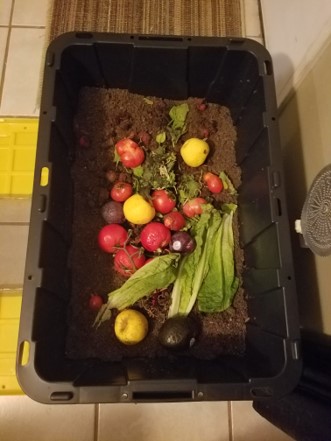
Lastly, add your scraps preferably in small pieces, as worms will consume smaller bits faster.

Picture6

Add your food waste. Photo by author.

What can I feed my worms? They can be fed any organic material except the following:

  • Spicy food
  • Acidic/citrus foods
  • Oily food/Oil
  • Potato peels
  • Animal products: Meat, Milk, eggs (rinsed egg shells are okay)
  • No animal feces

Pros and Cons on Vermicompost

Pros

  • Easy to manage
  • Can be done indoors
  • Creates great highly nutrient rich compost quickly

Cons

  • Limited on how much you can compost
  • Limited on what you can compost
  • Can smell if done indoors (shouldn’t happen)
  • May attract bugs

How to maintain your bin: Every six weeks you will need to sort the worms from the dirt and add new bedding. You can sort them by shining a bright light over the bin and gradually skimming the top layers of dirt away. The worms will keep migrating to the bottom until you remove most of the finished compost.

How to use your compost: Use to fertilize plants. There is no way to use too much compost and it won’t harm the plants.

How to use compost to improve desert soil: According to the Sandoval County Master Gardeners, adding compost to desert soil will “allow for aggregation and water retention in sandy soil.” Adding compost reduces the alkalinity of the soil to a more neutral pH, but not permanently. Make holes in your soil with garden tools and then add the compost [and worms, if desired]. Then water and add mulch to your space all year around which will keep your soil moist. You can also add a cover crop for additional nutrients and to break up compacted ground.

-Tifani


Posted in Uncategorized | 1 Comment

Futuristic Farming

image002

Population Clock. Image: US Census

The Earth is home to more and more people every day, and as more people are born more resources are used. Currently the population of the world is roughly 7.5 billion people, growing at such a rate that alternative and futuristic advances in farming may be necessary. New Mexico’s population growth may be stagnant, but our state’s water use is growing. About 80% of New Mexico’s water goes to agriculture, and with the incorporation of a few new and different farming methods, people and ecosystems in the state could greatly benefit. 

The first advancement in farming technology that could be expanded in New Mexico — particularly, in Albuquerque — is indoor growing. Indoor growing systems could be modeled after Irving Fain’s Bowery company, an indoor vertical farm. The other method is greenhouse production, modeled after Matthew Stong’s Preferred Produce operation, which utilizes a hydroponic system to reduce overall water use.

An arid city such as Albuquerque could benefit greatly from a large-scale indoor growing operation. The Bowery company has an indoor space with vertical growing stacks going five levels high. The plants are protected indoors, allowing for 4-season growing and are grown using LED light fixtures. The veggies, herbs and greens such as arugula or basil are watered by an adaptive hydroponic system. Albuquerque could adopt a similar system that would best fit and benefit our community. With grant money or funding from the state it would be possible to build a technical facility similar to Bowery and their system to produce greens and veggies for the city. Local farmers or specialists can operate and manage such a facility to help reduce water use.

image004

Five-level vertical growing stack at Bowery. Image: Fortune.com

According to Bowery, they are able to save 95% of the normal water used for the plants. This will not reduce the overall agricultural use of water by 95% but will hopefully spark an agricultural practice that can flourish into the future. According to Irving Fain, the CEO of Bowery, the measurement system that tracks plant water use, growth, and other indicators is the most advantageous part of indoor growing. The wattage requirement in Bowery is 32 watts per square foot and varies depending on the stage of growth the plants are in. Another advantage Albuquerque has is the use of the sun and solar power to cut cost of energy and overall to help reduce our footprint. Because of their efficient practices, Bowery is able to keep cost of products — such as 5-ounce container of greens — at a reasonable price of $3.99, helping the community eat at an affordable and sustainable price for years to come.

image008

A few of Bowery’s products. Image: boweryfarming.com

image011

Matthew Stong working in his greenhouse. Image: Deming Headlight

Another important method to implement into New Mexico is a greenhouse hydroponic system. Matthew Stong has a PhD in agriculture and bio-systems engineering, and is the owner of Preferred Produce in Deming, New Mexico. His company has developed a business model that produces a livable wage and addresses water availability issues in New Mexico. By creating this new type of 4-season farming operation, former field hands are now able to work in the greenhouse growing high value crops for a livable wage. The culture and system of agriculture that is created here needs to be replicated and adopted by more farmers, as it could add to the general economy by having better wages and more jobs for a better future. Additionally, the hydroponic system cycles water three times — allowing for a significantly less water used in growing food. Some of food grown by Preferred Produce includes romaine and other greens, tomatoes, and various small veggies and fruits.

Preferred Produce

Fresh greens from Preferred Produce. Image: Albuquerque Journal

Both of these methods practiced by Bowery and Preferred Produce could greatly benefit New Mexico and help reduce the amount of water that is currently used in agriculture. Another great aspect of these methods is that they can bring a new and young generation to farming to keep the culture and life alive.

-Reed


Posted in Uncategorized | Leave a comment

Nurturing Sprouts: Insight into Albuquerque Public Schools’ Food Education for Primary Students

Personal Insights

My insight into food has always been rooted in what I was taught in school. Public education in the U.S. taught me to balance what I ate in terms of the food pyramid. It stated that I consume large portions of grains and just a small amount of sugar and fats.

I shifted this perspective when I moved to Kuwait in 2006. While there I attended a private school that required health as a core subject. Within the class we were taught to balance our diet and have insight on what we eat. Cultural perspective and scientific reasoning were heavily relayed to us. Thus, food became more than fuel we ingest to keep ourselves on the move. I jumped to eating foods without any corn-based additives and all foods that were non-GMO. Years later, I would become vegan and try to source my food locally. I have since switched back to an omnivorous diet, but my roots remain. I treat food as a cultural item and understand how it intersects with a healthy life.

Cultural Perspective

Culture is fostered at an early age. In society today, kids spend most of their time at school. This environment fosters a communal culture, one aspect of which is food. Food culture deeply affects how students react to food and develops their thoughts on healthy diets. Understanding how food culture is promoted in schools will help us to identify emerging health and diet trends. This blog entry provides some insight into how Albuquerque Public Schools (APS) interpret and create their culture of food.

USDA Guidelines

Albuquerque Public Schools have long used nutritional guidelines provided by the federal government. Nutritional initiatives fall under the jurisdiction of the U.S. Department of Agriculture (USDA), and these nutritional guidelines are often shared with the public in the form of an infographic. The infographic has undergone various iterations over the past century, from pie charts to the more recent food pyramid. The differences between the 1992 food pyramid and the MyPlate model illustrate how the guidelines have evolved. In the MyPlate model, fats, sugars, and oils have been eliminated and what used to be termed meats has been replaced by protein. In addition, serving sizes and the pyramid shape have changed into recognizable sizes on a dinner plate. The federal guidelines fundamentally change how students talk about food. With meats shifted more broadly to protein, other foods such as nuts, seeds, and beans are seen as valuable assets to a plate. This cultural shift makes dietary preferences such as vegetarian an understandable option.

FoodCorps

Numerous program have been set up to support health and nutrition in low income communities. One of these federal initiatives is FoodCorps, which provides service members to public schools and community organizations in high-need states. Service members implement a three-part initiative to promote hands-on learning, a balanced diet, and general health education. FoodCorps services seventeen states and the District of Columbia, including New Mexico.

In New Mexico, FoodCorps supports seven service sites. Three of these sites are in the Albuquerque metropolitan area, and include La Plazita Institute, the Southwest Organizing Project and the Albuquerque Public School Gardens. Mallory Garcia holds the position as APS School Gardens coordinator. In an interview, she stated that her main role facilitates interactions between individual schools and local companies. She believes that student gardens engender a form of ownership among students that tend them. With the earned knowledge and dedication, they are more likely to know and care about the food they eat. However, many student gardens face issues of long-term leadership and access to funding. These issues are mitigated by community inclusion and the support of facilitators like Garcia.

farm to table

Farm to Table, a sponsor of APS Gardens, facilitates a public tour of the Kirtland Elementary school garden. Image from: Farm to Table

DOT Gardens

Garcia has connected multiple partners together to provide resources to individual schools. Albuquerque Academy is one of those resources. This private school maintains the Desert Oasis Teaching (DOT) Gardens. Its original focus was centered on xeriscaping and understanding local desert flora. Tiana Baca is the garden manager for the DOT gardens. When interviewed, Baca expressed that the DOT gardens provide multiple functions to both the school and the wider public. They grow seedlings in a greenhouse on campus, and provide them to other schools in the area, including Lavaland Elementary School. Baca noted that many students, especially in elementary, have trouble growing plants from seeds. “Giving students sprouts builds their confidence because they can see it,” Baca stated. The DOT Garden also offers biweekly on-campus volunteer opportunities where volunteers learn a variety of gardening methods. These lessons include management of raised beds, soil health, and compost. WaterSmart gardening workshops, supported by the local Water Utility Authority, are also offered free to the public. These workshops and volunteer opportunities help foster community engagement and provide an exciting hands-on learning experience.

Conclusion

Albuquerque is a mixing pot of many unique cultures. Food culture is fostered in many ways, from those supported by the USDA to community initiatives such as the DOT Gardens. How we craft the culture of food is vital to the health of future generations and their communities.

-Edwin

Posted in Uncategorized | Leave a comment

Chicos

Corn, also known as maize, has been a foundational part of Native American, Aztec, Maya, and other cultures across the world. These cultures each believe in corn deities — many of which are associated with fertility — and have created stories of planting, growing, and harvesting corn. Mayans created their calendar on the planting season of corn and believe that they were fashioned from corn. Native Americans have dances that are specifically for the health of the corn. Corn is not only worshiped, but is also a staple food that gives us nutrients we need.

Corn is a traditional food of New Mexico — one of the foundational three sister foods, along with beans and squash. Chicos are fire-cooked corn that are dried and preserved for use in stew and other dishes. Chicos are a part of both the Hispanic and Native American cultures in the Southwest region, where food is symbolic of togetherness. Smoking and drying corn is an important ancestral food preservation tradition. Lois Ellen Frank, a Santa Fe based chef and native food historian, provides a brief history of chicos.

4

Chicos. Image from Pinterest.

As a member of Sandia Pueblo, I have grown up around agriculture and have been a part of making chicos many times — each time with different harvests and conditions. This process has been a joyous occasion that can be either a family or community gathering. Everyone can walk away with a piece of life from the garden. Making chicos requires hard work, and it starts from the seed. Weeding, watering, and time spent in your garden all gets rewarded with a value-added product like chicos.  The tradition and culture of chicos has given me a sense of what our ancestors did to preserve food. The taste of chicos is like no other way of cooking corn: the earth and fire give it a certain smoky earthy taste that you can’t get anywhere else. My favorite part of making chicos is picking the corn with family and trying not to get lost in the paradise.

To make chicos you will need corn, corn stalks, a shovel, big rocks, rebar, tin sheets, water, and dirt. First: dig a pit of any length that is at least 3 feet deep. Start a fire in the pit, and allow it to burn for 5 hours. Once coals have formed, you’ll have ample heat for cooking. While the coals are forming, put the ears of corn in buckets to be soaked in water. Next, cover the coals with corn stalks so the corn won’t burn. Once the stalks are down, cover the pit with tin sheets, leaving an doorway opening through which to put the corn and water.

Steam will rise out as soon as water is put in to the pit, so the key to the process is to quickly cover the corn once water is added. Another trick is not to put too much dirt on top of the tin sheets because uncovering them will be arduous and you may get dirt in corn. The hardest part of this process is putting the corn in the pit quickly so as not to lose any steam. This process is an all-day event or could be done overnight. Below is a video of the setup preparation on how to make chicos.


The success of the cooking phase all depends on the steam and pressure; if it is high, the ground and tin will rumble, this is an excellent sign. Once the corn has been cooked for four hours, the next step is to uncover the pit by taking the dirt off the tin sheets, so dirt does not fall into final product. We would drive a flatbed as close as we could to the pit to put the corn on and wipe away any dirt that got on them. After collecting all the corn, we do one of four things; give it away to the community, hang it to be dried, eat it straight off cob, or prepare a meal with it. The way I prepare chicos is by cutting the corn off the cob and mixing it with squash in a pan. I cook it until soft and serve it with beans and tortillas. Michele Ostrove’s article in New Mexico magazine offers a variety of recipes for adding chicos to your cuisine.

3

Stew with chicos. Image from: foodgps.com

-Paul

Posted in Uncategorized | Leave a comment

Protect Our Soils!

Food. It is a big part of our lives to say the least. Most of us live in cities and have little idea of the huge amount of land that is devoted to growing or raising food and other agricultural products. It is difficult to truly understand how big of an impact agriculture has on the environment. Two fifths of America is farmland. That is 9.15 million acres of land being used to grow our food. It makes sense with the amount of people there are on earth that there would need to be a lot of food grown. Yes, there is a bit of room for improvement on the waste and distribution side of things, but I want to focus on the impact of the land.

In a forest the soil is healthy and rich in nutrients because they are being cycled through plants, animals, bacteria, fungi, and many other living organisms. This keeps important elements such as Carbon, Nitrogen, and Phosphorus locked in the soil or the organisms themselves. Forests are a perfect example of a closed system where one output is an input for something else. For example, the carbon of a tree when it dies and falls over is a product for fungi, bacteria, as well as other organisms to consume. Fungi and bacteria are good at fixing nitrogen into the soil, which is something most plants can’t do. This fertilizes the soil so that now more trees or plants can grow. An animal can feed off the plant and then the animal’s droppings can become fertilizer for another tree, plant, fungi, bacteria.

This slideshow requires JavaScript.

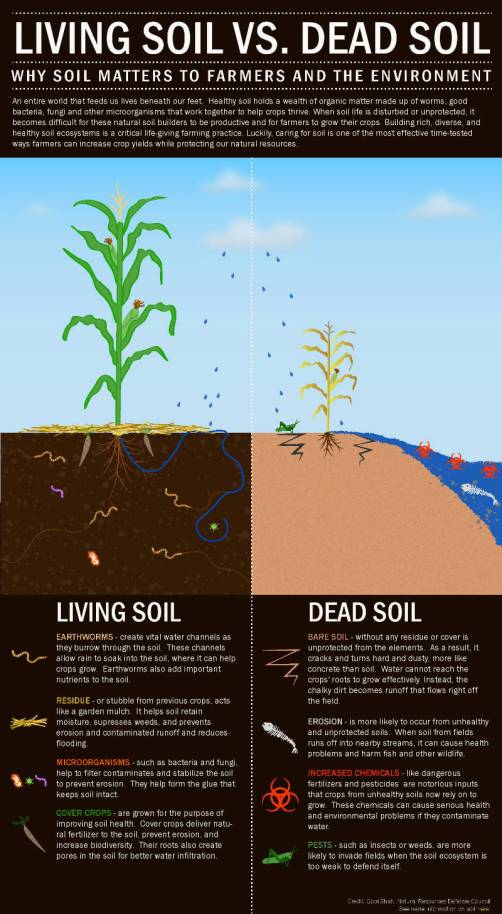
With industrial agriculture systems, which typically practice monoculture, there is just one variety of crop growing in bare dirt. When the plant produces its fruit (final product), it is taken away from the field to be consumed or processed into a product. This is a constant cycle of nutrients leaving the soil. When there is only one type of plant in the soil, it also depletes a singe profile of nutrients from the soil. On top of that, soil erosion happens when the soil is bare and turned frequently. It loses nutrients and carbon because there is not living material to hold these nutrients in the soil; they vanish with the wind — or when it rains, with the water that evaporates. Carbon can leave the soil in the form of CO2, and fixed Nitrogen decays into nitrogen gas.

There are many symbiotic relationships between mycorrhiza and root systems of plants and trees that can be lost with soil erosion. Diversity in an ecosystem is essential for not only maximizing the production, but it can also protect from pest invasion and damage. Using other plants that have a symbiotic relationship with each other can protect a crop from pest damage.

image006

Soil erosion is something that typically happens in a positive feedback loop, which causes it to get worse and worse over time. When vegetation starts disappearing and the soil begins eroding, it gets harder for anything else to grow in it and so the soil further erodes. On top of that these exposed plants that are being planted as a crop are vulnerable to pests, so they usually get sprayed with pesticides and fertilizers to make up for the lost nutrients in the soil. This adds more toxic compounds in the soil making the soil more “dead.”

Think of it this way, everything you buy that was grown in a field is full of nutrients and water from the field it came from. So, ideally, any waste would go back to the farm to be recycled. We can’t really cycle the nutrients we consume but we can at least compost the inedible components. The weeds and other unwanted vegetation should be composted to cycle the nutrients back into the field. Another way to maintain soil health is to practice crop rotation. Rotating what is growing in the soil helps it maintain a balance of nutrients and aid the proliferation of symbiotic subterranean life.

We should make it a priority to stop expanding agriculture, especially industrial agriculture, further into undisturbed lands. It should be a priority to protect our natural biomes that support biodiversity, because symbiotic relationships will be lost and so might many different species of plants and animals. We can make agriculture more efficient and still easily produce enough food if we can optimize the way we do it. Shrinking the scale down and adding diversity are simple ways to do that. All we are is a collection of water and nutrients. As such, we should try to put the highest quality nutrients into us, while minimizing the intake of and pollution from toxins. Understanding the cycles of nutrients and the problems of toxins can easily align us in a better way of living, both for ourselves and the ecosystems we are a part of.

image008

-Andrei

Posted in Uncategorized | Leave a comment

Food Banks in the USA and Japan

When you are full but there is some food left over, what do you usually do? When you have food that has just expired, do you throw it away? Across the world, a lot of food is thrown away even though it is edible. Meanwhile, the global problem of hunger is serious. There are currently 815 million people suffering from hunger or chronic under nourishment. According to the FAO (Food and Agriculture Organization), nearly 1.3 billion tons of food is abandoned annually in the world, which is enough to feed 1 billion hungry people. In this blog, I focus on the USA and Japan because there are many people in these countries who are suffering from hunger, even though there is adequate food available to provide for the hungry.

The present situation of hunger and food banks in the USA and in Japan is as follows:

Statistic USA Japan
The number of people who are suffering from hunger 41 million (1 in 7) 20 million (1 in 6)
The number of food banks 200 43
The amount of food loss annually 72 billion pounds 13.6 billion pounds

As you can see, many people are suffering from hunger even though these countries are considered “developed.” In Japan, a lot of food is discarded, even though the country depends heavily upon imports. The food self-sufficiency rate in Japan is about 39%, and 58 million tons of food are imported each year. Additionally, Japan does not have many food banks, and there is little social recognition of the problem of hunger.

Food banks rely upon donations from national food and grocery manufacturers, retailers, shippers, packers and growers, and from government agencies and other organizations. In these organizations, there are often staff who work closely with partners to match excess food with the food banks that most need it. In food bank, there are staff with training, oversight and equipment to ensure perishable and non-perishable food is handled and stored properly. Food banks then distribute food and grocery items through food pantries and meal programs that serve families, children, seniors and individuals at risk of hunger.

1

Roadrunner Food Bank. Image from ABQ Journal.

In New Mexico, 14.4% of residents don’t know where their next meal will come from. The state is also ranked #2 in childhood hunger. Roadrunner Food Bank is the largest food bank in Albuquerque, and I volunteered there to learn more. They are helping 70,000 hungry people in our state weekly. That figure is equivalent to feeding a city the size of Santa Fe every single week. Usually, volunteers working in the Roadrunner Food Bank will help prepare food for distribution to hungry people across the state. When I worked as a volunteer I bagged loose beans into smaller packages for distribution at food pick-up sites. I want to continue volunteering because Roadrunner has so many tasks that need to get done each day by volunteers.

2

Food donations are being recruited from the general public at an event. The flag reads: Turn something that may go to waste into a “thank you.” Image from: Second Harvest Kyoto

In my town, Kyoto, in Japan, there is a food bank whose name is Second Harvest Kyoto. In Kyoto prefecture, the amount of food loss is about 300 million pounds per year; however, the amount of food contributed to the food bank is only 30,000 pounds per year. Second Harvest Kyoto served food to 13,000 people during 2017, a much smaller number of people than those who receive food bank services in New Mexico. As you can see from these numbers, there is little social recognition of the problem of hunger in Japan.

We know that there are many people who cannot get enough food in our countries. So, if there is something that you can personally change, please shift your eating habits in order to reduce food loss. For example, you should not buy a lot of food all at once, even though it may be really cheap to do so. Also, you should discriminate between “best-by dates” and “expiration dates.” If the food has just passed its “best-by date,” it is still safe to consume. However, there are many people who will throw it away. Like this simple example, there are many other things you can do to shift your eating habits, and they can lead to a significant reduction in food loss.

-Ami

Posted in Uncategorized | Leave a comment

Walmart’s CSR Practices: Investing in the future

Corporate Social Responsibility (CSR) is a common term used to describe positive practices performed by a company that contribute to the greater society. CSR derives from the concept of the triple bottom line, which focuses on social, economic and environmental costs and benefits of operating a business. According to Investopedia, CSR “generally applies to efforts that go beyond what may be required by regulators or environmental protection groups.” In this article I will try to evaluate CSR practices of Walmart, a corporation with  revenues of $482 Billion in 2016, and recommend potential practices to better serve the interests of small and mid-size farmers.

According to Walmart’s corporate website “When Sam Walton opened his first Walmart, it was strongly grounded in its local community. Today, Walmart’s 2.3 million associates are residents, neighbors, friends and relatives in thousands of communities around the world.” Being the world’s largest corporation, Walmart has an unrivaled opportunity to invest in practices that benefit both their business and the greater community.

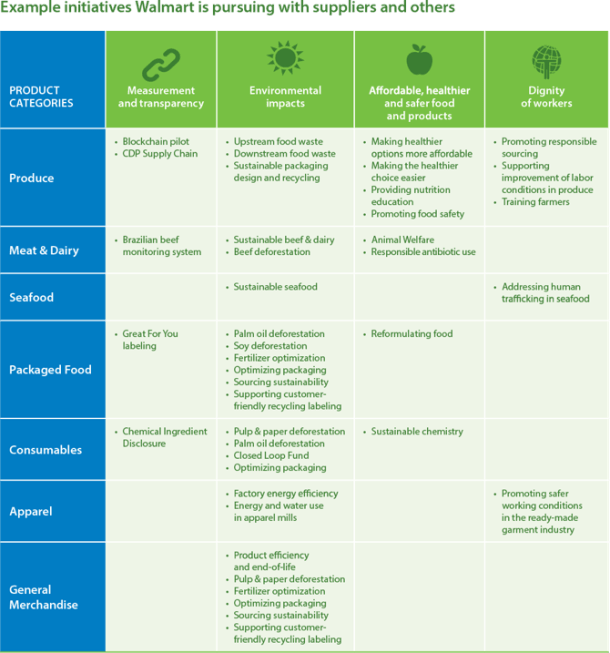
Walmart’s Global Responsibility Report details their global approach towards building a better community. According to the report, Walmart believes social and environmental programs are of interest to long-term stakeholders because there is a symbiotic relationship. The report states that, Walmart gave over $1 billion annually to projects that create opportunity, enhance sustainability and strengthen community.” The infographic below shows some of the initiatives the company is taking to move towards more sustainable operations.

Blog-1

Walmart’s current initiatives for community development. Image from Walmart’s 2017 Global Responsibility Report.

According to the Global Report, in the U.S., Walmart more than doubled its sales of locally grown produce from 2010 to 2015, from $404 million to $825 million and is committed to doubling it again by the year 2025. Moreover, Walmart is supporting farmer training campaigns around the world, with an aim of aiding smallholder farmers with the tools and knowledge they need to succeed. Between 2011 and 2016, the Walmart Foundation invested over 1 million dollars for farmers training programs. The company is also working with developing countries like Bangladesh, Kenya and Mexico to promote sustainable farming practices.

Blog-2

A Walmart store front. Image from Talk Markets.

For a better future, some recommendations may include rapidly increasing number of local suppliers/farmers by incentivizing small scale production and launching programs that supports small family farms more rather that mass production can be helpful. Also, the company could work with other government agencies to implement sustainable practices in production and design a section dedicated for local produce to promote small farms. Moreover, increasing purchase price can be beneficial for small farmers. The annual revenue may decline at first, but it can be an investment to the future. Furthermore, establishing a healthy and supportive relationship with farmers or suppliers can help foster mutual development.

It is high time for Walmart to consider alternative supply chain by involving small farmers or suppliers more. The current efforts are commendable however, they are not impacting the society and the farming community as much as they should. A great portion of farmers remain in darkness in terms of modern training an infrastructure. Therefore, it is necessary to have a concrete plan to provide accessible resources for the welfare of the farming community.  At first, there might me some obstacles, however it is entirely feasible for a company like Walmart to implement some positive changes. After all, when a company becomes as vast as Walmart, it naturally becomes an obligation to consider the notion of triple bottom line (social, economic and environmental costs of operation) in every aspect.

– Shaikh

Posted in Uncategorized | Leave a comment

Morning Star Farm: The Epitome of Sustainable Design

Farming in New Mexico is very diverse. There are 24,721 farms in the state, 90% are family owned, 5% are partnership owned, and 5% are corporation owned (“New Mexico Family Farms,” 2016). The average farm size in New Mexico is 1748 acres. Currently, the top agricultural products in NM are dairy products, meat animals, and cattle and calves to name a few. Industrial systems of meat production are often not sustainable. Animals are kept in close quarters, fed high-calorie diets with antibiotic/hormone supplements, and the animal waste is highly concentrated which lets off harmful fumes. When it comes to crop production, chemicals and pesticides are utilized and monoculture is practiced.

Throughout the decades, biodynamic farming has been practiced all over the world and in a variety of climate conditions. It has been proven time and time again that this method can be applied to a multitude of situations. Within the state of New Mexico there are several farms that choose to practice these methods. Morning Star Farm is situated on 2.5 acres and located North of Taos, in the village of Arroyo Seco. This farm is a viable model for biodynamic agriculture because of its diversity and healthy relationship with the community. It also serves as a method of farming that is a welcome contrast to the industrial form of agriculture found in New Mexico.

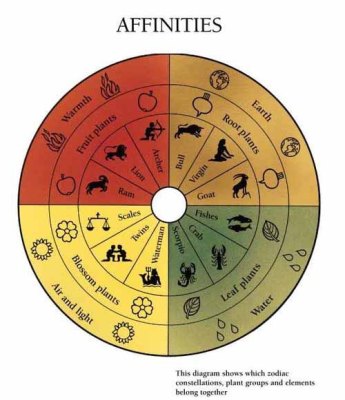
Image 1 biodynamic_affinities

The zodiac constellations, plant groups and elements that belong together. Image source: thegrowingclub.com

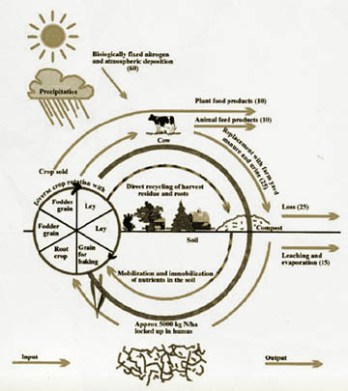
Biodynamic farming is a holistic, ethical approach to agriculture that was developed by the philosopher Dr. Rudolf Steiner in the early 1920s. Steiner‘s main theory is that the farm needs to be treated as a living organism and requires biodiversity to operate. In industrial agriculture, biodiversity is reduced due to pollution and soil erosion. Biodynamic farming is a closed-loop system that attends to the relationship amongst the soil, plant life, and animals. It is organized so that the waste from the animals, for instance, would become the nutrients needed by the soil. Industrial methods are not focused around the relationship between soil, plants, and animals. Animals are sometimes treated unfairly, and pesticides are frequently used that hinder plant growth and decrease soil health. Biodynamic agriculture is an organic way to grow nutrient rich food within a completely self-sufficient system. Within this method of farming, crops are influenced by the positions of the moon, sun, and other planets.

Studies on the subject have concluded that biodynamic methods result in enhanced soil quality and lower production when compared to conventional systems. Farms of this type will ultimately produce less; however, the soil content enhances the taste, nutrition, and quality of crop yields. Biodynamic agriculture thrives off diversity and focuses on regenerating the different areas of the farm to maintain a healthy balance. Waste is recycled into feed or fertilizer. Mixtures of manure, minerals, and herbs are introduced into the soil. This practice significantly enhances the quality, flavor, and nutritional value

biodiagram2_sm

The cyclical system of Biodynamic agriculture. Image from Earth Haven Farm

of the crops that may be growing. This type of agriculture encourages farmers to develop a relationship with the cosmos and understand how they influence soil, plant, and even animal health. The initiatives behind this method of growing embody triple bottom line approaches towards ecological, social, and economic sustainability. Community supported agriculture is a system that was pioneered by biodynamic farmers. CSA groups provide the community with healthy, seasonal, organically grown food; keep in mind the ecology of the environment; care about families; and provide hands-on opportunities for people who wish to learn about farming. This practice stresses the importance of humans working with and learning from their environment.

Morning Star Farm was founded in 1991 by farmer Melinda Bateman. Two years later, Melinda began selling produce to local restaurants and the subsequent year, to farmers’ markets. In 1994, Melinda was the fifth farmer to join the certified organic agency in New Mexico. During 1998, the farm began making horn manure, which is a fundamental part of biodynamic agriculture. Cow dung is packed into a cow’s horn and then it is buried during cooler months. After 4 months pass, the horn is removed, the dung is liquified, sprayed and reintroduced into the soil as nutritious fertilizer. Melinda also started the first CSA in Taos, which was operational for a little over a decade. In the beginning it served 20 families and 100 when it was closed. Melinda has big plans for the future of Morning Star that include an outdoor kitchen to host farm-to-table meals and housing for interns/students to promote education.

Today the farm harvests a variety of seasonal produce such as cauliflower, garlic, turnips, beets, and much more! Eggs are produced year-round while flowers and fresh herbs are available every season except winter. In the fall, value-added products like pickles and honey are sold. Classes on various topics such as composting, basic gardening, and biodynamic prep making have been taught in the past. Morning Star Farm is a small farm making huge strides in the world of sustainability.

– Kathrine

Posted in Uncategorized | Leave a comment