The Lobo Growers’ Market is Back!

EAT SMART, BUY LOCAL, BE LOBO!

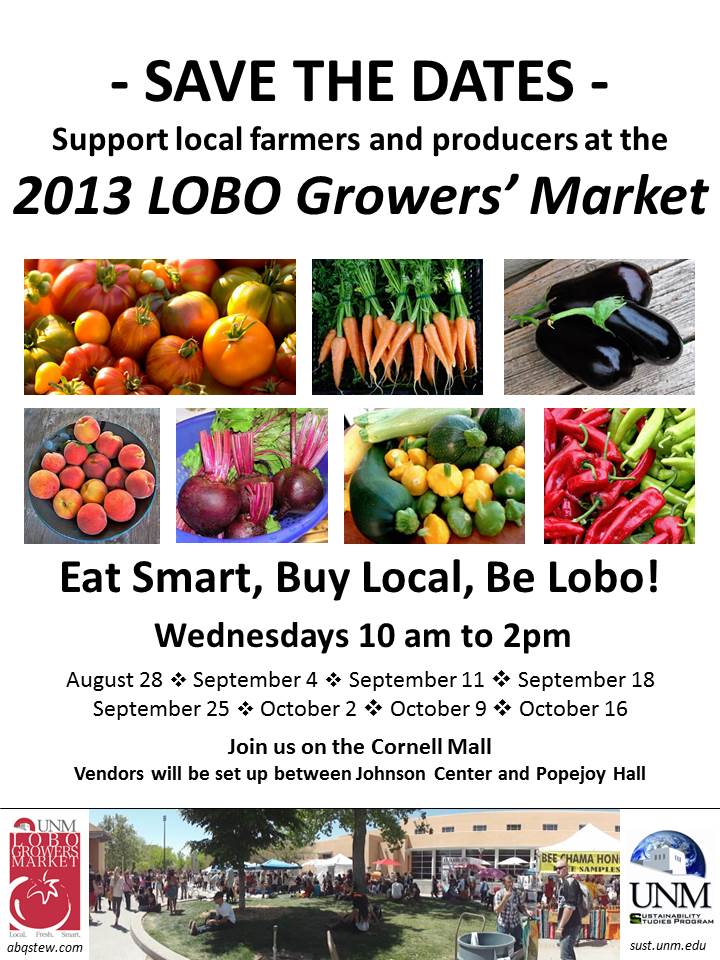
The Lobo Growers’ Market is returning to UNM main campus this fall! Starting the second week of the semester, the Sustainability Studies Program will be hosting a series of six weekly growers’ markets on the Cornell Mall. Come on by and support your local, sustainable growers and producers.

The market will be held on Wednesdays from 10am to 2pm, and will run from August 28 through October 2. There will be about ten vendors set up in the grassy, shady area between Johnson Center and the bronze statues just south of the SUB.

Markets will be held on:
August 28
September 4
September 11
September 18
September 25
October 2

At the Lobo Growers’ Market you’ll find fresh produce, locally-made value-added products, and prepared foods. Offerings will vary from week to week, but may include tomatoes, corn, melons, apples, potatoes, onions, summer squash, beets, carrots, herbs, chard, garlic, honey, salsas, aguas frescas, breads and pastries, and handcrafted soaps and bodycare products.

See you there!


Posted in Uncategorized | Leave a comment

Save the Dates

SavetheDates2013

Posted in Uncategorized | Leave a comment

We’re Hiring a Market Manager!

The Sustainability Studies Program is thrilled to announce that the fall series of Lobo Growers’ Markets will again take place this coming semester.

We are hiring a student market manager to plan and run the weekly event, and will be accepting applications from now until mid-August. The position is for 10 hrs/week for the first 8 weeks of the fall semester. See more details on the online job posting.

The Lobo Growers’ Market was originally developed as a UNM student project and was held for the first time in the Fall of 2007. Students brought numerous growers and value-added producers on campus to promote local farming and small business – and ultimately, to educate campus members about sustainable agriculture and healthy food choices. The market has subsequently been held more than 15 times. We offer one Earth Day-inspired growers’ market event in the spring semester, and six markets in the fall when local produce is at its best.

Join us on Cornell Mall every Wednesday from 10am to 2pm, starting August 28th through October 2nd. EAT SMART, BUY LOCAL, BE LOBO!

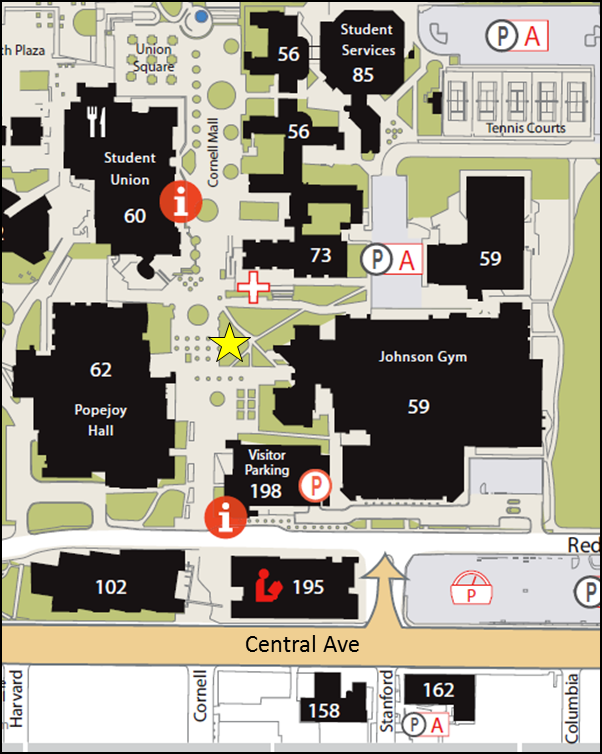
The yellow star shows the market location. Join us Wednesdays from 10am-2pm on the Cornell Mall, in the grassy triangle between Johnson Center and the bronze statues.

The yellow star shows the market location. Join us Wednesdays from 10am-2pm on the Cornell Mall. There will be ten vendors in the grassy triangle just west of Johnson Gym.

Posted in Uncategorized | 1 Comment

2013 Expo & Growers’ Market

Thanks to all who contributed to the success of the 5th Annual Sustainability Expo & Lobo Growers’ Market! Over 70 vendors and thousands of customers enjoyed a gorgeous spring day on Cornell Mall on the day after Earth Day.

UNM Parking & Transportation Services, the Office of Sustainability, and Sustainability Studies Program Growers’ Market Practicum students deserve special recognition for their efforts. And, with the help of Knowaste, we were able to effectively make the expo a no-waste event.

This slideshow requires JavaScript.

Some of the many wonderful vendors that participated in our event:
Albuquerque Growers’ Market Alliance
Albuquerque Old School
Bernalillo County Open Space
Bike-in Coffee at Old Town Farm
Cecilia’s Biscochitos
Chartwells
Cycles of Life
Delicious New Mexico
Earth Gift Herbals
East Mountain Organics
East Central Ministries Growing Awareness Farm
Edible Santa Fe
Erda Gardens
Feed the Hood Farms
Food and Water Watch
Granja Para Mañana
Knowaste
La Montanita Food Co-op
Land of Enfigment
Le Paris Bakery
Luque Meat Sauce
Mid-Region Council of Governments Agriculture Collaborative
Roadrunner Food Bank
Santa Fe Honey
Shabeta’s Healing Garden
Sol Harvest Farm
South Valley Soaps
Southwest Organizing Project
Tio Frank’s Chile Sauce
Train Naturals
UNM Lobo Gardens
UNM Lobo SEEDs
UNM Fair Trade Initiative
Urban Orchards
Ye Ole Kitchen Witch
Quetzelcoatl Food Truck (CODECE)

Join us next year for the 6th Annual Sustainability Expo & Lobo Growers’ Market on April 22, 2014. In the meantime, the Sustainability Studies Program is aiming to hold another series of six weekly Lobo Growers’ Markets in the Fall 2013 semester. During August and September, local produce will be at its best and most abundant! Stay tuned for more info…

– Posted by Jessica

Posted in Uncategorized | Leave a comment

Back to Basics

Bread has been a staple of the human diet for thousands of years. Traces of leavened bread have been found that date all the way back to 4000 BCE in Egypt and it can be found, in one form or another, in almost every culture in the world. It is amazing to consider how such a simple and humble food, composed of only three or four ingredients, has transcended the boundaries of class, religion and culture. It is a food that has been consumed with equal vigor by both the rich and the poor, and in many religions it fulfills special ceremonial roles; think of the Eucharist in Christianity or the Challah from Judaism.

Here in New Mexico the bread made by the Pueblo Indians has traditionally been baked in a clay oven called an horno. These ovens were brought to the pueblos by the Spanish conquistadors who introduced wheat to the Native Americans and taught them how to bake in ovens instead of on stones heated in a fire. In fourth grade my class built our own horno and used it to bake bread. Ever since then I have wanted to build my own wood-fired oven.

When I first started this blog I had grand plans to build myself a huge masonry oven, one that was big enough for twelve loaves of bread or a whole pig, but, as a little research soon showed, I had severely underestimated how much time and effort such an undertaking would require. Though I still have plans to construct my grand oven, for now I have contented myself with a smaller, more basic version that can be built in a few weekends.

  1. Build a stand
    1. This slab has a base that is 4 feet 8 inches by 5 feet.

    Picture 1

  2. Insulating slab
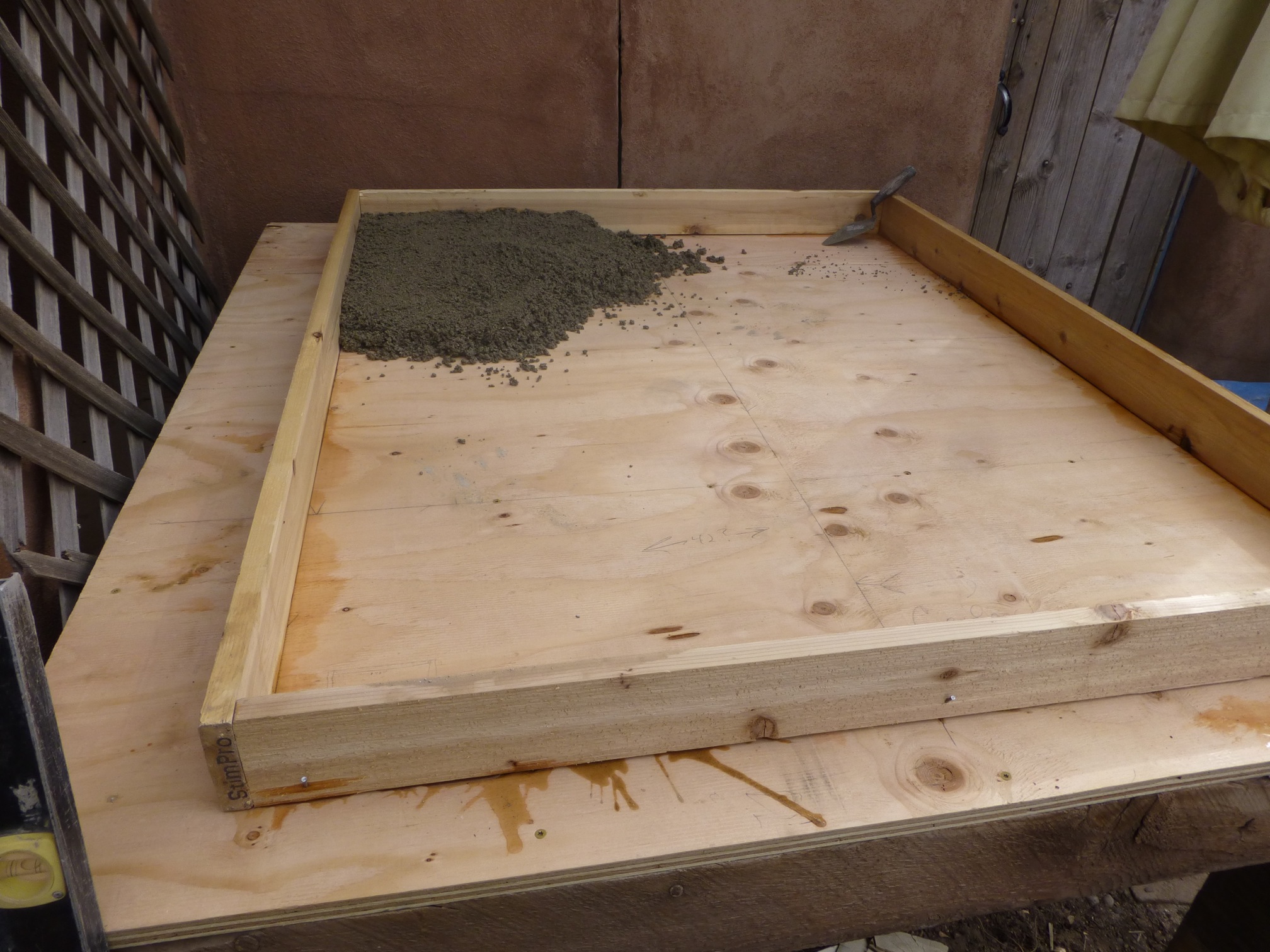
    1. Construct a wooden frame to hold the slab.
      Picture 2
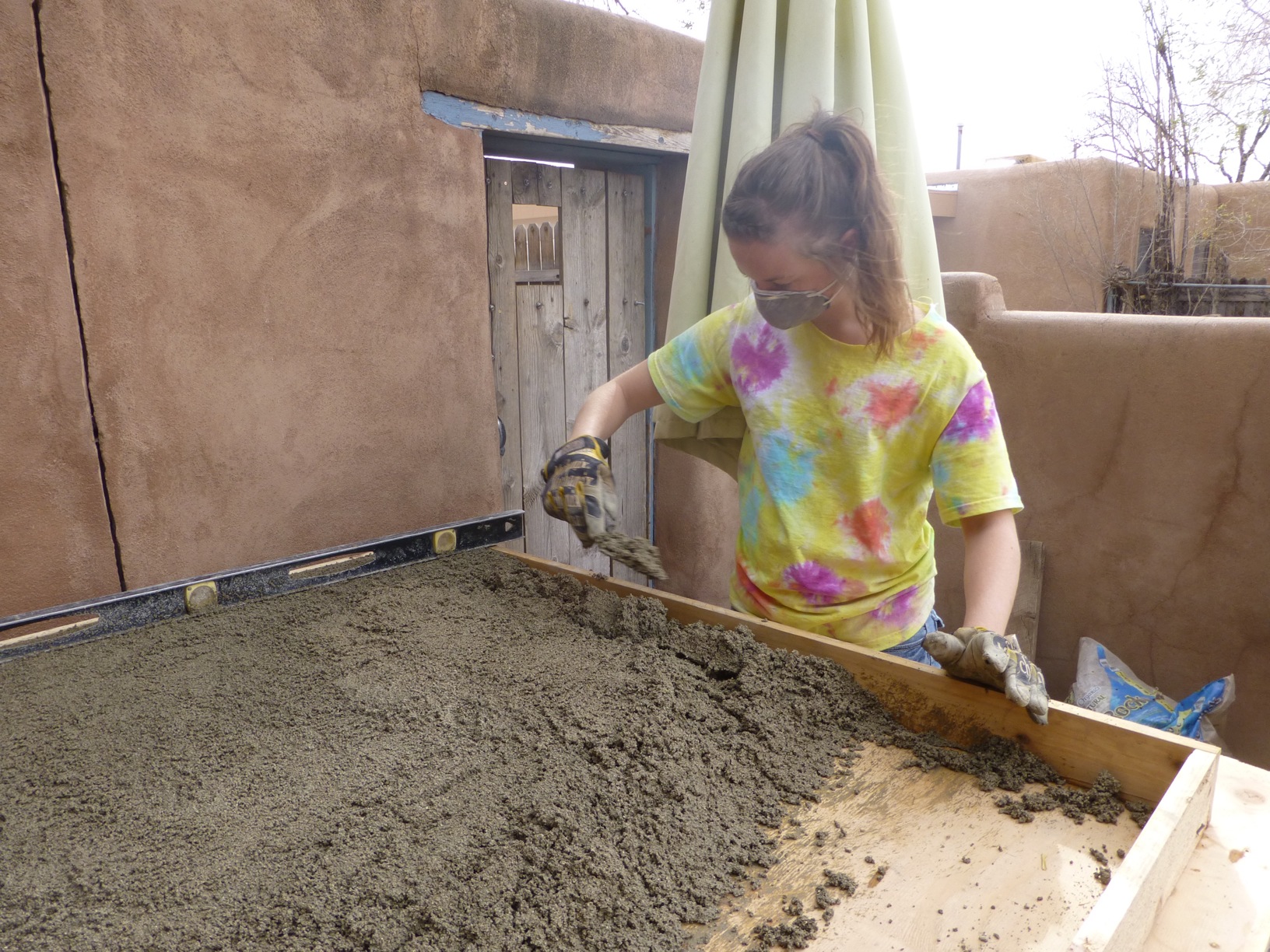
    2. Mix together 6 parts vermiculite with 1 part Portland cement and then add enough water to make it the consistency of wet oatmeal.
      Picture 3
    3. Pour the concrete into the frame, making sure that the top is level. This must now sit for about a week to allow the cement to harden and dry.

    Picture 4

  3. Laying the Hearth
    1. On top of the concrete slab place a piece of cement board that has been cut to the size of the slab.
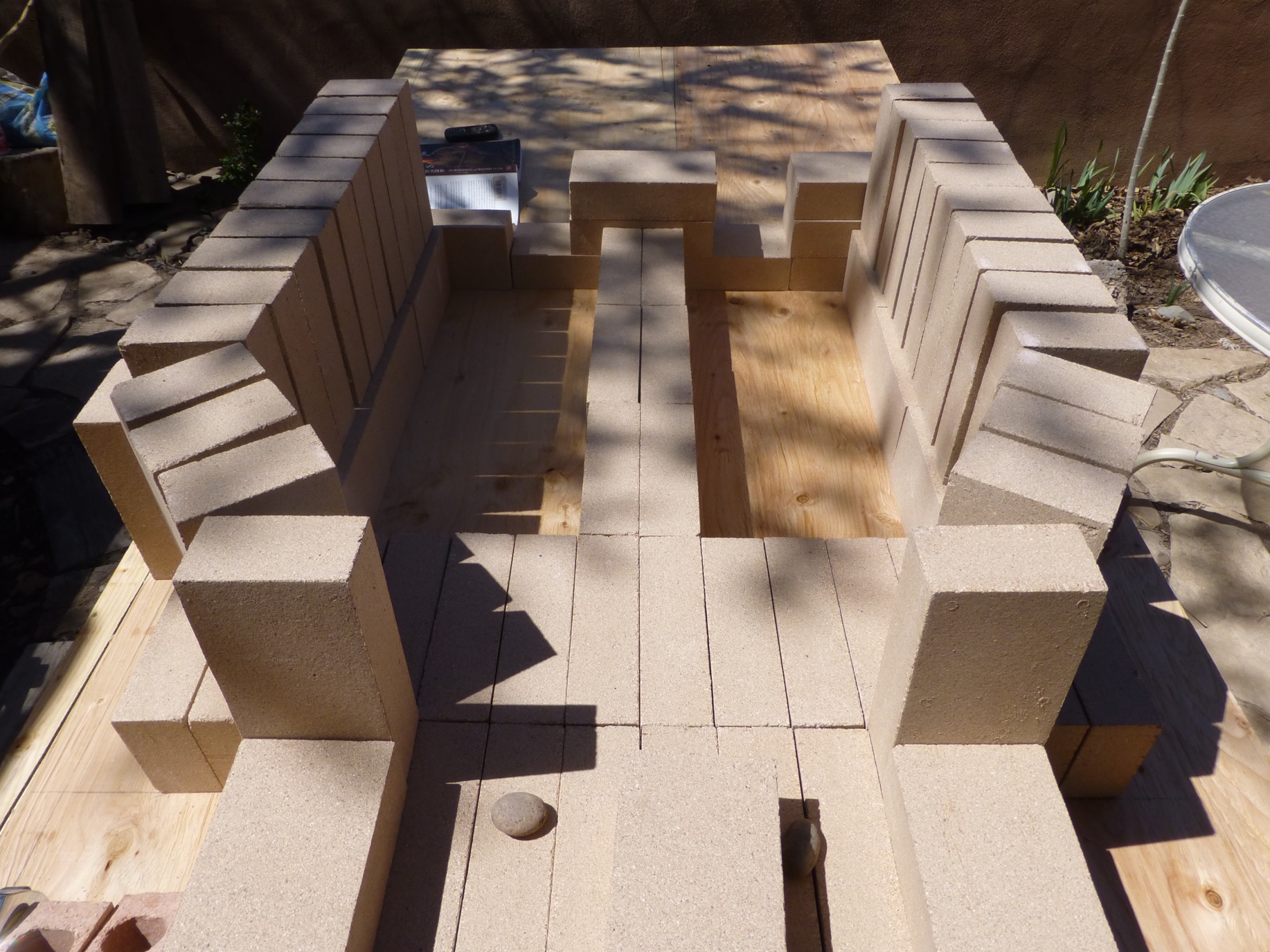
    2. Before placing the firebricks on the slab lay them out on a flat surface so you can get a feel for how your oven will look.
      Picture 5 i.   The firebricks, along with the fire clay and masonry sand can be bought at Kinney Brick Co. They have their own kiln where they make many of their bricks and they even recycle old bricks and use them to make new ones!
    1. Mix together equal parts fire clay and masonry sand and add enough water to make a paste.
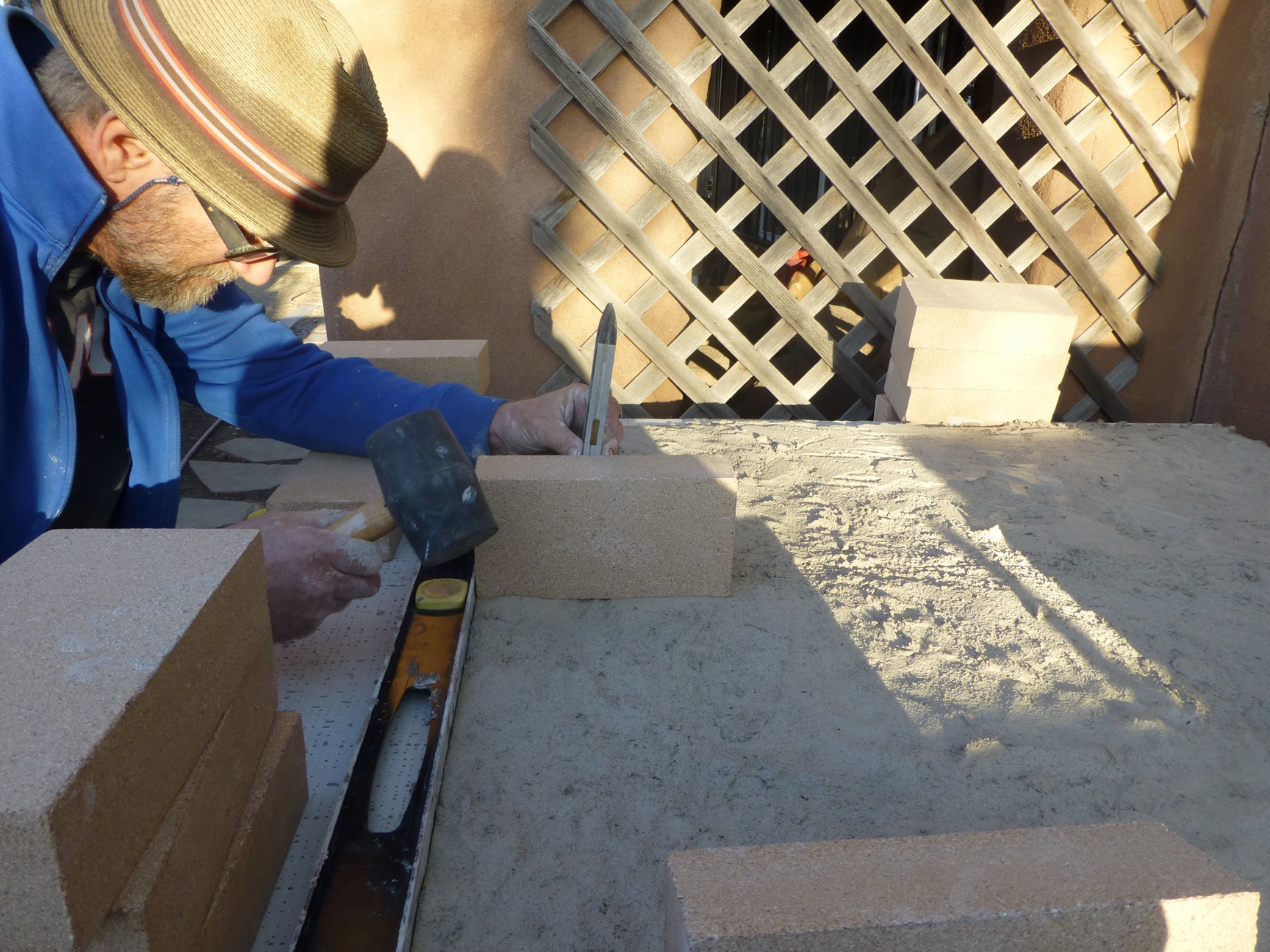
    2. Spread the paste in a ¼ inch thick layer over the cement board. Mark a line down the center as a guide for laying your first bricks.
      Picture 6
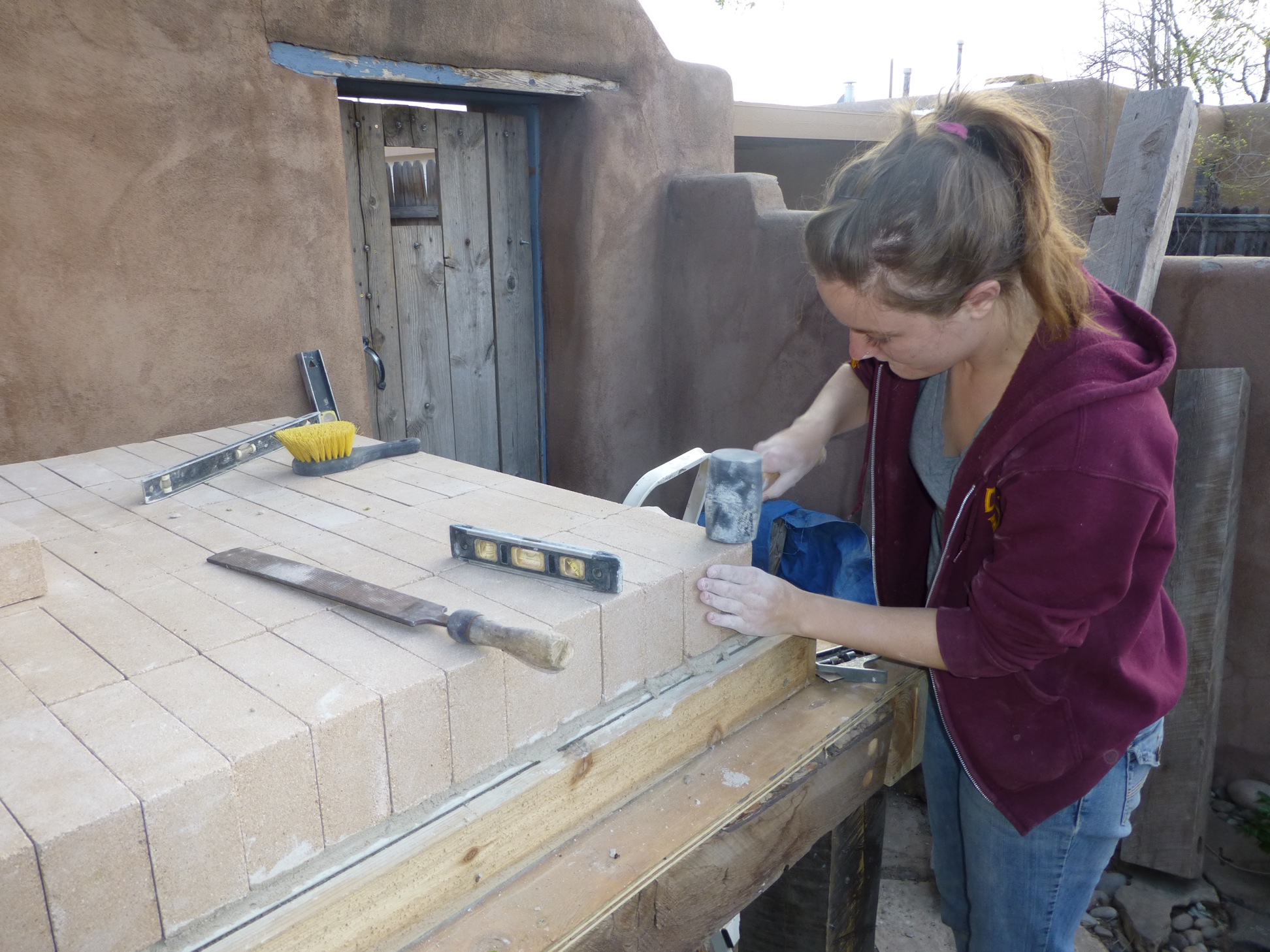
    3. Begin laying the center bricks first, one on either side of the line, then continue with the rest of the bricks. Make sure to check that all bricks are level.
      Picture 7
  • 4. Building the walls
    • A. Lay the back wall first
      i.      Make a mortar out of 10 parts masonry sand, 3 parts Portland cement and 1 ½ parts fire clay with enough water to make it workable.
      Picture 8
      ii.     Construct the wall in a pyramid shape to conform to the domed shape of the oven roof.
      Picture 9
    1. Now lay the side walls

      This slideshow requires JavaScript.


      i.      Use the same mortar mix as for the back wall.
  1. Build the arches
    1. Trace an outline of your arch on a piece of plywood and use this to create a form for building your arches.
    2. Start with the back arch and build them one at a time, still using the same mortar.

      This slideshow requires JavaScript.

  2. The Doorway
    1. It is very important that the height of the door be 63% of the height of the oven to allow for proper circulation of heat.
    2. A chimney set into the doorway will help to draw the smoke out and circulate the heat even better.
  3. The oven is now complete but must sit for a week or two to allow the mortar to set.
    Picture 21

If you are interested in building your own oven or just want to learn how to bake some really great bread here are a few book worth looking at:

The Bread Builders: Hearth Loaves and Masonry Ovens by Daniel Wing and Alan Scott

Build Your Own Earth Oven by Kiko Denzer

Tartine Bread by Chad Robertson and Eric Wolfinger

Bread Earth and Fire by Stuart Silverstein

-Posted by Lydia

Posted in Uncategorized | 1 Comment

Big Beer and a Little Brew

Chances are you’ve heard of an ecological footprint, a tool that quantifies energy consumption and waste production in terms of land area. But have you ever heard of a “beer footprint”? The idea is the same except that instead of assessing an individual’s impact on the planet, it is beer that is put under the microscope. Like nearly every other product at the grocery store, beer has undergone an extensive manufacturing process and has traveled great distances to make it from barley to brew kettle and then to the consumer’s belly.

It was my goal to examine this process and to determine the environmental effects of one of my favorite brewing companies, New Belgium Brewery, located in Fort Collins, Colorado (If you haven’t tried Fat Tire, I recommend you hop on your bike and go grab a pint ASAP). Not only was I curious about the footprint of New Belgium, I wanted to see how brewing my own beer would compare in terms of sustainability. Would I be reducing the environmental strain by producing the product myself or did the scale and sustainable mindfulness of New Belgium make them the more environmentally friendly choice?

Because there is no calculator or established quantifier (in truth there was no such thing as a “beer footprint” until this blog) to determine a beer’s environmental impact, I had to devise my own set of criteria to judge the brews. Pulling from the ecological footprint I came up with a series of categories to assess both the New Belgium beers and my home brew: water usage, transportation distance, and waste produced.

The results of my investigation were not what I had expected. I had been anticipating and hoping that by brewing my own beer I would be saving the planet some harm. What I found led me to believe that conscious, committed companies of scale have the potential to provide consumers with a more environmentally friendly product.

Water Usage
Beer is essentially water with a little hops, yeast, malt, and an alcoholic kick. Water is the main ingredient of the finished product as well as the backbone of the brewing process. Unfortunately, I found that that this process is very water intensive regardless of whether you brew your own or buy a commercial beer.

New Belgium
As of 2011, New Belgium Brewery reported that it took 4.22 glasses of water to produce 1 glass of beer. In reality, this is very efficient, at least compared to my operation.

Homebrew
I regret to say that my home-brewing adventure gulped down the gallons. While I can only come up with a rough estimate, I’d say that the ratio for water usage to beer produced would be more around 8 to 1. This regrettably large amount of water was attributed to a variety of factors including: soaking recycled beer bottles to remove their labels, sanitizing equipment, washing bottles in the dishwasher, and the water as an ingredient of the beer.

New Belgium – 1                             Homebrew – 0

This slideshow requires JavaScript.

Transportation Distance
The calculation of distance is somewhat subjective. For example, buying an imported beer obviously means that the distance traveled will be much greater then a domestically produced one. Conversely, if you can find a more local ingredient supplier you can reduce travel miles for your homebrew.

It was very difficult to come up with an accurate comparison. Fort Collins, Colorado is located 510 miles from Albuquerque but that number doesn’t take into account where New Belgium sources all of their ingredients, equipment, etc. As for my home brew, the equipment was purchased from an online retailer who shipped from Minneapolis, MN, a distance of 1,223 miles from Albuquerque – but, this was a one-time purchase and I can theoretically brew unlimited batches from this setup. My ingredients were purchased at a local store but they were surely sourced from other parts of the country. While both styles of beer production require ingredients from various suppliers, I give New Belgium a slight edge in beer miles traveled because of their commitment to sourcing as locally as possible.

New Belgium – 2                             Homebrew – 0

Waste Produced

New Belgium
During 2011, New Belgium claims to have diverted 94.38% of their waste from the landfill. This waste includes the manufacturing byproducts but does not take into account the potential waste of packaging from bottles, cans, boxes, etc.

Homebrew
I am proud to proclaim that my operation produced no material waste! The bottles I used were recycled from friends and from the local recycling center, and there was no use of boxes or containers. Additionally, the leftover brewing “sludge” (from the yeast and hops) was added to my compost, creating a closed system in terms of waste.

New Belgium – 2                             Homebrew – 1

This slideshow requires JavaScript.

Conclusion
I was somewhat naïve in thinking that brewing my own beer would be better for the planet. While there are trade-offs to both forms of production, it appears as though a larger scale, environmentally conscious company better succeeds at producing a smaller “beer footprint.” If a company, such as New Belgium Brewing, embraces the goal of sustainability, their size and efficiency means that they can provide a product with a minimal footprint.

That being said, brewing my own beer—or for that matter making any good yourself—has many wonderful and less quantitative benefits and advantages over buying commercial products. There is more intimacy, feelings of accomplishment, self-education, community building and fun to be had in getting your hands dirty and turning something into nothing—hops, yeast, malt and water into delicious homebrew.

-Posted by Spencer

Posted in Uncategorized | Leave a comment

Biodynamics in New Mexico

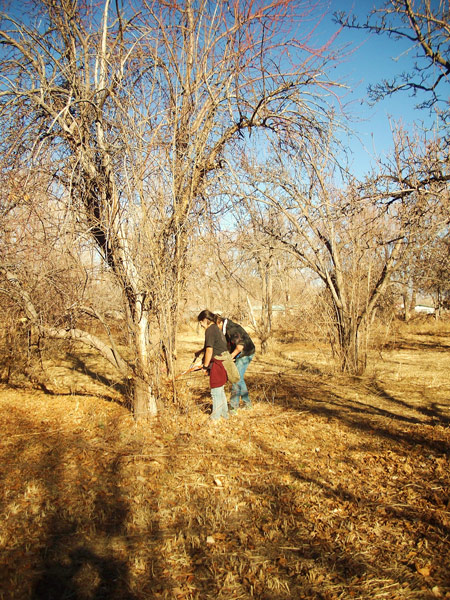
After what is quite possibly the longest city bus ride of my life and a short walk later, I am in front of the little yellow house with the big tree and the chain-link gate. It’s a cool but sunny day, and storms mill around the edges of the Rio Grande valley like cattle. Though I’m still in the city, the neighborhood feels like a rural village with its big yards full of old cottonwoods and acequia canals. The fences and stables and mailboxes have all seen several decades since they were new, but the area feels quietly alive. I’m here to meet with Amanda Rich of Erda Gardens and to join in whatever is happening in the orchard they take care of. I see some people working in the orchard behind the yellow house, and I step through the gate to go meet them.

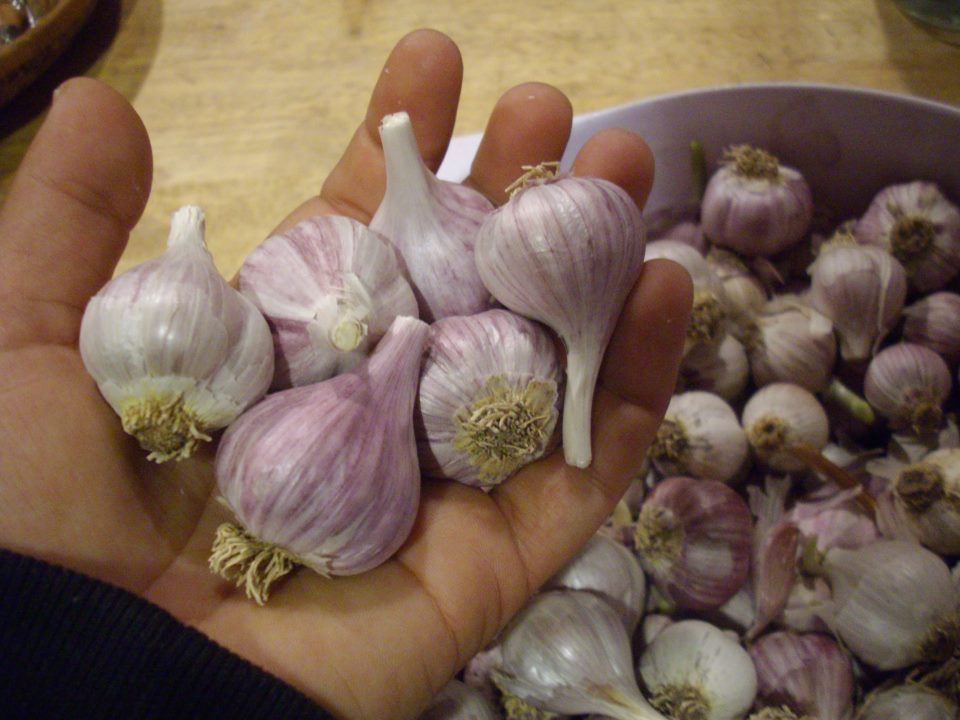
I first met Amanda planting garlic on a field trip last fall

I first met Amanda planting garlic on a field trip last fall

I first met Amanda on a field trip to Erda Gardens’ other location with my Intro to Sustainability class last fall. We helped plant garlic and learned a little about biodynamics, the holistic agricultural methods that the farm uses. The warm, delicious scent of garlic of clung to me for the rest of the day, but my fascination with biodynamics just wouldn’t wash out, and this fascination is why I’m back at Erda to investigate biodynamic agriculture.

Biodynamics is a set of theories and methods of farming that were put forth in series of eight lectures by Rudolph Steiner in Poland in 1924. Steiner’s lectures were considered the first on modern organic agriculture, but of course, farming without chemicals has been practiced all over the world since the beginning of civilization. As someone who believes that learning from traditional indigenous practices is imperative for the global sustainability movement, I wanted to learn more about biodynamics and its relationship to indigenous practices, as well as how it’s being used here in New Mexico today.

Erda’s Orchard

Erda’s Orchard

After meeting up with Amanda and getting a quick tour of the orchard, she invited me to shovel manure with her. I jumped at the chance to get my hands dirty, and we began our informal interview.

The first thing I asked Amanda over the pile of horse manure was: What is biodynamics? Even with a basic understanding of the topic, it still seemed vague to me. Amanda told me that biodynamic agriculture is quite a large field of study, and even people who have read all of Steiner’s lectures and studied it for a lifetime still don’t know everything about it. It’s so complex partly because of how experimental it is – Steiner himself urged people to test and experiment with his methods – and because it is a holistic approach that by definition has a great number of manifestations. But she was able to explain the core concepts of biodynamic farming, which really put it into perspective for me. Biodynamics can be broken down to three basic aspects:

1.1.      Holism. Agriculture is seen as a part of a larger ecological organism, and all inputs and outputs are considered. For example, the horse manure we were shoveling came from a house across the street from the orchard. Even though it wasn’t from the Erda property itself, they chose to source it as locally as possible.

1.2.      Preparations. Every year, biodynamic farmers use liquid preparations in homeopathic (very small, but potent) quantities on their fields. Amanda described this aspect of biodynamics as “homeopathy for the land.” Preparations are fermented concoctions made from compost, herbs, and minerals, and introduce phytonutrients, enrich the diversity of the microorganisms in the soil, and engage with the influences of cosmic patterns and energy.

1.3.      Calendar. Practitioners of biodynamics follow an astrological calendar that recommends the best days to plant, harvest, etc.

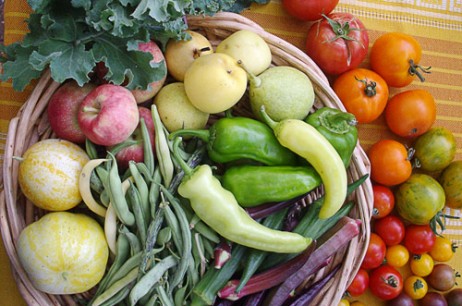
New Mexico veggies

New Mexico veggies

It’s clear that biodynamics is an attempt to relearn much older farming techniques – like many indigenous cultures across the world, biodynamic practice has a strong spiritual aspect, and a commitment to holism and sustainability. Though some of these aspects have been criticized as pseudoscience, there is a worldwide precedent for the effectiveness of this kind of farming. Indigenous agricultural techniques successfully utilized related practices for thousands of years before the rise of industrial farming. At their core, agricultural approaches like biodynamics are ways of seeing farming as a part of a larger ecosystem. Regardless of the diverse methods that they employ, they are effective because of their commitment to holism and sustainability, a commitment that is becoming more and more relevant all over the world as we continue to understand our environment and how we impact it.

There are several ways you can get involved with biodynamics in New Mexico. If you’re interested in learning more, I recommend 12 Ways to Learn More About Biodynamics. Then head over to Erda Gardens’ website, where you can learn more about their CSA, Farm Camp, volunteering, their work trade program, and scheduling a visit to their beautiful locations.

-Posted by Ian

Posted in Uncategorized | Leave a comment

A Day in the Life of Lizette, the Dairy Goat

Well, hi there!  I bet you weren’t expecting to see me here, but no worries, if you hear me out, I promise I won’t disappoint.

Lizette - South Mountain Dairy. Photo by Stacy Boyne

Lizette – South Mountain Dairy. Photo by Stacy Boyne

My name is Lizette, and I am a Sable Saanen dairy goat at South Mountain Dairy, just a short drive (I hear that’s how humans get around) away from the greater Albuquerque area.  I’m the head honcho over at the farm, but rightfully so.  Sable Saanens are known to be hardworking, well-mannered, strong, and easy on the eyes.  I’ve been around for a while now, but everyone tells me age is just a number.  A lady never reveals her true age, so I will leave that up to you to speculate.  My wonderful owners, Marge and Donna call me the herd queen.  As the herd queen, I call the shots around here.  It sure is a lot of work, but I am rewarded with a primo sleeping spot and first dibs during milking time.  I guess you could say that I’m kind of a big deal, at least out here in Edgewood.

Here at South Mountain Dairy, we are preparing to embark on another year of production.  Around this time of year, things really start to pick up around the farm.  Marge and Donna, joint owners of South Mountain Dairy, are wonderful caretakers and help us girls get back in the swing of things after these long, cold Edgewood winters.  When Marge and Donna aren’t busy milking or creating delectable dairy products, they are out showing people around the farm.  Beginning in April, Marge and Donna offer tours of our home.

Gosh, I can be such a rambler sometimes.  Luckily, I’ve been keeping a journal these last few years—mentally, of course, because, well, I don’t have thumbs, making writing out of the question. I have elected to share with you my account of the summer months—the time of the year when I am kept busiest.

Journal Entry #1:
July 3rd 2012
Tuesday

I think I’m finally getting used to this whole 5 a.m. thing.  Personally, I’m a night owl, and the girls and I love to stay up late and gossip about the wethers (male goats).  

While the other girls are still shaking the early morning from their eyes, I’m standing by the gate waiting. What exactly I am waiting for is yet to be determined.  Zorro, one of the guard llamas here on the farm, won’t stop staring at me.  I’ve been meaning to ask him what the fuss is about.  The other girls are still down at the cabanas, but I have staked out a prime spot at the front by the gate.

Ah, milking season is in full swing, and the girls and I are feeling the heat (literally).  Now I know why Marge and Donna get us up at the crack of dawn—to get the milking done before we all turn into ice cream. Milking is hard work, and I’ve sure worked up an appetite… I can’t wait to get to the feeder this morning. Eight of us file in to the milk room, where we wait our turn to be milked.  There’s room for four at the milkstand, but as herd queen, I usually get to go in the first group. When I do have to wait, I don’t really mind… it gives me time to think.
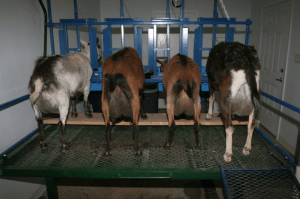
The milking machine. Photo by South Mountain Dairy

The milking machine. Photo by South Mountain Dairy

When we’re in the milkstand, we get to chow down on a hearty blend of sunflower seeds, grain, flax, and calf manna. Calf manna is a dietary supplement that helps keep us girls in peak milking condition.  \As a sustainable farm, Marge and Donna make sure that our feed has nothing that would ultimately hurt you or me. Our food is antibiotic and growth hormone free.  I’m not sure what that means, but those words are difficult say, so they must be bad. Try saying ‘antibiotic’ ten times fast… it doesn’t quite roll off the tongue; I tried, but the other girls quickly became annoyed and told me to “put a sock in it.”  How rude.   

Whatever.

The milking machine. Photo by South Mountain Dairy

The milking machine. Photo by South Mountain Dairy

This morning I had a ravenous appetite, so I didn’t even notice when the milking machine was hooked up to my udders.  Because there are 79 of us milking girls, Marge and Donna prefer to use the machine.  I hear hand cramps are no fun.  I’m indifferent to this strange machine because it’s only on my udders for 10 minutes or so.  Any longer and I might start to become antsy.

Finally, after all of us girls are done milking, we get to go back out into the field.  I overheard some of the younger girls discussing what happens to our milk after milking.  Some of the scenarios they were concocting were absolutely ridiculous.  I don’t quite know how to tell them that goat milk does not possess magical healing powers.  Where do they come up with this stuff?  It does, however, provide you humans with a variety of yogurts, cheeses, and pasteurized milk.

————————————————–

Journal Entry #2:
July 4th 2012
Wednesday

Fun Fact: Did you know that South Mountain Dairy is the only local producer of pasteurized goat milk and yogurt?

Lately, I’ve been hearing the word “pasteurized” a lot.  My good friend Kathy told me that Marge and Donna use something called “Low Batch Pasteurization.”  Apparently, this keeps our milk flavorful.  I once witnessed Donna filtering my milk into an 80 gallon cooling tank.  The tank is stainless steel because it is easy to wash and disinfect.  The milk has to chill as soon as possible so that bad bacteria doesn’t spoil it.  After the milk has had a chance to cool, it goes through pasteurization, ultimately creating edible products.  Rumor has it, the milk is pasteurized in a huge 50 gallon vat. Kathy seems pretty sure that this is true, and I guess it is reasonable considering 65- 80 gallons of milk is processed on the farm daily.  I hate when Kathy’s right.    

————————————————–

There you have it folks.  The untold stories of a dairy goat have been unraveled before your eyes. Of course, there’s a lot more hard work that goes into running the farm than I have described. Marge and Donna really do mean it when they say “It’s all about the girls!”

South Mountain Dairy cheeses, milk, and yogurt can be purchased locally at the Santa Fe, Corrales, and Los Ranchos Farmers’ Markets, as well as the La Montañita Co-ops in Santa Fe, Rio Grande, and Nob Hill.

For more information about South Mountain Dairy, feel free to check out our website.

Additional Resources can be found by visiting the American Dairy Goat Association’s website.

-Posted by Caitlin

Posted in Uncategorized | Leave a comment

Ready, Set, Brew

Brewing beer has become a lost art with the rise of massive, international breweries whose products are shipped and readily available at any part of the globe. For a true beer lover, why not ditch the mass-produced and mediocre brews of these huge corporations and concoct your very own, unique blend in your very own properly sanitized kitchen? That’s exactly what my roommate and I have set out to do, to try our hand at the simple and creative combination of water, yeast, malt, and hops, all while doing it in the most environmentally and economically conscious way possible. College student or not, you can still harness your ingenuity and conduct your brew process in a sustainable way as you acquire your equipment and prepare to brew.

The most essential things we needed were:
-6 gallon stainless steel stock pot
-an excessively large stainless steel spoon
-thermometer
-2 five gallon food grade plastic buckets (one fitted with a spigot)
airlock
hydrometer
siphon hose (simple plastic tubing)
-bottle filler
-50 brown glass 12oz bottles, and caps
-sanitizer

Most likely you can find some of these things already around your kitchen, or in someone’s kitchen you can steal from. But if for whatever reason you don’t have a hydrometer lying around, you will have to get equipment from somewhere else. The most essential bits of equipment we needed to start our first batch were bought online as a complete kit, costing $119.29 from Midwest Supplies, shipping out of Minneapolis, Minnesota, 1,222 miles away from us in Albuquerque. It wouldn’t have been difficult to have pieced our equipment together from more local sources. Southwest Grape and Grain, on Eubank and Candelaria, is a great, local brew store full to the brim with any equipment you will ever need to brew on your own. The staff are all friendly and extremely knowledgeable, able to answer any question that is sure to arise while giving your first home brew a shot. They also sell starter kits at comparable prices to what we found online.

This slideshow requires JavaScript.

Brown glass beer bottles are definitely not something you need to invest in. They are probably everywhere you look, abundant in every college student’s house, just waiting to be recycled. Ask all your beer-drinking buddies if they wouldn’t mind saving their bottles for you, and let them know you will happily take them off their hands. Most people jump at the idea of getting their recycling hauled away for them, and if they need a little encouragement, you have 5 gallons of beer in the making that you can barter with. Use it wisely.

If after ransacking your friends recycling bins you are still short, you can do what we did and go to a recycling drop-off center and rummage around for what you need. Be aware that twist off bottles won’t work. The grooves on the mouth of the bottle won’t allow your caps to seal airtight, so make sure you only scrounge for the pop tops.

Our next step was to sanitize and get all the labels off of our bounty. Sanitation is key during every step of the brewing process, but because we collected these bottles from recycling bins, we wanted to be extra thorough. We filled our bathtub with warm water and soap, enough to submerge most of them, and let the scrubbing begin. Some labels come off without much fuss, and some can be more difficult. We found copper wool to work well on the tough ones. After 50 bottles had been scrubbed of their labels, they were ready to go to the dishwasher, for good and sanitary measure.

These repurposed bottles were filled with our first attempt at home brewing, which turned out much better than anyone had expected. In a month and a half, we had created something that looked like beer, tasted like beer, and acted like beer, all without venturing too far away from our own kitchen. We invited friends to share in our successful first try and hosted a “beer-tasting party.” Good food and drink have an unparalleled way of bringing people together, and providing people with something you’ve made yourself makes the process as well as the end product all the more special. Cheers!

-Posted by Takeo

Posted in Uncategorized | Leave a comment

Your Neighborhood Herb Store

Herbalism is the medicinal use of herbs and plants. It concentrates on how wellness is deeply connected to diet and lifestyle. Herbs can help the body in almost every way and during most illnesses. It is a simple method of healing that is most kind to our bodies. Herbalism can be studied independently as well. The science and art of herbalism has been passed down for generations. It is a method of healing that can empower people to become aware of their bodies’ symptoms and choose herbs based on their acquired knowledge. Most herbs are pretty safe and will have positive and preventative effects long term.

Albuquerque has many herbs that can be grown at home or found nearby. Some examples are chamomile, peppermint, sage, basil, rosemary, ginger root, and dandelion roots and leaves. Chamomile is very good for an upset stomach and soothes indigestion. Peppermint is good for headaches, digestion, and gas. Sage is best for colds, coughs, and congestion. You can learn additional herbal properties and kitchen remedies in this free Healing Herbs eBook, or look for “Grow Your Own Drugs,” by James Wong.

For those who want to make their own tinctures and salves or learn more about herbs, oils, and acupuncture, you can visit the Herb Store in Nob Hill for its many resources. Cristy, the owner of the store let me interview her. Cristy became interested in alternative medicine at a young age. She understands conventional medicine is important at certain times, but completely prefers alternative medicines.

One summer her family was on a boat and her father fell into the water, got trapped under the boat, and his leg got caught in the propellers. It was a traumatic experience for everyone. The doctors said his leg would have to be amputated. His friend told him to try an acupuncturist first. Her father never believed in alternative medicine, but was willing to try anything. After one hour with the acupuncturist, the swelling on his leg had gone down by 50%. From then on her father has always resorted to natural alternative medicine or acupuncture. He still has his leg today.

After Cristy received an advanced certificate in herbal studies, she bought the Herb Store in Nob Hill and it became her new classroom. It has been in business since 1976. By opening the Herb Store, her community has grown immensely. She is now in touch with farmers in New Mexico and in various other states, as well as the Nob Hill community, and nearby neighborhoods.

This slideshow requires JavaScript.

Cristy’s goal is to provide customers with knowledge of what they are buying and how they can discern for themselves what is beneficial. She sees a huge importance for herbs grown organically.

Cristy does her best to supply her store with local and organic herbs, but must also reach out to suppliers from all over the world for a diverse stock. A neat service the herb store provides is custom formulated tinctures. The Herb Store sells a variety of essential oils; soaps; homeopathic remedies; Western, Chinese, and ayurvedic herbs; teas; containers; gift items; and many other products.

In Cristy’s message to students she says, “We are a community resource for alternative health and wellness.”  She quotes Hippocrates, “Let food by thy medicine,” and believes that “diet and lifestyle play a huge part in wellness.”

The Herb Store offers quarterly internships to students as well, for those who would like to learn more about how the business works.

At home Cristy grows comfrey, thyme, basil, chamomile, lemon verbena, and other herbs. Comfrey is good for broken bones, ulcers, and cell growth. Thyme is good to drink just as you feel you are getting sick, as it is an anti-inflammatory. She says local herbs are always best.

Cristy explains that growing herbs at home is wonderful, but is not always easy. Changing weather patterns, the dry climate, cloudy days and excessive wind can make growing difficult. Weather has changed so much over the years and all over the world that farmers have to grapple with their previous knowledge and try to keep crops alive in this new climate. She is worried for the future climate and believes that “sustainability is key. If we don’t follow that, we will run into crop failures.”

Grow your own herbs or buy them locally. Know where your herbs and food come from and be conscious of your choices. Herbs can help keep you healthy, reduce your use of conventional medicine, and heighten a sustainable life!

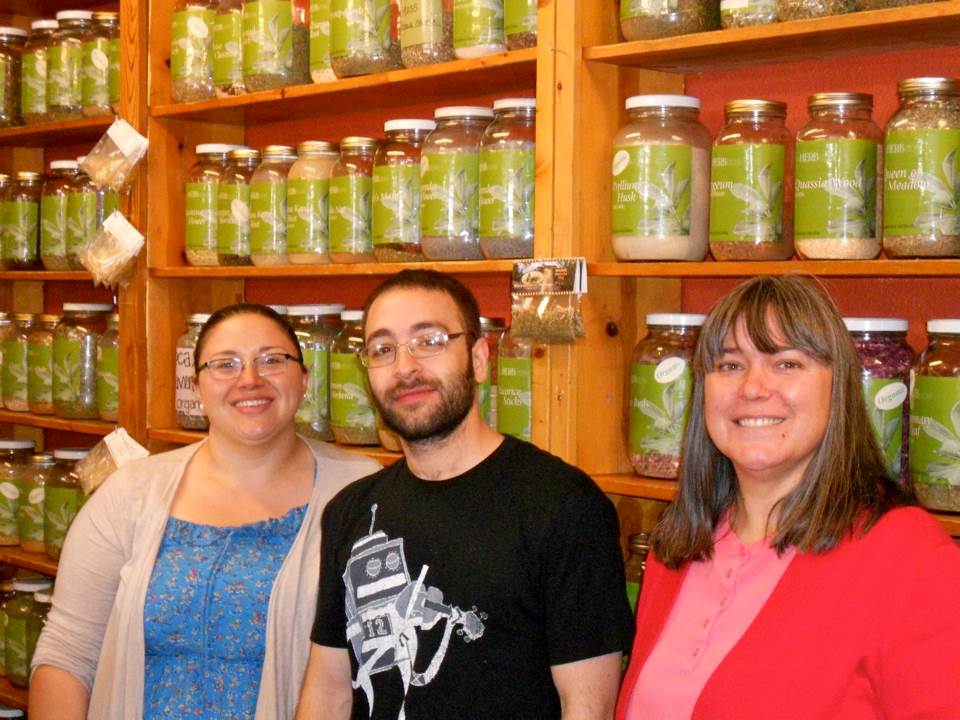
Jessica is the Manager, Jessie is an Employee and a student in Chinese Acupuncture, and Cristy is the Owner of the Herb Store

Jessica is the Manager, Jessie is an Employee and a student in Chinese Acupuncture, and Cristy is the Owner of the Herb Store

-Posted by Betsy

Posted in Uncategorized | Leave a comment