Pesticides, Produce and Children

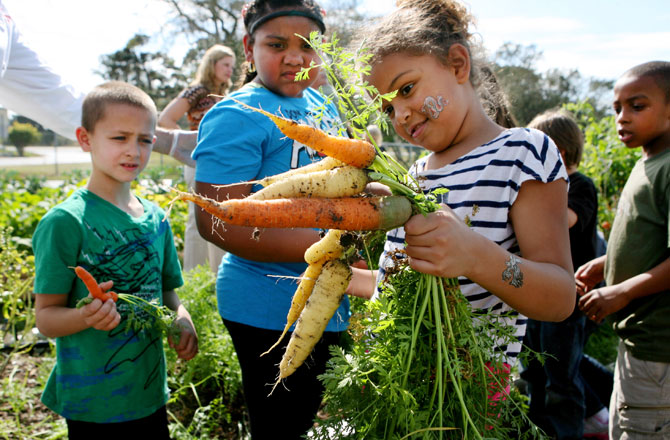
There is no denying that organic food has made a name for itself in the past decade. It has gained a lot of support for many good reasons and is changing the way that people eat for the better. Not all organic food is healthier than conventional food but for the most part organic is better, and for many reasons. One of the main reasons is due to its lack of chemical pesticides. Contrary to common belief, organic farmers do use pesticides. These pesticides are naturally-derived, unlike synthetic pesticides found in conventional produce – and typically pose very little threat. The Environmental Protection Agency (EPA) defines a pesticide as  “any substance or mixture of substances used to destroy, suppress or alter the life cycle of any pest.” I don’t know about you but words like destroy, suppress and alter make me feel nervous about my food.

A Consumer Reports Special Report on Pesticides in Produce indicates that their recent “survey of 1,050 people found that pesticides are a concern for 85 percent of Americans.” People are skeptical about the quality of what they eat and for good reason. The Environmental Working Group (EWG) has released a list of 12 conventionally-grown fruits and vegetables they call “The Dirty Dozen” all of which have been tested to have high levels of pesticide residue on them. Some of these products include apples, cucumbers, potatoes, celery, and spinach, all of which many people eat on a daily basis. The Dirty Dozen report indicates that 99% of apples, 98% of peaches, and 97% of nectarines all have at least one pesticide on them. Potatoes have more pesticides by weight than any other crop and some crop samples contained as many as 13 individual pesticides. With that knowledge at hand, an apple a day may not keep the doctor away.

Diseases that can be caused by pesticide ingestion include brain/central nervous system, lung, colon, and breast cancer, and Hodgkin’ and non-Hodgkin’s lymphoma and many more. Organic food is a great alternative to conventional, and if you have children it may be the safest choice for them. The nutritional content of conventional vs. organic produce is nearly identical according to many recent studies, but that is not the issue. The issue at hand is that children are especially susceptible to diseases caused by pesticides. Remaining as healthy as possible while growing up is the best way to ensure a proper and prepared immune system for adulthood. Adults don’t have such a high risk of contracting a disease because their immune systems are fully developed and pound for pound they do not ingest as much pesticides as do children.

Ingesting pesticides is something that no one should do, especially developing children. Pesticide exposure at very low levels can have long term affects meaning that even a “safe” level of pesticide residue can pose risk. Many kids do not clean their fruits and vegetables off with water before they eat them, leading to harmful pesticide ingestion from conventional produce their parents buy for them. As a matter of fact some of the most popular produce eaten by children is on the Dirty Dozen list, apples being number 1 and peaches a little further down.

A recent article by the EWG reported that a study conducted by “Cynthia Curl of the University of Washington published February 5, found that people who report they “often or always buy organic produce had significantly less organophosphate insecticides in their urine samples, even though they reported eating 70 percent more servings of fruits and vegetables per day than adults reporting they “rarely or never” purchase organic produce.” WOW, what an amazing study.

There is mounting evidence that organic food is clearly the healthier choice. Not only does organic food help out or environment by being sustainable but it helps us grow our future and that is healthy children. However it is important to remember that not all organic produce is pesticide free and that they can still pose health risks. Always thoroughly wash your produce.

-Posted by David

Posted in Uncategorized | Leave a comment

Permaculture Chickens

Permaculture

The basic concept behind a permaculture approach is finding a design solution to a multiple of problems.

Chickens themselves offer a variety of solutions to a variety of problems. Specifically, chickens act as lawn mowers for overgrown brush and weeds, bug eaters for invasive creatures, garbage disposals for food scraps and dead animals, fertilizers of the soil and compost tillers, egg layers for the breakfast table, and a hearty source of meat for the dinner table.

Print

“The Chicken Connection” by Abundant Permaculture illustrates the cycle of the chicken and how it works in tandem with its environment.

Chickens

The Challenge
The chicken serves to answer a whole host of challenges, however the one challenge that is furthest reaching and most relevant is egg production.

If you frequently purchase eggs at your nearest grocery store you may have noticed an increase or a fluctuation in egg prices. It is very plausible that this could be the result of the avian flu that impacted a great number of egg laying birds resulting in a shortage of eggs. Even some restaurants were affected by it!

Not only is the shortage of eggs a very real dilemma but the way they are being produced is also a very real issue. Many of the eggs purchased at the grocery store are products of inhumane treatment of chickens who live in cramped, dirty, and claustrophobic environments such as those highlighted in the documentary Food, Inc.

Additionally, free range* labeling leads us to think we are buying humanely raised chickens that can roam outdoors when in reality there is no regulation for minimum space per bird. The United States Department of Agriculture’s (USDA) definition of ‘access to the outdoors’ looks different from that of The Humane Farm Animal Care (HFAC). The HFAC states that in order for chickens to be considered “free range” and Certified Humane they must have at least 2 square feet when indoors and be outdoors for at least 6 hours a day as weather permits. This is much better than the USDA and industry standard of “free range” where the many chickens may have so much as a “pop hole” to the outdoors. (*Free range indicates that chickens are not confined to cages inside.)

The Solution
So how do we help alleviate this problem? Backyard chickens! By housing these backyard permaculture chickens we not only have access to delicious eggs, lawn mowers, and debuggers, we also get a new and unconventional family pet!

Raising Chickens

The General How To
You might be asking yourself what comes first when owning permaculture chickens…the chicken or the egg? Well, luckily this time there is an answer. It is the chicken!

In order to get started with your chickens Justin Rhodes offers a step by step how-to, answers to frequently asked questions, as well as a comprehensive list of basic materials needed at Getting Started with Chickens: the Ultimate Guide. To go over a few of the basic responsibilities for owning chickens we will look at housing, feeding, and harvesting.

Housing, Feeding, and Harvesting
Housing. There are several aesthetically and functionally diverse ways to design a chicken house. A few designs featured by Justin Rhodes of Abundant Permaculture have proven to be successful when raising chickens:

The A-frame is designed for mobility and has an exposed ground, it is also perfect for winter housing due to the covered roof. The Chicken Tractor is ideal for mobility with two wheels and wire mesh flooring to eradicate manure build up. Lastly, the Poultry Pen, like the A-frame, has an exposed bottom and is ideal for summer use due to the partially covered roof.

Feeding. This part of the puzzle does not have to be a constant high expense; in fact there are ways to make it relatively cheap and affordable…

  1. Ration your feed
  2. Soak your feed
  3. Feed grass – 20 percent of diet, free range
  4. Kitchen scraps – feed them everything
  5. Feed weeds and insects

Lastly, the benefits to us: Harvesting! In the morning you get to walk out the back door and snatch a few eggs for your morning breakfast. Once the chickens mature to about 5 months of age they are typically able to produce about 4 eggs a week. So with only 3 chickens that is a dozen eggs a week!

Where to get them
There are several different options to choose from when deciding where to purchase chicks. In Albuquerque we have online forums (such as here, here, and here) where the local community can post notifications of chickens for sale, as well as tips, tricks, or answers to any questions asked. You can also get chickens shipped to you through poultry supply websites.

Enjoy all of the benefits of your backyard chicken while having peace of mind that you are helping bring about a solution to a widespread problem.

-Posted by Rebekah

Posted in Uncategorized | Leave a comment

The Future of Sustainable Agriculture in Albuquerque

New Mexico’s local food production system is being cultivated through sustainability efforts in newly rewritten and revised planning documents. These multi-jurisdictional plans contain visions, goals, and policies surrounding sustainability of local health and agriculture systems, but will these efforts be enough to support future population growth, if executed to their fullest potential?

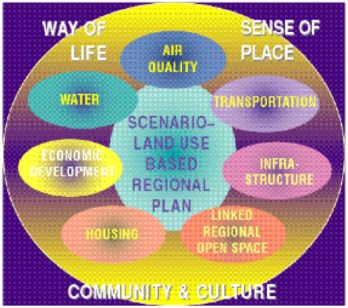
To begin, the Middle Region Council of Governments (MRCOG) encompasses the middle Rio Grande region including Bernalillo, Sandoval, Valencia, and Torrance counties, and focuses planning efforts for the future on a long-term regional scale. The Regional visioning process within the MRCOG Focus 2050 plan emphasizes preservation of agricultural, cultural, and historical areas, and emphasizes a regional focus based on inevitable future growth within the region. A federally mandated regional plan is necessary for all urban areas, and emphasizes key issues for the region based on a preferred land-use model:

These three different areas lead into a focus on issues of community health, agricultural preservation, and expansion of community open space. Focus 2050 regional plan outlines its decision power on who pays for open-space preservation and expansion, and provides a general framework to devise common goals for the future. Within the Focus 2050 plan, some smaller focus groups include the MRCOG Agriculture Collaborative, which outlines specific goals and operational strategies for regional conservation and preservation efforts.

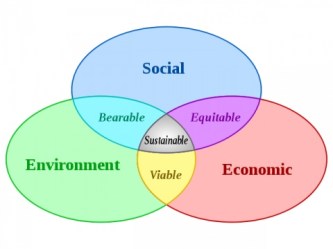
Image 2

The triple bottom line of sustainability. Credit: www.americanalertnews.com/sd3bl.png

Currently the City of Albuquerque and Bernalillo County are also in the process of rewriting and revising the county comprehensive plan, known as the ABC to Z Comprehensive Plan, which contains sections pertaining to land-use, parks and open-space, and resilience and sustainability. The document is currently online and is available for public review before the final draft will be voted on at the end of 2016. In the “Resilience and Sustainability” chapter, the plan references the generations principle as well as the triple bottom line of sustainability, with the biggest underlying future issue being water sustainability. A demand for resilient infrastructure would produce lower life cycle costs, and higher efficiency in public systems. A vision within the plan emphasizes agriculture as green space, and creation of signature parks within the county. The Bernalillo County Commission references the 2015 Parks, Recreation and Open Space (PROS) Master Plan for specific procedures regarding funding, acquisition of land, and future development of Open-Space and Parks/Recreation facilities.

P.R.O.S Master Plan was formulated based on surveys of community members and district officials, which produced a common vision of agriculture preservation, local food access, education venues, community based agriculture, and designated P.R.O.S facilities as a county health resource.

Here we have yet another version of the sustainability triple bottom line, but as a means to promote public health through fresh food and healthcare access. “Recreating recreation” is the resounding mission throughout the Parks, Recreation and Open Space plan, and funding for agriculture, health, and education venues is of highest priority. Stakeholders and partners such as NMFMA and NMSU Cooperative Extension Service are identified as partners to assist with educational programs at their facilities. At the same time, Open Space is one of the ultimate authorities on regulating local land-use, as they protect unique areas that are not zoned for urban development. In many cases, open space forms a greenbelt or growth boundary for an urban area, and has the power to influence preservation of natural areas, and promote infill development. An example of a high priority development in the plan is acquiring funding for agriculture improvements to the UNM North Golf Course, to build a water re-use pipeline to facilitate a campus farming operation.

Food policy councils are increasing in popularity throughout the U.S., and are focused on “the long process of striving in improvements in food for all, not the few.” The New Mexico Food and Agriculture Policy Council originated through grassroots efforts to influence political policies regarding the local food economy, and has been successful in acquiring funding for farm-to-school, food education, farm to restaurants, farmers’ market expansion, and food assistance programs. Santa Fe has also formed a food policy council with similar efforts and successes, and serves as an example that a food policy council can exist on both a state and local level.  Albuquerque and Bernalillo County currently operate under the New Mexico Farm to Table policies, as well as in partnership with the NMSU Bernalillo County Cooperative Extension Service as stated in current planning documents.

Are the current planning efforts enough to sustain a strong local food system for the City of Albuquerque and Bernalillo County? Will the current and recent plan revisions eventually act as a de facto food policy council for Albuquerque, or do these planning documents simply draw the political framework necessary for a stronger local food economy? As a general observation, municipalities with successful food policy councils such as Santa Fe, and many others in the U.S., have year round farming and farmers’ markets as a potential measure of their success.

-Posted by Daniel

Posted in Uncategorized | Leave a comment

Diving for Food Waste

March 5th 2016, midnight.  Partner in crime, check. Clad in black, check. Headlamps, check.

We set out on an undercover investigation to see if the rumors and urban legends are true. What rumors?  Well, I’m sure you’ve heard all those shocking statistics from the United Nations Food and Agriculture Organization (FAO) about how they estimate that 32 percent of all food produced in the world is lost or wasted. I’ve also heard urban legends of those divers whose reefs are dumpsters, taking home pounds and pounds of booty…perfectly edible food that was thrown out…for no cost at all!

Jeremy Seifert’s award winning film, Dive!, shows him and his friends going around America eating like royalty off their dumpster finds. “854 million people in the world go hungry. In the United States even our trash cans are filled with food, you just have to go get it,” he says.

1

Dumpster diving. Image credit: Dive!

Ridiculous – but I was curious, is it true? So I decided to find out. I found myself diving under the cover of nightfall, inside of one of the many dumpsters around Albuquerque, a grave site for some of the many tons of American food waste.

My total findings were about 60 pounds of doughnuts and 15 pounds of bagels.  Quite the find, but nothing like the pounds and pounds of all different types of food that were shown in the Dive! documentary.

It seems that there is a definite commercial food waste problem, but that wasn’t too apparent from my findings. Most of the places I investigated either donate their food waste or keep it in locked trash compactors, so I wasn’t able to snoop around as much as I wanted. I encourage you to look around yourself and see what you can find.  I’m sure you will be surprised.

2

Doughnuts from the dumpster. Image credit: Nick

But why is this a problem? Interestingly, In the United States, organic waste is the second highest component of landfills. When the organic matter decomposes in a landfill it undergoes a process of decomposition that is different from how it would decompose on earth’s surface. Inside the landfill, the food waste decomposes anaerobically (without oxygen) instead of aerobically (with oxygen). Simply, when this happens the waste gives off methane gas instead of carbon dioxide. And unfortunately, methane gas is a greenhouse gas that is more detrimental to changing the climate than carbon dioxide!  Shockingly, landfills account for 7% of global methane emissions.

So food waste is harmful to our environment, but it is also even more inadmissible when we understand how many people in the United States are food insecure. How is it possible that we throw away so much food when so many people go hungry? According to Feeding America, one in seven people in the US is at risk of hunger, and when speaking strictly about children in New Mexico, nearly 30% or one in three children is at risk of hunger.   Located here in Albuquerque, Roadrunner Food Bank is an awesome organization that is trying to help bring this commercial food waste to the hungry across New Mexico. Amazingly, they help get food to about 70,000 people who struggle with food insecurity!

So work is being done to help combat the food waste issue. What do you think is the best way to solve this issue? Dumpster diving? Well definitely not here in Albuquerque, but I want to inspire you all to get creative and find ways to combat food waste in your community.

-Posted by Nick

Posted in Uncategorized | Leave a comment

They Are Un-Bee-lievably Important

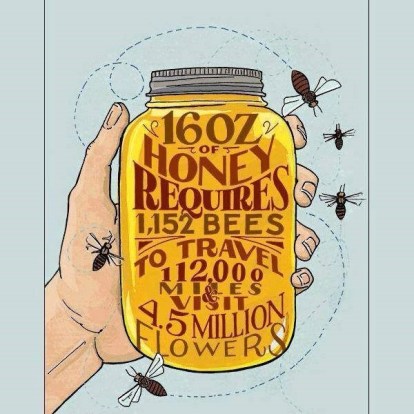
As a child I always thought of bees as a summertime nuisance but in all reality they are, in large part, responsible for the survival of many plants, seeds and food crops. If honeybees didn’t exist our world and how we live would be greatly altered due to their large contribution to the pollination of our food and our food’s food. It all begins with the honeybee’s need for nectar for survival, which in turn acts as a fertilization messenger, going from plant to plant and allowing flower reproduction. This is possible due to the bee’s furry body that picks up pollen and brings it to the next flower. These little furry insects are pretty amazing creatures and do much more for us than we give them credit for.

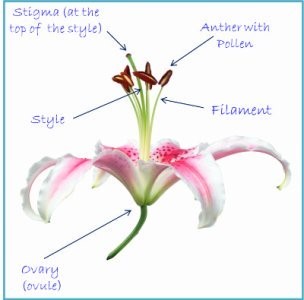
The image of the lily below shows the various parts of a flower. The male part is comprised of the anther and filament which together are called the stamen, whereas the female part is called the ovary, which is comprised of the stigma and style. The ovary is found at the base of the flower, an area called the carpel. The pollination process starts with the pollen grain being brought over by the bee or other pollinators (bats, birds, and insects) and coming into contact with the sticky stigma. The pollen then flows down the style that is then joined with the male sperm nuclei. At this point the male sperm fuses with the ovules, that then turns into a seed and the ovary develops into fruit. This process is called cross pollination which is responsible for 30 percent of the global food crops and over 90 percent of wild plant growth.

This may be hard to believe, but bees contribute to the US’ “humming” economy through the agricultural sector. Over 15 billion dollars a year in crops produced in the US are known to be pollinated by bees – which doesn’t include the 150 million dollars a year in honey sales. With the large decline in the honey bee population, crop yields have also been declining at a loss of 5.7 billion dollars a year. Along with what bees provide directly to humans, indirectly they are responsible for the pollination of alfalfa and clover which is what cattle feed on. So bees contribute a great amount to our meat and dairy industry as well.

Bees play a major role in what and how much we consume but they also provide other important products like pollen, a superfood that is said to be the “life giving dust.” It contains a large amount of nutrients that humans need for survival like proteins, vitamins, minerals, fatty acids, carotenoids and bioflavonoids, which are antibacterial and help strengthen capillaries. Bees also contribute to the production of other products like beeswax, candles and propolis, also called bee glue, which is used in cosmetics. These insects may be small, but as you can see they play a large role in our lives.

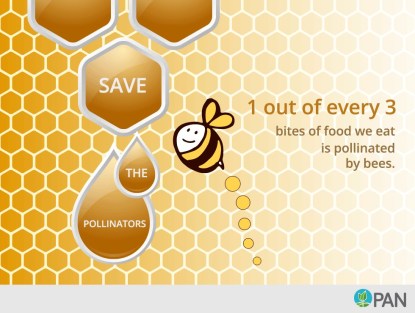
So, one may wonder why I chose to write about honeybees and the important role they play in the production of food and other goods. The answer is because sadly, the population of honeybees is and has been in a rapid decline due to Colony Collapse Disorder, a condition in which there are abnormally high die-off rates. It is responsible for 25 percent of managed honeybees’ disappearance since 1990.  Issues that cause this collapse include things like a changing climate, increasing usage of harmful pesticides, habitat degradation, and parasites. Most of these issues are being addressed through organizations like PAN (Pesticide Action Network), a group that focuses on reducing the influence of biotech corporations on farmers’ production practices – namely the use of great amounts of pesticides that can lead to major health and economic burdens.  There are so many other organizations out there and I encourage anyone and everyone to get involved and informed about what is going on regarding the magical honeybee.

-Posted by Jessica

Posted in Uncategorized | Leave a comment

Save the Date for the 8th Annual UNM Sustainability Expo

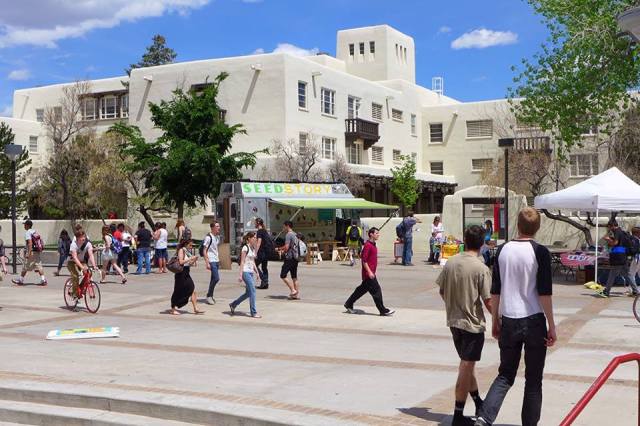
You’re invited to join us for the 8th Annual UNM Sustainability Expo, happening this year on Thursday, April 21 from 10:30am to 2:30pm on Cornell Mall. The Expo will feature a local growers’ market, educational displays, a bicycle auction, a book exchange, and an arts and crafts fair. The event will also showcase numerous alternative transportation, energy conservation, waste reduction, and sustainable lifestyle practices.

Grab lunch from food trucks at the growers’ market, and stick around for live music during the noon hour. Interact with sustainability-minded organizations at a variety of engaging displays and activities. Learn about sustainable initiatives on campus and in the surrounding community.

This Expo is organized by UNM students in the Sustainability Studies Program Growers’ Market Practicum class. Longtime coordinating partners include the UNM Office of Sustainability and UNM Parking and Transportation Services. We are excited to announce that this year we have partnered with Knowaste to make the Expo a “zero waste” event.

Stay up to date on Expo happenings on our Facebook event page. Come celebrate Earth Day with us – one day early – on April 21!

Expo

Posted in Uncategorized | Leave a comment

First Growers’ Market of the Fall Semester

Day one of the Lobo Growers’ Market was a success! 

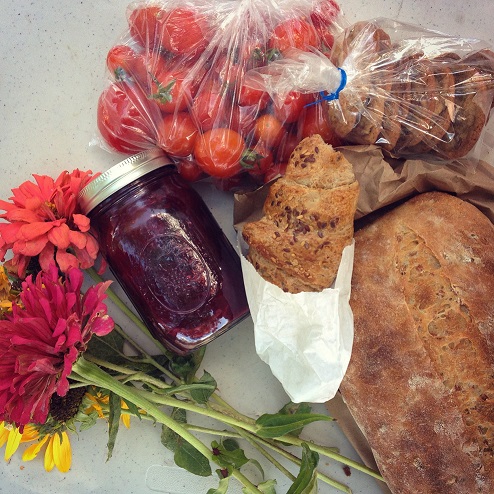
market1Pictured here are some beautiful flowers and fresh tomatoes from Arretche Farms, freshly baked croissants from Le Paris French Bakery, chocolate-chip cookies from Cookie Carry Out, and bread from Kuma, and a blackberry preserve from Cornelio Candelaria Organics.

Not pictured; honey and bee products from Bee’s Honey, fragrant soaps from South Valley Soaps, amazing body care products from Ye Ole Kitchen Witch, delicious pizza from Irrational Pie, and more!

Come hang out with us and get your fill of local products on Tuesdays, 10am-2pm.

-Posted by Keila

Posted in Uncategorized | Leave a comment

The Fall Growers’ Market Returns!

The UNM Sustainability Studies Program is bringing back the Lobo Growers’ Market for another season this Fall 2015.

The market will be held for six consecutive Tuesdays, 10AM-2PM, starting on September 15th. It will be located in the grassy area on the west side of Johnson Gym. Dates include: September 15, 22, 29 & October 6, 13, 20.

IMG1The Lobo Growers’ Market was originally developed by Sustainability Studies students in 2007, and has since been held as a student-managed event during several Fall semesters. Keila Gutierrez, an undergraduate in Biology and Sustainability Studies, will manage this fall’s market.

The market provides students, staff, faculty, and the surrounding community with an opportunity to connect with local farmers, value-added producers, and small business owners, and helps foster a relationship between the university community and our local foodshed and economy.

All are welcome to stop by and shop for prepared foods, value-added products, fresh vegetables, and more. Whether you’re looking to do some of your grocery shopping for the week, or to do something different on your lunch break, the market will provide a welcoming and lively environment in which to enjoy local products and entertainment. Keep up with the UNM Sustainability Studies Program on Facebook, Twitter, and Instagram, and check out our blog at abqstew.com and website at sust.unm.edu for more announcements and updates.

We’ll see you there!

Posted in Uncategorized | Leave a comment

Learning From Growing: Gardening as medium for education

As globalization spreads, each generation experiences a weaker connection to food than the one before. What we eat defines us in infinite ways; it speaks of our culture, defines our identity, determines our health… Yet, our relationship with the land and the work that grows the things we eat has become one of detachment and foreignness. We have come to a crossroads in the development of food culture; a point where we must decide whether we will continue to encourage the industrialization of the food market, or instead cultivate a relationship with food involving personal connection. To do the latter, we must seek to increase the number of urban farms, prioritize the consumption of local produce, and reincorporate gardening and farming into the way we live our daily lives.

The answer to reshaping our food systems lies largely in the way we structure education. Education is at the root of how we interact with and relate to the world around from childhood onward. Schools and programs such as Camino de Paz, Food Corps, The Edible Schoolyard, Farm to Table, Farm to School, and The Farm-Based Education Network have constituted a growing movement of incorporating farming and gardening programs into education for youth. Through school gardens, kids get to have a hands-on experience growing food while developing a sense of understanding and connection to food systems. A space devoted to gardening can also function as an interactive lesson for other school subjects, and the products from the garden can go into school meals as a way to provide all students with a source of healthy, fresh food that they can feel personally connected to. I spoke with Kendal Chavez, a member of the Food Corps team in New Mexico, to learn more about how these programs work.

One of the most important points brought up in my conversation with Kendal was the importance of context. Starting a school garden can provide an outlet for children to take an active role in their education, but we must also consider in what ways a particular community will be engaged. What cultural issues are relevant and important? What language is accessible? What goals should be set? For instance, a school focused on bringing up students’ test scores may not feel they have as much to gain from starting a garden as one that is seeking to increase interactive methods of education. So, the first question we must ask is: how can we take a particular school’s goals and priorities and make them applicable to a school garden that will be meaningful and engaging for its students?

In an article by Harold Hungerford and Trudi Volk, published by the Southern Illinois University, data from various studies showed that our ability to get involved with environmental issues is shaped by education through three main variables that the authors summarize as “entry-level,” “ownership,” and “empowerment” variables. Entry-level variables are those dealing with basic knowledge of issues. Ownership variables begin to deal with a deeper awareness of how issues function, paired with a sense of connection to the environment and the knowledge that we have an impact. These two variables aren’t enough to inspire initiative without the third: empowerment. A person is empowered by their skills, their confidence, and their intention to take action.

Traditional education systems typically focus heavily on entry-level variables. School is densely packed with information and lacks room for freedom, creativity, and a sense of belonging. However, in order to develop ownership and empowerment, children must be encouraged to learn in an environment they can build a personal and emotional connection to, and they must gain experience holding responsibility and witnessing the rewards. Through school gardens, children are given opportunities to understand the environment in terms of food culture on a personal level, to hold responsibility, and to see, quite literally, the fruits of their labor.

Diagram by the writer on entry-level, ownership, and empowerment variables in education as described by Hungerford and Volk in their article Changing Learner Behavior Through Environmental Education, available here: http://www.elkhornsloughctp.org/uploads/files/1374624954Changing%20learner%20behavior%20-%20H%20and%20V.pdf

Diagram by the writer on entry-level, ownership, and empowerment variables in education as described by Hungerford and Volk in their article Changing Learner Behavior Through Environmental Education, available here: http://www.elkhornsloughctp.org/uploads/files/1374624954Changing%20learner%20behavior%20-%20H%20and%20V.pdf

Empowerment was an idea that also came up in my conversation with Kendal, and one that I believe lies at the very heart of food culture education. Food dictates the way we consume, the daily choices we make, our health, the well-being of our very planet, and much more about the way we interact with ourselves, others, and the planet. Gardening gives kids an array of ways to be active, involved, and to feel relevant to these issues, while breaking their alienation of food. Kendal described one of the main goals of her work as getting children to “connect the dots.” Through gardening and growing something they can see, touch, eat, and take home to their families, kids are given the opportunity to see how everything, from themselves, to their parents, to their communities, to their environment, and to their food, is interconnected.

-Posted by Keila

Posted in Uncategorized | 1 Comment

Feeding my neighbor: A glimpse into Native American food & farming projects in New Mexico

We reside in a state with a deep-rooted history and a diverse mix of culture. This mix has cultivated a unique food distinct to the area, which has evolved over time with the influence of Native American, Mexican, and many other cultures that have made New Mexico their home. Before the imaginary lines of state boundaries were created, food was fresh and organic, and water was abundant. Today, many Pueblos and the Navajo tribe are thriving as some of the many food providers of the State and Nation’s food basket.

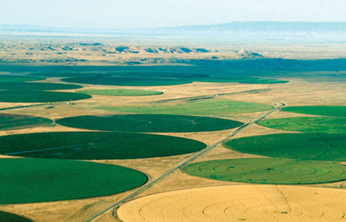
The Navajo tribe has been operating the Navajo Agricultural Products Industry (NAPI) for 44 years under the brand name, Navajo Pride, just south of Farmington, NM. The 100,000 acres of farmland produces native traditional foods (blue corn, white corn, sumac berries, pinto beans and traditional plants used in religious ceremonies) and non-traditional foods (potatoes, flour, alfalfa, and corn for grain and feed).

Several Pueblos in the state are known for their casinos that are strategically situated outside the Albuquerque city limits. Yet, it is less well known that the Santa Ana Pueblo of Rio Rancho is also operating the sister company Tamaya Blue, growing and producing their most prominent crop, blue corn, which is held in high reverence for many Pueblos and Native Americans of the Southwest. They also offer many food products from other Native Americans under their brand name.

Additionally, our great state is home to the first Native American Food Hub operated by the Ten Southern Pueblos Council, contracted with the Acoma Business Enterprises. At the end of growing season many farmers are faced with an overabundance of food. The food hub will provide many farmers a sustainable central location where food can be aggregated, processed and distributed.

One of the many dilemmas facing underserved communities across the nation is the access to fresh food. Jemez Pueblo acknowledged this challenge and expanded their local community garden by 60%, which is now providing locally grown produce to the schools of the community through a farm-to-school program. Access to fresh food will help promote education and healthy alternatives and ensure the community thrives as knowledge of farming is passed down to younger generations.

With the many farming projects by the Pueblos and the Navajo tribe, one may begin to ask, where does all the water come from? Eleven of the Pueblos that reside along the Rio Grande River have water rights that pre-date other existing water rights under the Senior Rights to Water to the Rio Grande. This agreement states that The Middle Rio Grande Conservancy District has an obligation to first deliver water to almost 9,000 acres of tribal land that holds “prior and paramount” rights before it delivers water to other users. To the Pueblos, the Rio Grande River is the epicenter of their daily lives as it is considered sacred and plays a crucial role in their traditional beliefs. The Navajos have negotiated an agreement between the State of New Mexico and the federal government that has allowed the Navajo Agriculture Products Industry to thrive. This agreement has allowed half a million acre-feet of water to be diverted annually from the Navajo Dam, located north of Farmington, NM, to NAPI under the Navajo Indian Irrigation Project (NIIP).

Who would have guessed that an arid climate like New Mexico would be home to an abundance of thriving fresh food producers who are ensuring that their local communities and their neighbors around them have one of the basic needs of life: fresh food?

-Posted by Wilmer

Posted in Uncategorized | Leave a comment