
“Mindfulness is the capacity to bring full attention and awareness to one’s experience, in the moment, without judgment.” This definition from The Center For Mindful Eating synthesizes pretty clearly what it means to be present and aware of one’s surroundings. Introducing these concepts to how people consume their meals can be highly beneficial for a number of reasons, including personal health (both physical and mental), environmental health and a deepening of self understanding.
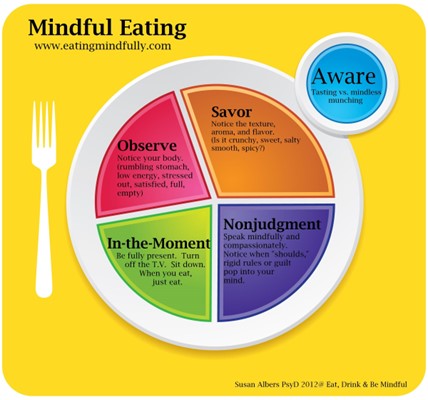
Mindful eating is a practice that starts with addressing one’s state of hunger and encourages decisions about eating choices to be made surrounding the state. There are seven types of hunger including stomach, mouth, eye, nose, cellular, mind, and heart.
- (Stomach) This is hunger based on needs. A body feels a physiological need for food or fuel.
- (Mouth) This is a craving that exists in the mouth. It’s based on one’s desire to experience a certain taste and not based on a physical need for food.
- (Eye) This is a craving based on sight and seeing a delicious food that one wants to experience.
- (Nose) This is a craving based on smell. It is intertwined with mouth hunger, the memory of a delicious food experience.
- (Cellular) This is a hard type to identify. When one feels dehydrated it is undeniable that one’s body needs water. The same is true for nutrients.
- (Mind) This is hunger based on thoughts and ideas about food. For example if one is stressed or anxious they may feel that food is needed to calm that mind.
- (Heart) This is hunger that is often attributed to “emotional eating.” Eating when one is experiencing extreme emotions. These can be both positive and negative.
Mindful eating does not say whether any of these seven are wrong or right but it’s important to know which is present to make the best choice for food consumption. For example, eating something that is craved and letting that lead to mindless eating. This reduces feeling empty or uncomfortably full as well since when one is present and not acted upon correctly it can lead to either over- or under-eating.
I decided to implement the practice into my daily routine over the course of four days. I journaled about the hunger I experienced and then what being mindful about the experience did for me. Overall through the experience I found myself feeling on both a physiological and mental standpoint much better than when I wasn’t being mindful about my food choices.
As I worked through this process, the organization that was the most helpful in guiding me was The Center For Mindful Eating. This organization works to educate people on the practice of mindful eating and helps people develop their own practice since it works a bit differently for everyone. The organization does this by offering free recorded online seminars, live events and personal mindful eating development. For further information, check out their Mindful Eating Food For Thought Blog.

Mindful eating has benefits for mental and physical health but beyond that it also is a great contributor to reducing a personal carbon footprint and working towards more sustainable food systems as a whole. Roughly 40% of food in the US is wasted every year. When food is put in a landfill and does not go through the process of composting it eventually rots and releases CO2 emissions into the atmosphere. Taking steps to reduce one’s own food waste is a great side-effect of implicating mindful eating practices.
This of course is only a first step but it is also a cascading one. The higher amount of people that participate in this creates a higher number of people living a more healthy lifestyle that can be used to make more sustainable choices.
-Posted by Michael

 ABQ Stew